The Conversion of St Paul
Oil on Panel
ca. 1525 (painted)
ca. 1525 (painted)
| Artist/Maker | |
| Place of origin |
Giovanni Francesco Rustici, (1474-1554) was a Florentine sculptor and painter although 1562-1904 is his only known surviving painting. Rustici was of noble birth, and no formal apprenticeship is recorded although he may have studied, along with Leonardo da Vinci with Andrea del Verrocchio. His later collaboration with Leonardo further supports this theory. Rustici also studied the Medici sculpture collection in the garden at S Marco in Florence, where, as an aristocrat, he would have been particularly welcome.
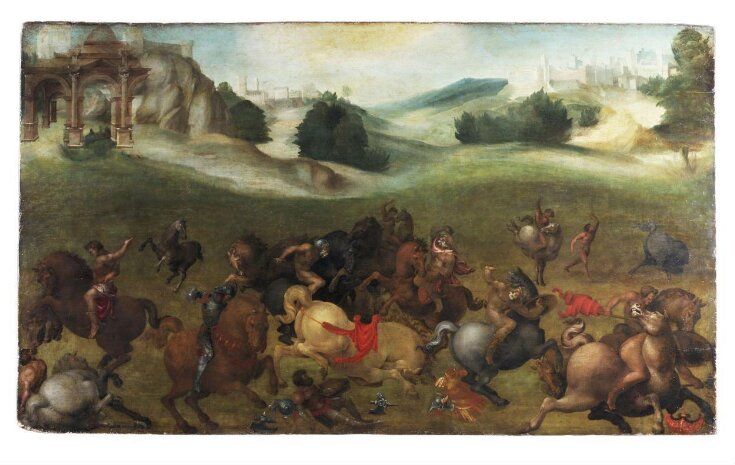
The panel depicts the Conversion of the Roman citizen Saul, later Saint Paul. He appears as if just thrown to the ground, lying under the rear legs of the white charger at the centre. No halo is visible, but the yellow glowing light at the top centre of the painting appears to represent the impact of the divine light which struck Saul blind and made him fall from his horse while on his way with his soldiers to Damascus to persecute Christians. On the ground, Saul’s helmet and a cuirass are scattered around him.
This work demonstrates the impact of Leonardo’s unfinished fresco for the Sala del Gran Consiglio on his contemporaries. In the group at the centre of 1562-1904, Rustici has reinterpreted the main scene of Leonardo’s Battle of Anghiari as a Conversion, probably with reference to Leonardo's preparatory drawings. The two were well acquainted, as in 1506, they had collaborated on a bronze group of Saint John the Baptist for the Baptistery in Florence. Rustici also appears to have been greatly inspired by the battle panels painted by Paolo Uccello (London, National Gallery, Paris, Louvre and Florence, Uffizi) then hanging in the Palazzo Medici, just steps from Rustici's home. F. Zeri (1962) noticed the similarity of the landscape in this painting to the one of three panels in Washington (National Gallery, 1939.1.344.a-c) once attributed to the so-called ‘Master of the Kress Landscapes’, now identified as Giovanni Larciani. Technical examination reveals that the architecture at the top left and the figures and horses in the foreground were added after the landscape had been painted. This tends to support the hypothesis that two hands were responsible for 1562-1904: one painting the landscape, and another the figures and the architecture at top left. This would explain why the figures and animals appear to float on the surface. Whether this was intentional from the outset, or whether the figure painter intervened on an already finished landscape is unclear.
The soldiers resemble a frieze of a Roman sarcophagus and elements such as the helmets, armour and horses do appear to derive from several different antique sources which he has adapted to depict the narrative of Saul's Conversion. Rustici has taken considerable liberties with the biblical text to represent the event as though it were a mounted battle scene full of nude and semi-nude warriors.
This panel has been identified with the work described by Giorgio Vasari as painted by Rustici as a gift for his friend and patron Piero Martelli.
The panel depicts the Conversion of the Roman citizen Saul, later Saint Paul. He appears as if just thrown to the ground, lying under the rear legs of the white charger at the centre. No halo is visible, but the yellow glowing light at the top centre of the painting appears to represent the impact of the divine light which struck Saul blind and made him fall from his horse while on his way with his soldiers to Damascus to persecute Christians. On the ground, Saul’s helmet and a cuirass are scattered around him.
This work demonstrates the impact of Leonardo’s unfinished fresco for the Sala del Gran Consiglio on his contemporaries. In the group at the centre of 1562-1904, Rustici has reinterpreted the main scene of Leonardo’s Battle of Anghiari as a Conversion, probably with reference to Leonardo's preparatory drawings. The two were well acquainted, as in 1506, they had collaborated on a bronze group of Saint John the Baptist for the Baptistery in Florence. Rustici also appears to have been greatly inspired by the battle panels painted by Paolo Uccello (London, National Gallery, Paris, Louvre and Florence, Uffizi) then hanging in the Palazzo Medici, just steps from Rustici's home. F. Zeri (1962) noticed the similarity of the landscape in this painting to the one of three panels in Washington (National Gallery, 1939.1.344.a-c) once attributed to the so-called ‘Master of the Kress Landscapes’, now identified as Giovanni Larciani. Technical examination reveals that the architecture at the top left and the figures and horses in the foreground were added after the landscape had been painted. This tends to support the hypothesis that two hands were responsible for 1562-1904: one painting the landscape, and another the figures and the architecture at top left. This would explain why the figures and animals appear to float on the surface. Whether this was intentional from the outset, or whether the figure painter intervened on an already finished landscape is unclear.
The soldiers resemble a frieze of a Roman sarcophagus and elements such as the helmets, armour and horses do appear to derive from several different antique sources which he has adapted to depict the narrative of Saul's Conversion. Rustici has taken considerable liberties with the biblical text to represent the event as though it were a mounted battle scene full of nude and semi-nude warriors.
This panel has been identified with the work described by Giorgio Vasari as painted by Rustici as a gift for his friend and patron Piero Martelli.
Object details
| Categories | |
| Object type | |
| Title | The Conversion of St Paul (generic title) |
| Materials and techniques | Oil on panel |
| Brief description | Oil painting, Giovanni Francesco Rustici, The Conversion of St Paul, c. 1525, Florence |
| Physical description | A frenzied group of soldiers on foot and on horseback respond to a bright light above, a man lays on the ground, thrown from the white bucking horse at centre, in the distance, a rolling landscape with fortified cities in the upper left and right hand corners and a village in the centre |
| Dimensions |
|
| Style | |
| Credit line | Given by Lord Carmichael |
| Object history | 1562-1904 was given by Lord Carmichael in 1904. His other gifts to the V&A include the Umbrian Crucifix (850-1900) but are mainly decorative arts and sculptures. Carmichael was a Trustee of the National Gallery (1906-8), of the Wallace collection (1918), and later was on the Advisory committee of the V&A (1923-5). He was a friend of the dealer Durlacher who served as intermediary between him and the V&A in the gift of 1562-1904. It was then described as a ‘supposed copy of a study by Leonardo da Vinci for the fresco of the battle of Anghiari’. It is not known when and where Carmichael acquired the panel. At the turn of the 19th and 20th centuries, he travelled to Italy on several occasions, and was in contact with the dealer Stefano Bardini who helped him to acquire works of art for his own collection. He was in Italy in 1904. His sale of 1926 (Sothebys, London, 8-10 June, lots 490-492) records only three Old Master paintings by Nardo di Cione, Parri Spinelli e Antonio Vivarini. After his death, his wife wrote a memoir (M. H. E. Carmichael, 'Lord Carmichael of Skirling, a memoir prepared by his wife', London 1929) which mentioned many of the objects in their collection, but 1562-1904 is not included. The panel was formerly attributed to Domenico Beccafumi (Berenson, 1932), Francesco Bacchiacca (A. Forlani Tempesti and D. Sanminiatelli) and the Master of the Kress Landscapes (Federico Zeri, 1962). In 1934, Maria Lessing identified its subject as the conversion of Saint Paul which remains the accepted interpretation of the painting. The attribution to Giovan Francesco Rustici was suggested for the first time by a former curator in the Sculpture department, Antony Radcliffe (1982, letter to the department), who identified the painting with one described by Vasari (see below). Historical significance: Giovanni Francesco Rustici, (b Florence, 1474; d Tours, 1554) was a Florentine sculptor and painter, active also in France. He was of noble birth, and no formal apprenticeship is recorded although Giorgio Vasari called him a pupil of Andrea del Verrocchio. His later collaboration with Leonardo da Vinci does suggest a mutual familiarity with Verrocchio’s workshop. Rustici also studied the Medici sculpture collection in the garden at S Marco in Florence, where, as an aristocrat, he would have been particularly welcome. Formerly ascribed to Domenico Beccafumi, Bacchiacca, the "Master of the Kress landscapes" (now identified as Giovanni Larciani), this work is now believed to have been painted by the Florentine artist Giovanni Francesco Rustici and identified with a work (described by Giorgio Vasari) he painted for Piero Martelli. This work demonstrates the impact of Leonardo’s unfinished fresco for the Sala del Gran Consiglio on his contemporaries. In the group at the centre of 1562-1904, Rustici has reinterpreted the main scene of Leonardo’s Battle of Anghiari as a Conversion of Paul probably with reference to his preparatory drawings. The two were well acquainted, as in 1506, they had collaborated on a bronze group of Saint John the Baptist for the Baptistery in Florence. Vasari adds that ‘Rustici acquired much valuable knowledge from Leonardo, and among other things the method of delineating horses, in which he delighted so greatly that he copied these animals in clay, in wax, full relief, and in half-relief; at a word, in every manner that one can possibly imagine’ (1857, pp. 62-63). Several terracotta sculptures of horses now divided between the Louvre, the Museo del Bargello and the Horne Museum in Florence, are attributed to Rustici and shows many similarities with Leonardo’s studies of horses (see Marani 2001, pp. 116-121). At the Villa Salviati, on the outskirts of Florence, Rustici executed some large roundels in terracotta, some of which clearly show their debt to Leonardo’s drawings of horses and designs for equestrian monuments. The villa was decorated in 1522-26, probably around the same time that 1562-1904 appears to have been painted. The horse in the middle distance on the left resembles one in a Leonardo study in Windsor (inv.no.058). The horse balanced on its forelegs in the middle distance at the right resembles one in Paolo Uccello’s San Romano panel in the Uffizi, which was then hanging in the Palazzo Medici, to which Rustici would probably have had access. F. Zeri (1962) has compared the landscape in this painting to the one of three panels in Washington (National Gallery, 1939.1.344.a-c) once attributed to the so-called ‘Master of the Kress Landscapes’, now identified as Giovanni Larciani. Nicola Costaras (in conversation, November 2006) noted that the buildings at the top right of 1562-1904 are almost identical to those at the top right in the Washington’s 1939.1.344.a. Technical examination reveals that the architecture at the top left and the figures and horses in the foreground were added after the landscape had been painted. This tends to support the hypothesis that two hands were responsible for 1562-1904: one painting the landscape, and another the figures and the architecture at top left. This would explain why the figures and animals appear to float on the surface. Whether this was intentional from the outset, or whether the figure painter intervened on an already finished landscape is unclear. Differences are apparent in the representation of the town at top right, whose typology seems to hark back to Trecento or early Quattrocento pictures, while the architecture at top left are typically Renaissance. It is unlikely that the sweeping landscape is by the same hand as the contorted, energetic figures in the foreground. Their exaggerated postures reach a climax in the horseman at the far left. Many of the soldiers’ postures are unconvincing, and they resemble a frieze of unrelated elements, occupying only half the height of the panel, like figures from a Roman sarcophagus. Rustici has transposed this agitated scene from a Biblical episode narrated by the same Paul, and Luke the Evangelist. The Roman citizen Saul, to become Saint Paul, appears in the foreground, lying under the rear legs of the white horse at the centre. No halo is visible, but the yellow glowing light at the top centre of the painting appears to represent the impact of the divine light which struck Saul blind and made him fall from his horse while on his way with his soldiers to Damascus to persecute Christians. On the ground, Saul’s helmet and a cuirass are scattered around him, in a mode similar to Paolo Uccello’s Rout of San Romano in London (National Gallery). Rustici has taken considerable liberties with the biblical text to represent the event as though it were a battle scene of nude warriors, some of whom are wearing a typical Roman cloak. This panel has been identified with the work described by Giorgio Vasari as painted by Rustici as a gift for his friend and patron Piero Martelli. |
| Historical context | This work may have originally been set into wooden panelling as a piece of painted furniture. During the fifteenth and sixteenth centuries in Italy, artists were often commissioned to create painted wooden furnishings for the domestic interior, especially for the camera (bedchamber) of wealthy private palaces. Such works were generally commissioned to celebrate a new marriage or the birth of a child and could include a lettiera (bed), spalliera or cornicioni (a painted frieze), a cassapanca (bench-chest) and a set of cassone (marriage chests) among other objects and furnishings. The decoration often included subjects associated with fertility, maternity, childbirth, marriage and fidelity and could include references to the patrons through inclusion of their coat of arms and heraldic colours, or of their personal motto or device. The central part of the composition clearly derives from Leonardo’s Battle of Anghiari (1503-5), a lost unfinished fresco in Palazzo Vecchio that celebrated a Florentine victory against the Milanese troops in 1440. A number of major battle scenes were painted in Florence during the 15th and early 16th centuries. These include Paolo Uccello’s three panels of The Rout of San Romano, Pollaiuolo’s engraved Battle of the Nudes and Michelangelo’s marble relief of the Battle of the Centaurs. Over time, this genre was increasingly conditioned by a growing taste for antique sculpture. Art ‘all`antica’ was validated by its links with illustrious works of the past. Antiquities, especially sarcophagi, were visible near Florence Cathedral and Baptistery. Ancient statues and reliefs were displayed in the so-called Garden of San Marco, Lorenzo de’ Medici’s sculpture garden, located near the San Marco convent. Artists and friends of the Medici, including Michelangelo and Rustici as accounted by Vasari, were among its selected visitors |
| Production | Formerly ascribed to Domenico Beccafumi (Kauffmann, 1973, cat. no.19) Kauffmann (1973) traced the history of the attributions made to this painting (Beccafumi, Bacchiacca, the "Master of the Kress landscapes"), and concluded "This picture defies firm attribution, as its eccentricities are not really parallelled elsewhere, but it still appears that, of known artists, Beccafumi remains the closest hand". More recently a consensus has grown that it should be attributed to Giovanni Francesco Rustici (1474-1554). Various publications which have advanced this attribution are cited in full in "References". The first reattribution is found in : "Italian Renaissance Sculpture in the time of Donatello", 1985, An exhibition to commemorate the 600th anniversary of Donatello's birth and the 100th anniversary of the Detroit Institute of Arts, p.242. The entry on the sculptor Rustici by Anthony Radcliffe noted, "Rustici was an erratic sculptor, but in his best works a major one, and he was an important figure in Florentine artistic life. He also practiced intermittently as a painter, his only known surviving painting being a large panel of the 'Conversion of Saint Paul' described by Vasari, given to Piero Martelli, and now in the Victoria and Albert Museum." |
| Subjects depicted | |
| Association | |
| Summary | Giovanni Francesco Rustici, (1474-1554) was a Florentine sculptor and painter although 1562-1904 is his only known surviving painting. Rustici was of noble birth, and no formal apprenticeship is recorded although he may have studied, along with Leonardo da Vinci with Andrea del Verrocchio. His later collaboration with Leonardo further supports this theory. Rustici also studied the Medici sculpture collection in the garden at S Marco in Florence, where, as an aristocrat, he would have been particularly welcome. The panel depicts the Conversion of the Roman citizen Saul, later Saint Paul. He appears as if just thrown to the ground, lying under the rear legs of the white charger at the centre. No halo is visible, but the yellow glowing light at the top centre of the painting appears to represent the impact of the divine light which struck Saul blind and made him fall from his horse while on his way with his soldiers to Damascus to persecute Christians. On the ground, Saul’s helmet and a cuirass are scattered around him. This work demonstrates the impact of Leonardo’s unfinished fresco for the Sala del Gran Consiglio on his contemporaries. In the group at the centre of 1562-1904, Rustici has reinterpreted the main scene of Leonardo’s Battle of Anghiari as a Conversion, probably with reference to Leonardo's preparatory drawings. The two were well acquainted, as in 1506, they had collaborated on a bronze group of Saint John the Baptist for the Baptistery in Florence. Rustici also appears to have been greatly inspired by the battle panels painted by Paolo Uccello (London, National Gallery, Paris, Louvre and Florence, Uffizi) then hanging in the Palazzo Medici, just steps from Rustici's home. F. Zeri (1962) noticed the similarity of the landscape in this painting to the one of three panels in Washington (National Gallery, 1939.1.344.a-c) once attributed to the so-called ‘Master of the Kress Landscapes’, now identified as Giovanni Larciani. Technical examination reveals that the architecture at the top left and the figures and horses in the foreground were added after the landscape had been painted. This tends to support the hypothesis that two hands were responsible for 1562-1904: one painting the landscape, and another the figures and the architecture at top left. This would explain why the figures and animals appear to float on the surface. Whether this was intentional from the outset, or whether the figure painter intervened on an already finished landscape is unclear. The soldiers resemble a frieze of a Roman sarcophagus and elements such as the helmets, armour and horses do appear to derive from several different antique sources which he has adapted to depict the narrative of Saul's Conversion. Rustici has taken considerable liberties with the biblical text to represent the event as though it were a mounted battle scene full of nude and semi-nude warriors. This panel has been identified with the work described by Giorgio Vasari as painted by Rustici as a gift for his friend and patron Piero Martelli. |
| Bibliographic references |
|
| Collection | |
| Accession number | 1562-1904 |
About this object record
Explore the Collections contains over a million catalogue records, and over half a million images. It is a working database that includes information compiled over the life of the museum. Some of our records may contain offensive and discriminatory language, or reflect outdated ideas, practice and analysis. We are committed to addressing these issues, and to review and update our records accordingly.
You can write to us to suggest improvements to the record.
Suggest feedback
You can write to us to suggest improvements to the record.
Suggest feedback
| Record created | December 13, 2005 |
| Record URL |
Download as: JSONIIIF Manifest
