Saint Stephen
Tempera Painting
ca. 1389-ca. 1406 (painted)
ca. 1389-ca. 1406 (painted)
| Artist/Maker | |
| Place of origin |
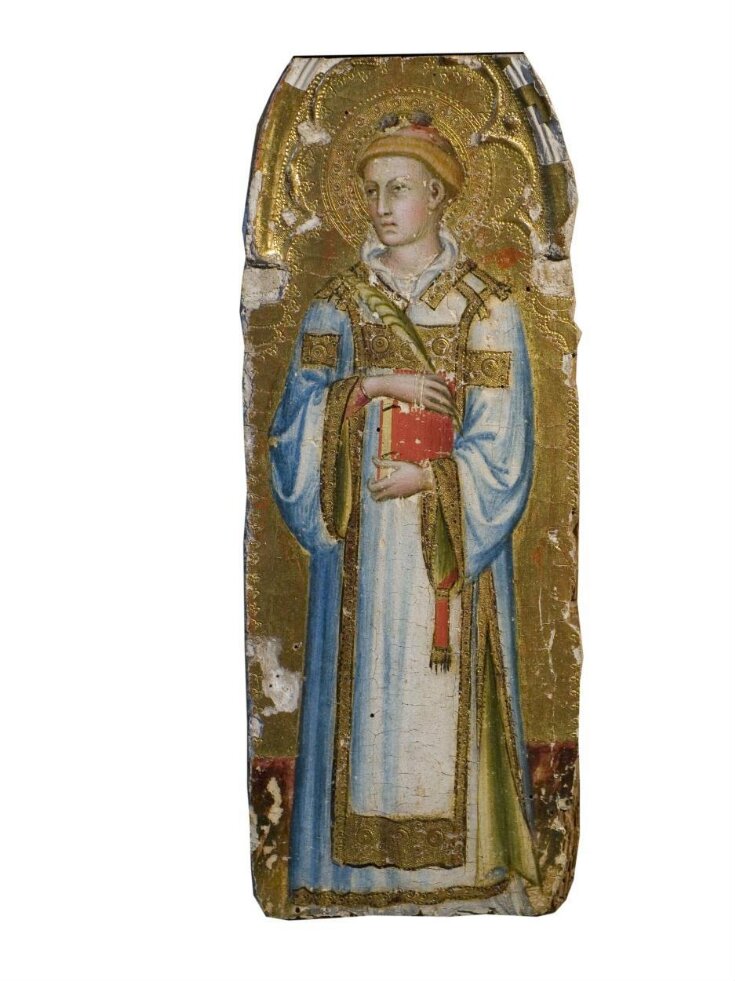
This fragmentary panel was one of a series of superimposed figures from the right pilaster of an unidentified Italian altarpiece, probably of late fourteenth century date. It shows St. Stephen with a book and a martyr's palm. The stone on his head identifies the deacon St. Stephen, the first Christian martyr, whose death by stoning is recorded in the Book of Acts (6:1-8:2). The bright tempera colours and gold background with decorative tooling are typical for the period.
The painting is attributed to Andrea di Bartolo (active 1389; died 1428), one of the leading artists in Siena. The top of the arched panel has been cut off, and it has been trimmed at the bottom. The style and treatment of the gold tooling suggest that it may come from the same dispersed altarpiece as panels of St. Lucy and St. Catherine, now in the Worcester (Mass.) Art Museum.
The painting is attributed to Andrea di Bartolo (active 1389; died 1428), one of the leading artists in Siena. The top of the arched panel has been cut off, and it has been trimmed at the bottom. The style and treatment of the gold tooling suggest that it may come from the same dispersed altarpiece as panels of St. Lucy and St. Catherine, now in the Worcester (Mass.) Art Museum.
Object details
| Categories | |
| Object type | |
| Title | Saint Stephen (generic title) |
| Materials and techniques | Tempera and gold on poplar panel |
| Brief description | Saint Stephen, Andrea di Bartolo, ca. 1389-ca. 1405/06 |
| Physical description | Saint Stephen stands, wearing a deacon's dalmatic and holing a book in his left hand and a martyr's palm in his right; he is tonsured and the bloodied stones of his martyrdom are visible on his head |
| Dimensions |
|
| Style | |
| Object history | Purchased, 1876 Historical significance: Andrea di Bartolo (between 1358 and 1364-1428) was a painter and illuminator who trained under his father Bartolo di Fredi. Unlike his father, Andrea employed a more summary drawing technique and softer, less emphatic modelling. In some ways, he was a more traditional painter than Bartolo di Fredi and less interested in naturalistic detail and expressionism. Andrea appears to have set up his own workshop after 1390 and soon became one of the most successful painters in Siena while also receiving prestigious commissions in the Veneto. In 1405–6 Andrea painted frescoes (destr.) in the chapel of S Vittore in Siena Cathedral, and in 1409–10 he painted several wooden sculptures for the cathedral, including St Crescentius by Francesco di Valdambrino (Siena, Mus. Opera Duomo). He also designed stained-glass windows (1410) for the sacristy of S Domenico, Siena. The four panels of SS John the Baptist, Francis, Peter and John the Evangelist, from a polyptych from S Petronilla, Siena (1413; Siena, Osservanza), are his only dated works. 371-1876 is a fragmentary panel from a series of superimposed figures from the right pilaster (as suggested by the direction of the saint's gaze) of a polyptych. St. Stephen is depicted with a book and martyr's palm. The stones on his head refer to his role as the first Christian martyr, whose death by stoning is recorded in the Book of Acts (6:1-8:2). The top of the arched panel has been cut off, and it has been trimmed at the bottom. The style and treatment of the gold tooling suggest that it may come from the same dispersed altarpiece as panels of St. Lucy and St. Catherine, now in the Worcester (Mass.) Art Museum (1940.31a; 1949.31b). |
| Historical context | An altarpiece is an image-bearing structure set on the rear part of the altar, and which normally declares to which saint or mystery the altar was dedicated. Its form and content customarily evoke the mystery or personage whose cult was celebrated at the altar. Altarpiece forms vary enormously, and may include movable statues, relics and sacrament tabernacles among other elements. The original association of the Christian altar was with the tomb of a saint, and theologically with the tomb of Christ. Altarpieces adorned both high altars and side altars. High altars often carried large altarpieces with elaborate programmes while side altars served a more private piety and their altarpieces were often endowed by private individuals. In Italy, the altar became a primary setting for painting on panel, a format developed in the West from the example of Byzantine icons. An early format, consisting of gabled panels in a vertical format representing a full-length saint flanked by scenes of his or her life, soon developed to include an elaborate gabled outer structure enframing several vertically conceived individual compartments to form a Polyptych. Polyptychs were increasingly elaborate, their frames often featuring piers, colonettes, cusped arches, tracery, pinnacles, crockets and finials, eventually transforming the altarpiece into an architectonic structure resembling in detail and spatial principles the façades of contemporary full-scale Gothic architecture. |
| Subjects depicted | |
| Summary | This fragmentary panel was one of a series of superimposed figures from the right pilaster of an unidentified Italian altarpiece, probably of late fourteenth century date. It shows St. Stephen with a book and a martyr's palm. The stone on his head identifies the deacon St. Stephen, the first Christian martyr, whose death by stoning is recorded in the Book of Acts (6:1-8:2). The bright tempera colours and gold background with decorative tooling are typical for the period. The painting is attributed to Andrea di Bartolo (active 1389; died 1428), one of the leading artists in Siena. The top of the arched panel has been cut off, and it has been trimmed at the bottom. The style and treatment of the gold tooling suggest that it may come from the same dispersed altarpiece as panels of St. Lucy and St. Catherine, now in the Worcester (Mass.) Art Museum. |
| Bibliographic references |
|
| Collection | |
| Accession number | 371-1876 |
About this object record
Explore the Collections contains over a million catalogue records, and over half a million images. It is a working database that includes information compiled over the life of the museum. Some of our records may contain offensive and discriminatory language, or reflect outdated ideas, practice and analysis. We are committed to addressing these issues, and to review and update our records accordingly.
You can write to us to suggest improvements to the record.
Suggest feedback
You can write to us to suggest improvements to the record.
Suggest feedback
| Record created | December 12, 2005 |
| Record URL |
Download as: JSONIIIF Manifest
