
Table
1790-1800 (made), 1750-1800 (made), 1820-1840 (made)
| Artist/Maker | |
| Place of origin |
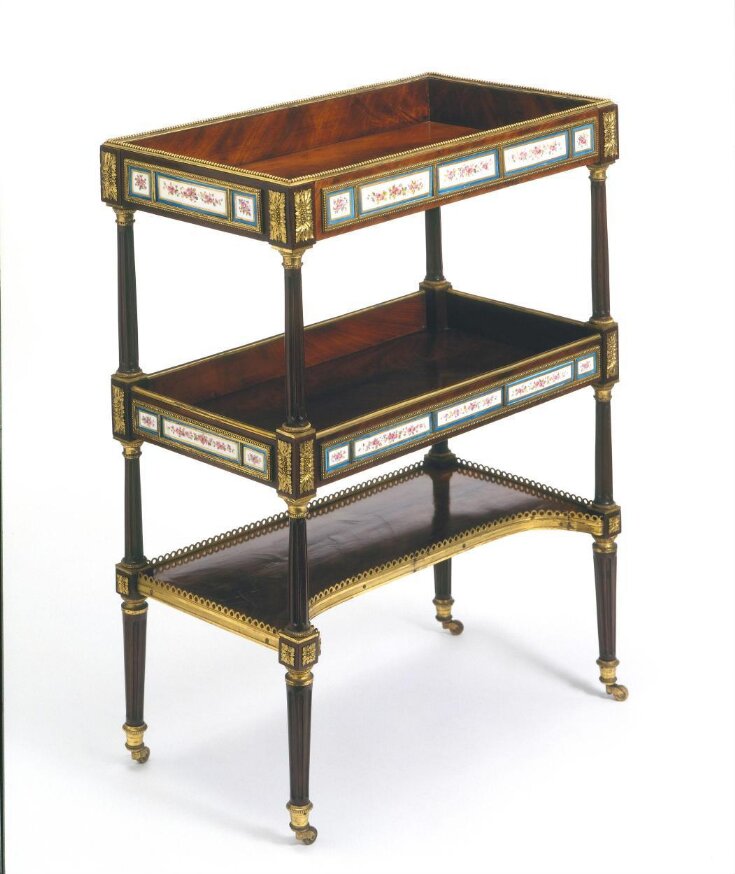
John Jones, who bequeathed his enormous collection of French decorative arts to the Museum in 1882, was particularly fond of small, highly decorative pieces of furniture like this, which had been the height of fashion in Paris in the 1780s. He was drawn to complex decoration and, in particular, to pieces set with porcelain plaques. In this he was very much following the taste of rich collectors in the 1860s and 1870s, when he was buying so keenly in London.
Not surprisingly, there grew up a lucrative trade in 'improving' pieces for the market and Jones was not alone in being taken in by these alterations. This little work table or tricoteuse (from the French verb tricoter, to knit) almost certainly started its life in the 1780s or 1790s as a much plainer piece, though always of high quality. The simple mahogany pieces of that date had no market in the nineteenth century, so many of them, like this piece, were embellished with extra gilt-brass mounts and with porcelain plaques. The soft-paste porcelain plaques on this table were made at Sèvres in the second half of the eighteenth century and redecorated in London between 1820 and 1840.
Jones displayed this table as well as two others (1039 and 1039A-1882) in the window recesses of the larger front drawing-room of 95 Piccadilly, his home from 1865 to 1882. In the Handbook of the Jones Collection (1883) William Maskell noted that 'Each of these three tables carried some work of art: on the middle one was the Sèvres cabaret (No. 762); on two side tables, with other things, were the mounted pieces of Chinese porcelain (No. 811) and the stand or rack for books (No. 1042).' (p. 34).
Not surprisingly, there grew up a lucrative trade in 'improving' pieces for the market and Jones was not alone in being taken in by these alterations. This little work table or tricoteuse (from the French verb tricoter, to knit) almost certainly started its life in the 1780s or 1790s as a much plainer piece, though always of high quality. The simple mahogany pieces of that date had no market in the nineteenth century, so many of them, like this piece, were embellished with extra gilt-brass mounts and with porcelain plaques. The soft-paste porcelain plaques on this table were made at Sèvres in the second half of the eighteenth century and redecorated in London between 1820 and 1840.
Jones displayed this table as well as two others (1039 and 1039A-1882) in the window recesses of the larger front drawing-room of 95 Piccadilly, his home from 1865 to 1882. In the Handbook of the Jones Collection (1883) William Maskell noted that 'Each of these three tables carried some work of art: on the middle one was the Sèvres cabaret (No. 762); on two side tables, with other things, were the mounted pieces of Chinese porcelain (No. 811) and the stand or rack for books (No. 1042).' (p. 34).
Object details
| Categories | |
| Object type | |
| Materials and techniques | Substrate of oak with legs of mahogany; veneers of flame mahogany; soft-paste porcelain; steel; gilt bronze |
| Brief description | Of rectangular form, with three shelves, in mahogany, later mounted with gilt bronze and with porcelain plaques painted with flowers |
| Physical description | Three-tiered rectangular table with two four-sided trays over a shelf, standing on four legs each composed of three fluted and tapering mahogany balusters between square-section corner blocks, on castors; the front of the top tray hinged to fall forwards and the shelf recess at the front; the whole veneered with mahogany and ornamented with gilt brass mounts and the two trays mounted on all four sides with thirty-two porcelain plaques with a white ground, redecorated with sprigs of flowers and fitted within brass frames to the table in the nineteenth century. |
| Dimensions |
|
| Style | |
| Gallery label |
|
| Credit line | Bequeathed by John Jones |
| Object history | In the collection of John Jones before 1882 |
| Subject depicted | |
| Summary | John Jones, who bequeathed his enormous collection of French decorative arts to the Museum in 1882, was particularly fond of small, highly decorative pieces of furniture like this, which had been the height of fashion in Paris in the 1780s. He was drawn to complex decoration and, in particular, to pieces set with porcelain plaques. In this he was very much following the taste of rich collectors in the 1860s and 1870s, when he was buying so keenly in London. Not surprisingly, there grew up a lucrative trade in 'improving' pieces for the market and Jones was not alone in being taken in by these alterations. This little work table or tricoteuse (from the French verb tricoter, to knit) almost certainly started its life in the 1780s or 1790s as a much plainer piece, though always of high quality. The simple mahogany pieces of that date had no market in the nineteenth century, so many of them, like this piece, were embellished with extra gilt-brass mounts and with porcelain plaques. The soft-paste porcelain plaques on this table were made at Sèvres in the second half of the eighteenth century and redecorated in London between 1820 and 1840. Jones displayed this table as well as two others (1039 and 1039A-1882) in the window recesses of the larger front drawing-room of 95 Piccadilly, his home from 1865 to 1882. In the Handbook of the Jones Collection (1883) William Maskell noted that 'Each of these three tables carried some work of art: on the middle one was the Sèvres cabaret (No. 762); on two side tables, with other things, were the mounted pieces of Chinese porcelain (No. 811) and the stand or rack for books (No. 1042).' (p. 34). |
| Collection | |
| Accession number | 1041-1882 |
About this object record
Explore the Collections contains over a million catalogue records, and over half a million images. It is a working database that includes information compiled over the life of the museum. Some of our records may contain offensive and discriminatory language, or reflect outdated ideas, practice and analysis. We are committed to addressing these issues, and to review and update our records accordingly.
You can write to us to suggest improvements to the record.
Suggest feedback
You can write to us to suggest improvements to the record.
Suggest feedback
| Record created | October 19, 1999 |
| Record URL |
Download as: JSONIIIF Manifest
