Guéridon
1860-80 (made)
| Artist/Maker | |
| Place of origin |
Object Type
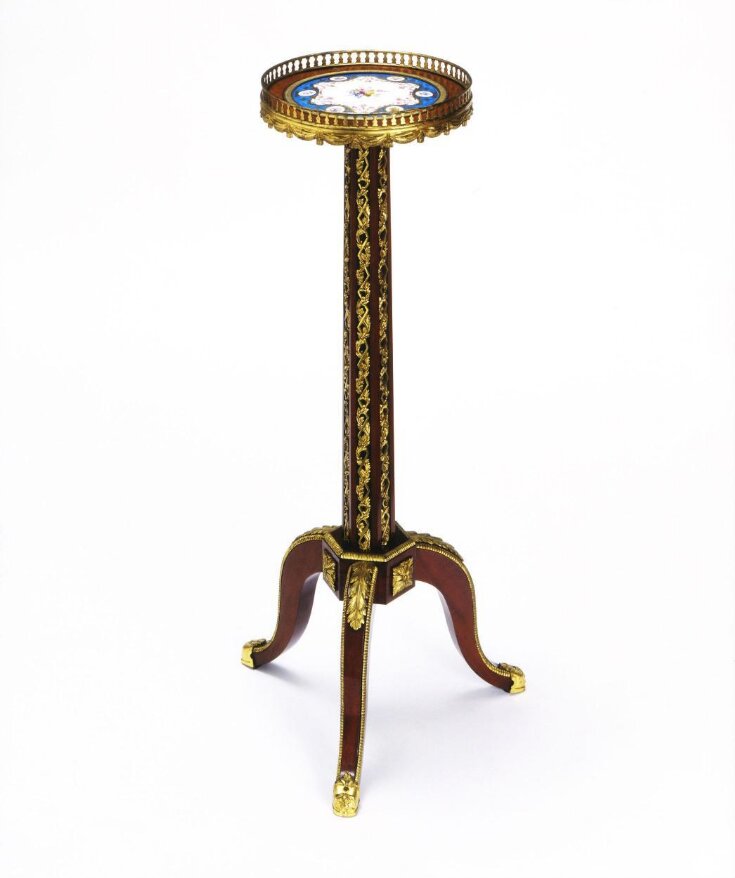
This stand was made to support a reading light or as an occasional table. Such pieces are sometimes known by the French name guéridon, a term originally used in the 17th century for a circular tray on a pillar, made of carved and gilded wood, used to support a candelabrum. The form was adapted in the 18th century as a small veneered table, but this example was probably made in the19th century, in London, as an imitation of late18th-century models.
Materials & Making
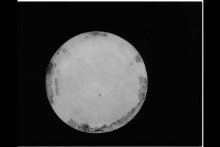
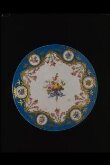
The top is inset with a soft-paste porcelain plaque, perhaps made originally as a plate at the French national porcelain factory at Sèvres, near Paris. It was probably later ground down to form this table top. The decoration was almost certainly applied in the 19th century, probably by expert flower painters in Britain who sought to imitate the fine work of the painters at Sèvres.
People
This stand belonged to John Jones, a military tailor who made considerable profits from supplying military uniforms to the army and navy between 1827 and 1881, especially during the Crimean War (1853-1856). Jones was a keen and discerning collector of 18th-century French furniture. He may have bought this stand believing it to be a late 18th-century antique or purchased it new in London. On his death in 1882 the South Kensington Museum (later the V&A) received Jones's furniture, books and art works, which became the Museum's founding collection of French fine and decorative arts.
This stand was made to support a reading light or as an occasional table. Such pieces are sometimes known by the French name guéridon, a term originally used in the 17th century for a circular tray on a pillar, made of carved and gilded wood, used to support a candelabrum. The form was adapted in the 18th century as a small veneered table, but this example was probably made in the19th century, in London, as an imitation of late18th-century models.
Materials & Making
The top is inset with a soft-paste porcelain plaque, perhaps made originally as a plate at the French national porcelain factory at Sèvres, near Paris. It was probably later ground down to form this table top. The decoration was almost certainly applied in the 19th century, probably by expert flower painters in Britain who sought to imitate the fine work of the painters at Sèvres.
People
This stand belonged to John Jones, a military tailor who made considerable profits from supplying military uniforms to the army and navy between 1827 and 1881, especially during the Crimean War (1853-1856). Jones was a keen and discerning collector of 18th-century French furniture. He may have bought this stand believing it to be a late 18th-century antique or purchased it new in London. On his death in 1882 the South Kensington Museum (later the V&A) received Jones's furniture, books and art works, which became the Museum's founding collection of French fine and decorative arts.
Object details
| Categories | |
| Object type | |
| Materials and techniques | Solid mahogany and mahogany veneered on oak, with inset plaque of porcelain or bone china and gilt-bronze mounts |
| Brief description | Tripod table or Guéridon; oak, veneered, porcelain plaque; stamped Jean-Henri Riesener, France or England, 1780-1800. |
| Physical description | One of a pair of tripod stands or ,guéridons of oak, veneered with mahogany & ebony, and with gilt bronze mounts. Each stand is raised on three short cabriole legs, jointed into an hexagonal block of solid mahogany, below a facetted (eight-sided) column, the facets set with gilt-bronze mounts of a continuous spiral of oak leaves around a zigzag. The faces of the block are set wtih gilt-bronze paterae and the tops of the legs are set with gilt-bronze acanthus and the edges with gilt-bronze gadrooning. The feet are set with gilt-bronze masks. The top surface is set with a porcelain plaque decorated with an central image of large pink and yellow roses tied with a blue bow on a white ground with a gold border edged by a blue and gold floral background. The top has gilt bronze diamond trellis trimming around the edge supported by a plain gilt bronze band below. |
| Dimensions |
|
| Marks and inscriptions | |
| Gallery label | British Galleries:
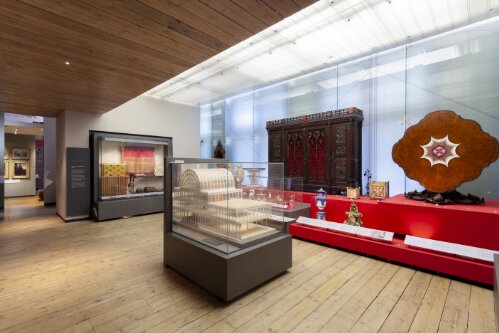
From about 1820 British collectors eagerly bought 18th-century French porcelain-mounted furniture. French and English furniture makers soon offered new versions of these decorative pieces.(25/03/2003) |
| Credit line | Bequeathed by John Jones |
| Object history | Possibly made in Paris by Paul Sormani (born in Canzo, France, 1817, died in Paris, 1877) The object is stamped Jean-Henri Riesener, although it was later discovered that the piece was probably an imitation. |
| Subjects depicted | |
| Summary | Object Type This stand was made to support a reading light or as an occasional table. Such pieces are sometimes known by the French name guéridon, a term originally used in the 17th century for a circular tray on a pillar, made of carved and gilded wood, used to support a candelabrum. The form was adapted in the 18th century as a small veneered table, but this example was probably made in the19th century, in London, as an imitation of late18th-century models. Materials & Making The top is inset with a soft-paste porcelain plaque, perhaps made originally as a plate at the French national porcelain factory at Sèvres, near Paris. It was probably later ground down to form this table top. The decoration was almost certainly applied in the 19th century, probably by expert flower painters in Britain who sought to imitate the fine work of the painters at Sèvres. People This stand belonged to John Jones, a military tailor who made considerable profits from supplying military uniforms to the army and navy between 1827 and 1881, especially during the Crimean War (1853-1856). Jones was a keen and discerning collector of 18th-century French furniture. He may have bought this stand believing it to be a late 18th-century antique or purchased it new in London. On his death in 1882 the South Kensington Museum (later the V&A) received Jones's furniture, books and art works, which became the Museum's founding collection of French fine and decorative arts. |
| Associated object | 1035-1882 (Object) |
| Collection | |
| Accession number | 1036-1882 |
About this object record
Explore the Collections contains over a million catalogue records, and over half a million images. It is a working database that includes information compiled over the life of the museum. Some of our records may contain offensive and discriminatory language, or reflect outdated ideas, practice and analysis. We are committed to addressing these issues, and to review and update our records accordingly.
You can write to us to suggest improvements to the record.
Suggest feedback
You can write to us to suggest improvements to the record.
Suggest feedback
| Record created | October 19, 1999 |
| Record URL |
Download as: JSONIIIF Manifest
