Model
1860-1900 (made)
| Artist/Maker | |
| Place of origin |
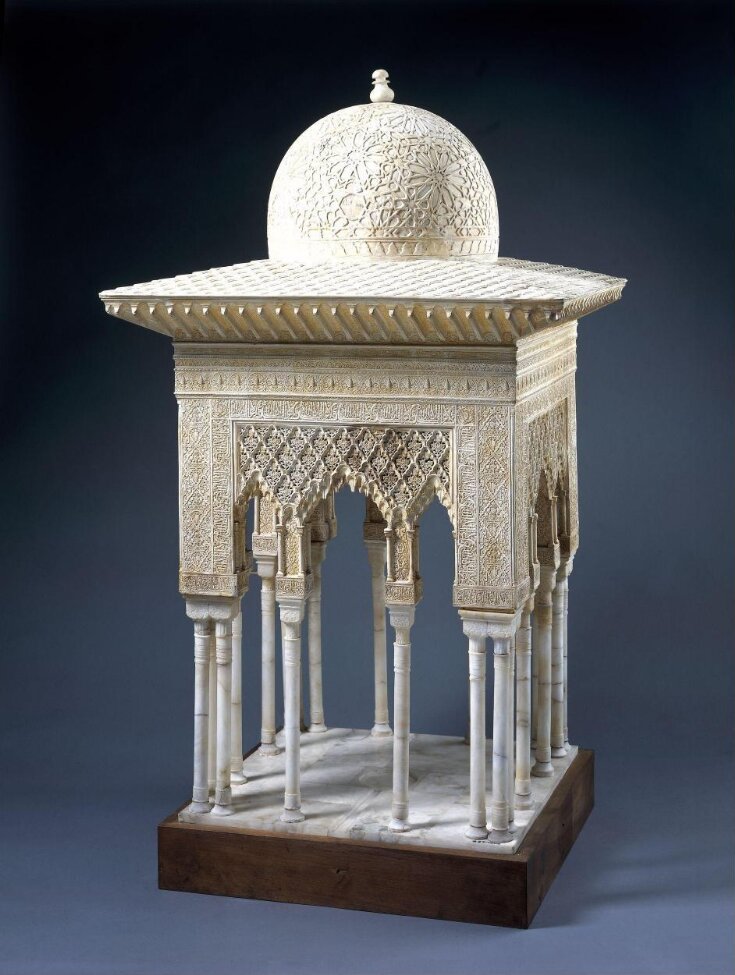
Architectural model of one of the pavilions at the Court of the Lions, Alhambra Palace, Granada, built about 1325-33. White/ivory coloured model with a domed roof, representing an inaccurate 19th-century restoration of the original pitched roof. The exterior of the model is carved with geometric shapes. The dome/roof is supported by a series of columns (roughly six on each side). The model sits on a square wooden stand.
There are two sorts of alabaster. Calcite alabaster is very hard and was used in ancient times. This object is made of gypsum alabaster which is a fine-grained, soft and smooth stone. Although at first glance it looks a little like marble, which it was intended to imitate, it was much easier to carve due to its softness, and alabaster objects were therefore significantly cheaper to produce. Marble does not originate in England, so it was imported if needed, whereas in the 15th century there were important alabaster quarries in Nottingham, York, Burton-on-Trent and London. England was a major centre for the production of objects such as this one. During this period, they were exported in very large numbers to Europe where they survive, unlike many examples which remained in England and were destroyed or greatly damaged during the Reformation.
There are two sorts of alabaster. Calcite alabaster is very hard and was used in ancient times. This object is made of gypsum alabaster which is a fine-grained, soft and smooth stone. Although at first glance it looks a little like marble, which it was intended to imitate, it was much easier to carve due to its softness, and alabaster objects were therefore significantly cheaper to produce. Marble does not originate in England, so it was imported if needed, whereas in the 15th century there were important alabaster quarries in Nottingham, York, Burton-on-Trent and London. England was a major centre for the production of objects such as this one. During this period, they were exported in very large numbers to Europe where they survive, unlike many examples which remained in England and were destroyed or greatly damaged during the Reformation.
Object details
| Categories | |
| Object type | |
| Parts | This object consists of 2 parts.
|
| Materials and techniques | Alabaster and walnut |
| Brief description | Model, Court of Lions, Albhambra, |
| Physical description | Architectural model of one of the pavilions at the Court of the Lions, Alhambra Palace, Granada, built about 1325-33. White/ivory coloured model with a domed roof, representing an inaccurate 19th-century restoration of the original pitched roof. The exterior of the model is carved with geometric shapes. The dome/roof supported by a series of columns (roughly six on each side). The model sits on a square wooden stand. |
| Dimensions |
|
| Style | |
| Gallery label | The Alhambra is the most important architectural ensemble to survive in Spain from the Nasrid period (1232-1492). It is located on top of a hill, on the left bank of the River Darro in Granada, and was once a fortress. The name comes from its reddish walls and literally means 'red castle' in Arabic.
From the 18th century the Alhambra was abandoned and part of the fortress was even blown up.
In the 19th century, however, Romantic travellers rediscovered the Alhambra, largely through the texts and illustrations of Joseph-Philibert Girault de Prangey, David Roberts and Owen Jones, and this led its restoration later in the century.
In this model the dome is incorrect. Domes do exist in Islamic architecture but were not used in Spain.
The original roof of this pavilion was pitched, but in the 19th century it was incorrectly restored as a dome that replicated the domed ceiling inside. This restoration has now been reversed.
To compensate for the hot, dry climate of southern Spain, the Alhambra palace has courtyards that are cooled by shade and water. In this pavilion, a central fountain feeds the channel and pool. (V&A Architecture Gallery object database label) |
| Credit line | Bequeathed by Mr Henry Vaughan |
| Place depicted | |
| Summary | Architectural model of one of the pavilions at the Court of the Lions, Alhambra Palace, Granada, built about 1325-33. White/ivory coloured model with a domed roof, representing an inaccurate 19th-century restoration of the original pitched roof. The exterior of the model is carved with geometric shapes. The dome/roof is supported by a series of columns (roughly six on each side). The model sits on a square wooden stand. There are two sorts of alabaster. Calcite alabaster is very hard and was used in ancient times. This object is made of gypsum alabaster which is a fine-grained, soft and smooth stone. Although at first glance it looks a little like marble, which it was intended to imitate, it was much easier to carve due to its softness, and alabaster objects were therefore significantly cheaper to produce. Marble does not originate in England, so it was imported if needed, whereas in the 15th century there were important alabaster quarries in Nottingham, York, Burton-on-Trent and London. England was a major centre for the production of objects such as this one. During this period, they were exported in very large numbers to Europe where they survive, unlike many examples which remained in England and were destroyed or greatly damaged during the Reformation. |
| Bibliographic references |
|
| Collection | |
| Accession number | 927:1, 2-1900 |
About this object record
Explore the Collections contains over a million catalogue records, and over half a million images. It is a working database that includes information compiled over the life of the museum. Some of our records may contain offensive and discriminatory language, or reflect outdated ideas, practice and analysis. We are committed to addressing these issues, and to review and update our records accordingly.
You can write to us to suggest improvements to the record.
Suggest feedback
You can write to us to suggest improvements to the record.
Suggest feedback
| Record created | November 16, 2005 |
| Record URL |
Download as: JSONIIIF Manifest
