

Ring
1770 (made)
| Artist/Maker | |
| Place of origin |
From at least the fifteenth century, candidates called to be admitted to the ranks of Serjeants-at-Law (the highest rank of lawyer below judges) were required to present rings bearing a suitable motto to the monarch and various dignitaries. They frequently also gave further rings as souvenirs to their friends. The practice came to an end when the office was abolished by the Judicature Act of 1875. New mottoes were chosen at each call; the rings differing in value according to the rank of their recipients. The rings were generally gold with a suitable motto inscribed around the outer hoop.
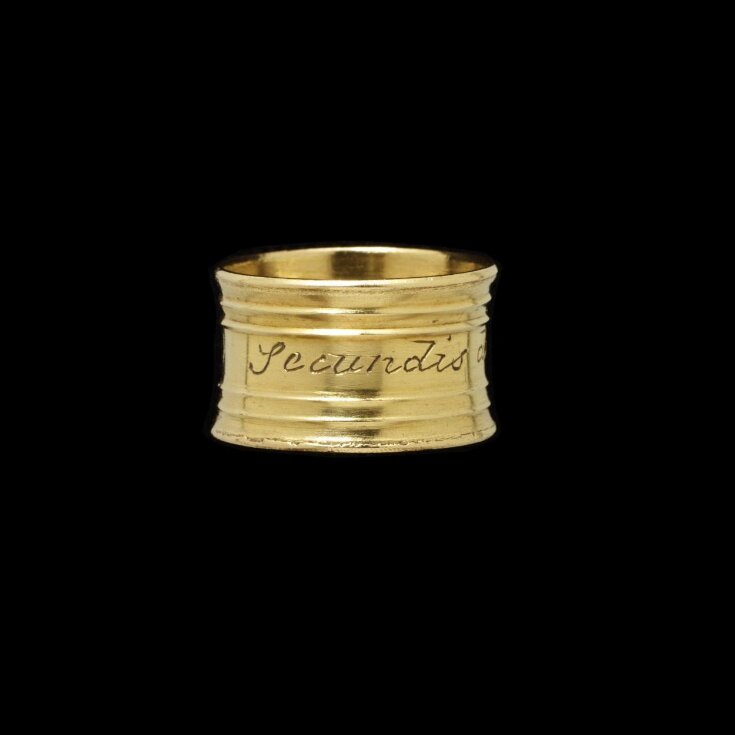
This ring was given at the general call for Serjeants at Law of Sir William Blackstone in 1770. It is inscribed in Latin around the hoop, 'Secundis dubiiq. rectus'. The inscription is taken from Horace 'est animus tibi rerumque prudens, et secundis temporibus dubiisque rectus' (you possess a mind both sagacious in the management of affairs and steady at once in prosperous times).
This ring was given at the general call for Serjeants at Law of Sir William Blackstone in 1770. It is inscribed in Latin around the hoop, 'Secundis dubiiq. rectus'. The inscription is taken from Horace 'est animus tibi rerumque prudens, et secundis temporibus dubiisque rectus' (you possess a mind both sagacious in the management of affairs and steady at once in prosperous times).
Object details
| Categories | |
| Object type | |
| Materials and techniques | Engraved gold |
| Brief description | Serjeant-at-Law's gold ring inscribed on the outside 'Secundis dubiisq.rectus', the call of William Blackstone 1770, maker's mark of Edmund Prince, England, 1770 |
| Physical description | Serjeant-at-Law's gold ring inscribed on the outside 'Secundis dubiisq.rectus', the call of William Blackstone 1770, maker's mark of Edmund Prince |
| Dimensions |
|
| Marks and inscriptions |
|
| Credit line | Given by Dame Joan Evans |
| Object history | The inscription is taken from Horace 'est animus tibi rerumque prudens, et secundis temporibus dubiisque rectus' (you possess a mind both sagacious in the management of affairs and steady at once in prosperous times) |
| Summary | From at least the fifteenth century, candidates called to be admitted to the ranks of Serjeants-at-Law (the highest rank of lawyer below judges) were required to present rings bearing a suitable motto to the monarch and various dignitaries. They frequently also gave further rings as souvenirs to their friends. The practice came to an end when the office was abolished by the Judicature Act of 1875. New mottoes were chosen at each call; the rings differing in value according to the rank of their recipients. The rings were generally gold with a suitable motto inscribed around the outer hoop. This ring was given at the general call for Serjeants at Law of Sir William Blackstone in 1770. It is inscribed in Latin around the hoop, 'Secundis dubiiq. rectus'. The inscription is taken from Horace 'est animus tibi rerumque prudens, et secundis temporibus dubiisque rectus' (you possess a mind both sagacious in the management of affairs and steady at once in prosperous times). |
| Collection | |
| Accession number | M.58-1960 |
About this object record
Explore the Collections contains over a million catalogue records, and over half a million images. It is a working database that includes information compiled over the life of the museum. Some of our records may contain offensive and discriminatory language, or reflect outdated ideas, practice and analysis. We are committed to addressing these issues, and to review and update our records accordingly.
You can write to us to suggest improvements to the record.
Suggest feedback
You can write to us to suggest improvements to the record.
Suggest feedback
| Record created | November 8, 2005 |
| Record URL |
Download as: JSONIIIF Manifest
