
Bridal Crown
1650-1750 (made)
| Artist/Maker | |
| Place of origin |
Every bride is a queen on her wedding day.
Throughout the world brides wear special jewellery, such as tiaras or crowns, to reflect this. In Scandinavia, bridal crowns are the most spectacular part of the wedding jewellery. Their design is based on medieval royal originals, and they are made of heavy silver, often gilded. They were supported by a ring of padded cloth which rested on the bride's head.
In Norway all brides wore some kind of special headdress. In the south and east of the country it was usually made of cloth or other material, smothered with ribbons, beads and silver appliqués. Bridal crowns were mainly used in the west of Norway. They were always expensive, and were handed down as heirlooms in wealthy farming families. Brides from poorer families borrowed them from their richer neighbours. Bridal crowns usually had their own special case, made of painted wood, which also contained the ribbons, supports and other accessories. They were known by the name of the farm or parish where they were kept.
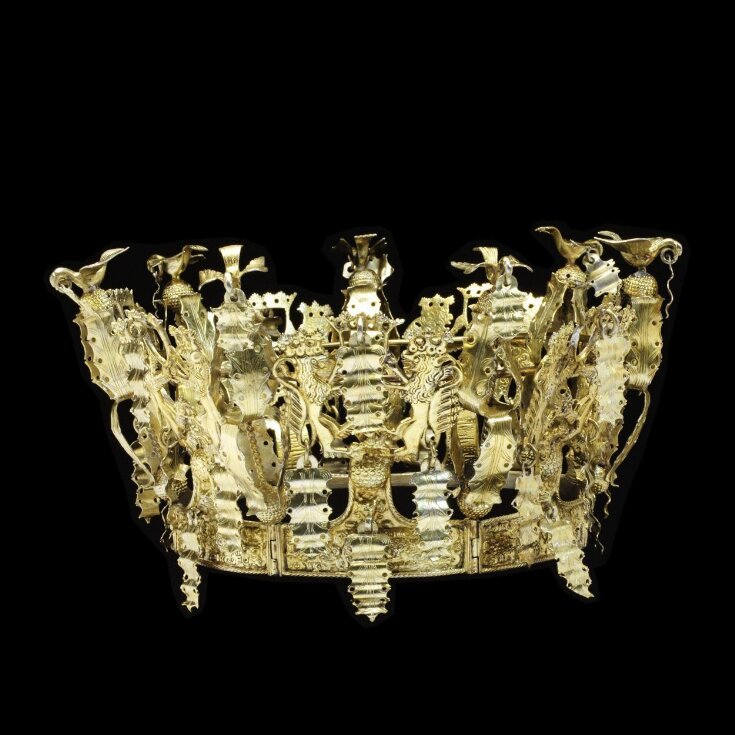
These crowns are full of symbolic values. The crown itself recalls the crown of the Virgin, and represents purity or virginity. The lions facing each other above each panel are symbols of strength. The birds at the top of each hinge may be cocks, which are an old symbol of fertility.
This crown was bought from a London antique dealer in 1879, so there is no information about its origins. It is one of a group of at least 12 of similar design made in Bergen between the late 17th century and the early 19th. This one has no maker's marks or silver marks. There are numbers scratched on the back of each of the panels, indicating how they should be put together, but they are not in order. It also has its weight scratched on the inside; 74 ½ L, which means over one kilo in modern terms. It is a very good example of Norwegian silversmith's work. It was illustrated (plate XIII) in 'Silverwork and jewellery', by Henry Wilson, to show 'the possibilities of work in thin sheet metal'.
Throughout the world brides wear special jewellery, such as tiaras or crowns, to reflect this. In Scandinavia, bridal crowns are the most spectacular part of the wedding jewellery. Their design is based on medieval royal originals, and they are made of heavy silver, often gilded. They were supported by a ring of padded cloth which rested on the bride's head.
In Norway all brides wore some kind of special headdress. In the south and east of the country it was usually made of cloth or other material, smothered with ribbons, beads and silver appliqués. Bridal crowns were mainly used in the west of Norway. They were always expensive, and were handed down as heirlooms in wealthy farming families. Brides from poorer families borrowed them from their richer neighbours. Bridal crowns usually had their own special case, made of painted wood, which also contained the ribbons, supports and other accessories. They were known by the name of the farm or parish where they were kept.
These crowns are full of symbolic values. The crown itself recalls the crown of the Virgin, and represents purity or virginity. The lions facing each other above each panel are symbols of strength. The birds at the top of each hinge may be cocks, which are an old symbol of fertility.
This crown was bought from a London antique dealer in 1879, so there is no information about its origins. It is one of a group of at least 12 of similar design made in Bergen between the late 17th century and the early 19th. This one has no maker's marks or silver marks. There are numbers scratched on the back of each of the panels, indicating how they should be put together, but they are not in order. It also has its weight scratched on the inside; 74 ½ L, which means over one kilo in modern terms. It is a very good example of Norwegian silversmith's work. It was illustrated (plate XIII) in 'Silverwork and jewellery', by Henry Wilson, to show 'the possibilities of work in thin sheet metal'.
Object details
| Categories | |
| Object type | |
| Materials and techniques | Silver-gilt |
| Brief description | Silver-gilt bridal crown (brudekrone), Norway, 1650-1750. |
| Physical description | Large silver-gilt bridal crown, made from a circle of hinged plaques, each surmounted by pairs of lions facing each other and holding between them an open shield. The pin of each hinge is extended upwards, encircled with leaves, and terminates in a hollow ball supporting a bird with a pendent leaf hanging from its beak. There are numerous pendent leaves hanging from all the elements. A ring of thick wire holds all the pieces together at the top. |
| Dimensions |
|
| Marks and inscriptions | '74 1/2 L' (Scratched on the inside.)
|
| Production | This crown forms part of a group of at least 12, identified by the Norsk Folkemuseum in Oslo, which were made in the Bergen area from the late 17th century to the mid 19th century. |
| Subject depicted | |
| Summary | Every bride is a queen on her wedding day. Throughout the world brides wear special jewellery, such as tiaras or crowns, to reflect this. In Scandinavia, bridal crowns are the most spectacular part of the wedding jewellery. Their design is based on medieval royal originals, and they are made of heavy silver, often gilded. They were supported by a ring of padded cloth which rested on the bride's head. In Norway all brides wore some kind of special headdress. In the south and east of the country it was usually made of cloth or other material, smothered with ribbons, beads and silver appliqués. Bridal crowns were mainly used in the west of Norway. They were always expensive, and were handed down as heirlooms in wealthy farming families. Brides from poorer families borrowed them from their richer neighbours. Bridal crowns usually had their own special case, made of painted wood, which also contained the ribbons, supports and other accessories. They were known by the name of the farm or parish where they were kept. These crowns are full of symbolic values. The crown itself recalls the crown of the Virgin, and represents purity or virginity. The lions facing each other above each panel are symbols of strength. The birds at the top of each hinge may be cocks, which are an old symbol of fertility. This crown was bought from a London antique dealer in 1879, so there is no information about its origins. It is one of a group of at least 12 of similar design made in Bergen between the late 17th century and the early 19th. This one has no maker's marks or silver marks. There are numbers scratched on the back of each of the panels, indicating how they should be put together, but they are not in order. It also has its weight scratched on the inside; 74 ½ L, which means over one kilo in modern terms. It is a very good example of Norwegian silversmith's work. It was illustrated (plate XIII) in 'Silverwork and jewellery', by Henry Wilson, to show 'the possibilities of work in thin sheet metal'. |
| Collection | |
| Accession number | 2-1879 |
About this object record
Explore the Collections contains over a million catalogue records, and over half a million images. It is a working database that includes information compiled over the life of the museum. Some of our records may contain offensive and discriminatory language, or reflect outdated ideas, practice and analysis. We are committed to addressing these issues, and to review and update our records accordingly.
You can write to us to suggest improvements to the record.
Suggest feedback
You can write to us to suggest improvements to the record.
Suggest feedback
| Record created | November 1, 2005 |
| Record URL |
Download as: JSONIIIF Manifest
