Coif
1550-1600 (made)
| Artist/Maker | |
| Place of origin |
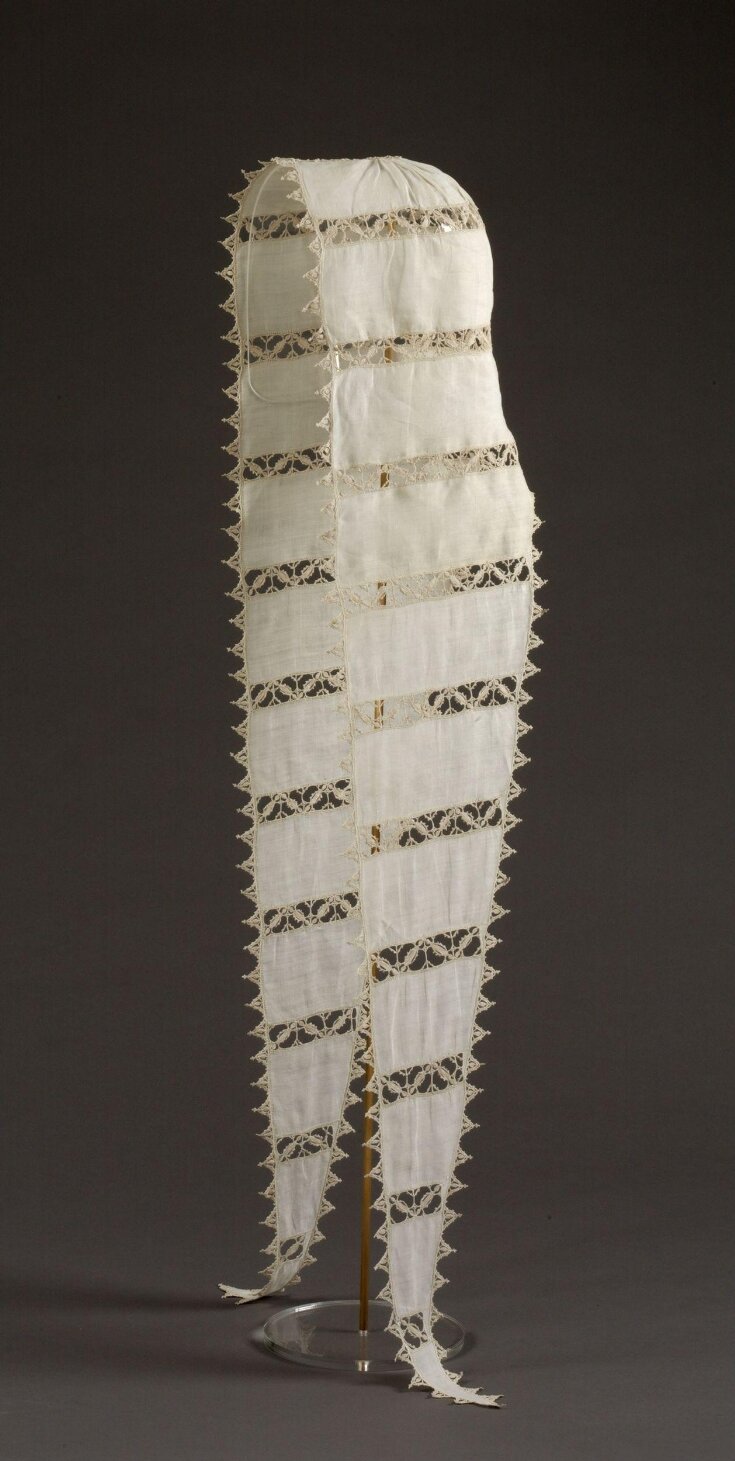
This coif is made of fine linen, gathered into a small needle lace roundel at the top, and with very long lappets which are integral and which taper gradually to a point. It is decorated with horizontal bands of cutwork with needle lace fillings, and edged with small triangular needle lace motifs, each one finished off with a tiny trefoil.
Nothing is known about how the coif was preserved before it entered the Museum's collection in the 1960s, and the survival of such a fragile object, intended to be functional even though it is so decorative, is rare. The needle lace which decorates it is Italian in style, and similar to designs published in Venetian pattern books of the 1590s. The overall shape of the coif, however, with its long lappets, is Flemish. Italian pattern books for lace circulated in Flanders, and the coif may well have been made there.
Nothing is known about how the coif was preserved before it entered the Museum's collection in the 1960s, and the survival of such a fragile object, intended to be functional even though it is so decorative, is rare. The needle lace which decorates it is Italian in style, and similar to designs published in Venetian pattern books of the 1590s. The overall shape of the coif, however, with its long lappets, is Flemish. Italian pattern books for lace circulated in Flanders, and the coif may well have been made there.
Object details
| Categories | |
| Object type | |
| Materials and techniques | Linen with cutwork and needle lace |
| Brief description | Coif of linen with cutwork and needle lace, possibly made in Italy or Flanders region, 1550-1600 |
| Physical description | Coif of white linen gathered into a small needle lace roundel at the top, and with very long lappets which are integral and which taper gradually to a point. Decorated with horizontal bands of needle lace in a pattern of small open squares, each one containing a motif arranged diagonally, to give a chevron effect. Edged with small triangular needle lace motifs, each one finished off with a tiny trefoil. |
| Dimensions |
|
| Credit line | Given by Miss G. I. Weinberg |
| Object history | Nothing is known about how this coif was preserved before it entered the Museum's collection in the 1960s, and the survival of such a fragile object, intended to be functional even though it is so decorative, is rare. It was given from a private textile collection; the donor had a particular interest in lace and whitework embroidery. |
| Historical context | The needle lace which decorates this coif is Italian in style, and similar to designs published in Venetian pattern books of the 1590s. The overall shape of the coif, however, with its long lappets, is Flemish. Italian pattern books for lace circulated in Flanders, and the coif may well have been made there. Comparable examples can be seen in 16th century Dutch and Flemish paintings, for example the Family Portrait by Maerten van Heemskerck (b.1498 Heemskerck, d.1574 Haarlem) in the Staatliche Museen, Kassel, Germany. |
| Production | The lace is Italian in style, but the shape of the coif is Flemish. |
| Summary | This coif is made of fine linen, gathered into a small needle lace roundel at the top, and with very long lappets which are integral and which taper gradually to a point. It is decorated with horizontal bands of cutwork with needle lace fillings, and edged with small triangular needle lace motifs, each one finished off with a tiny trefoil. Nothing is known about how the coif was preserved before it entered the Museum's collection in the 1960s, and the survival of such a fragile object, intended to be functional even though it is so decorative, is rare. The needle lace which decorates it is Italian in style, and similar to designs published in Venetian pattern books of the 1590s. The overall shape of the coif, however, with its long lappets, is Flemish. Italian pattern books for lace circulated in Flanders, and the coif may well have been made there. |
| Collection | |
| Accession number | T.83-1961 |
About this object record
Explore the Collections contains over a million catalogue records, and over half a million images. It is a working database that includes information compiled over the life of the museum. Some of our records may contain offensive and discriminatory language, or reflect outdated ideas, practice and analysis. We are committed to addressing these issues, and to review and update our records accordingly.
You can write to us to suggest improvements to the record.
Suggest feedback
You can write to us to suggest improvements to the record.
Suggest feedback
| Record created | October 27, 2005 |
| Record URL |
Download as: JSONIIIF Manifest
