
Pair of Waistcoat Shapes
1750-1759 (made)
| Artist/Maker | |
| Place of origin |
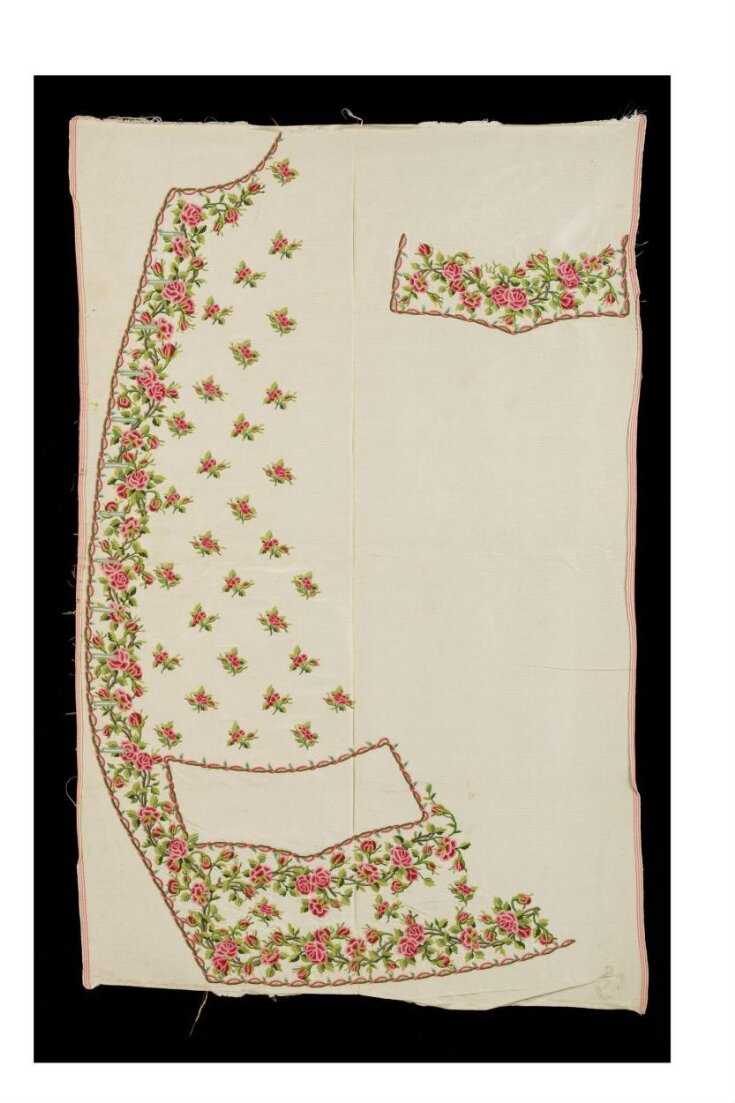
This extraordinary length of embroidered silk documents three important aspects of 18th-century dress: the high quality of French needlework, the sequence of decorating and sewing up waistcoats and the efforts to which the British went to acquire desirable French fashions.
To make an embroidered waistcoat, the needlework was done first on two lengths of fabric, one for the left front and the other for the right front. The lengths, known as waistcoat shapes, were purchased at a silk mercers or haberdashers, then taken to a tailor for making up into a waistcoat.
The stamp seen on the inside of the lower right edge reads ‘Custom House / SEIZED DOVER / GR II’, indicating that this is contraband – a French waistcoat shape apprehended during an attempt to smuggle it into England during the reign of George II (1727–60). For most of the 18th century, imported French silks and laces were taxed heavily, in order to protect British textile industries. Smuggling of these and other taxable goods was rife through all levels of society; customs officials at British ports searched very carefully and seized any contraband items. Articles confiscated in this manner were usually burned, so the survival of this beautiful but forbidden object is indeed remarkable.
To make an embroidered waistcoat, the needlework was done first on two lengths of fabric, one for the left front and the other for the right front. The lengths, known as waistcoat shapes, were purchased at a silk mercers or haberdashers, then taken to a tailor for making up into a waistcoat.
The stamp seen on the inside of the lower right edge reads ‘Custom House / SEIZED DOVER / GR II’, indicating that this is contraband – a French waistcoat shape apprehended during an attempt to smuggle it into England during the reign of George II (1727–60). For most of the 18th century, imported French silks and laces were taxed heavily, in order to protect British textile industries. Smuggling of these and other taxable goods was rife through all levels of society; customs officials at British ports searched very carefully and seized any contraband items. Articles confiscated in this manner were usually burned, so the survival of this beautiful but forbidden object is indeed remarkable.
Object details
| Categories | |
| Object type | |
| Parts | This object consists of 2 parts.
|
| Materials and techniques | Silk; hand-woven, tamboured |
| Brief description | Pair of shapes for a man's waistcoat, France, 1750-1759; ivory silk taffeta tamboured with pink roses |
| Physical description | Pair of waistcoat shapes for a man’s waistcoat, each a loom-width of ivory silk taffeta, tamboured in silk floss in shades of pink and green in a pattern of roses. Each shape outlines a curving neckline, shaped pocket and pocket flap and skirts reaching to the mid-thigh. Along the left front are 12 rectangles for the buttonholes. Each shape has a British customs’ seizure stamp on the reverse. |
| Dimensions |
|
| Marks and inscriptions | 'Customs House / SEIZED DOVER / GR II' (Stamped in black ink on reverse of each part) |
| Gallery label | Waistcoat panel
1750–60
Some silks were professionally embroidered in the shape of the intended garment, as with this waistcoat front. The tailor then cut and sewed the textile to fit his client. French silks were highly desirable and heavily taxed when imported to Britain. This silk was smuggled into Britain and seized by customs officials at Dover, who stamped it on the reverse.
France
Silk, embroidered with silk
Stamped ‘Customs House/Seized Dover/GR II’(09/12/2015) |
| Object history | Purchased from Lawrence Antiques. No further provenance available. |
| Historical context | Waistcoat panels worked like this were known as shapes in the 18th century. The areas of undecorated silk allowed the waistcoat to be cut and fitted to whatever size was required for the customer. |
| Subjects depicted | |
| Summary | This extraordinary length of embroidered silk documents three important aspects of 18th-century dress: the high quality of French needlework, the sequence of decorating and sewing up waistcoats and the efforts to which the British went to acquire desirable French fashions. To make an embroidered waistcoat, the needlework was done first on two lengths of fabric, one for the left front and the other for the right front. The lengths, known as waistcoat shapes, were purchased at a silk mercers or haberdashers, then taken to a tailor for making up into a waistcoat. The stamp seen on the inside of the lower right edge reads ‘Custom House / SEIZED DOVER / GR II’, indicating that this is contraband – a French waistcoat shape apprehended during an attempt to smuggle it into England during the reign of George II (1727–60). For most of the 18th century, imported French silks and laces were taxed heavily, in order to protect British textile industries. Smuggling of these and other taxable goods was rife through all levels of society; customs officials at British ports searched very carefully and seized any contraband items. Articles confiscated in this manner were usually burned, so the survival of this beautiful but forbidden object is indeed remarkable. |
| Bibliographic references |
|
| Collection | |
| Accession number | T.12&A-1981 |
About this object record
Explore the Collections contains over a million catalogue records, and over half a million images. It is a working database that includes information compiled over the life of the museum. Some of our records may contain offensive and discriminatory language, or reflect outdated ideas, practice and analysis. We are committed to addressing these issues, and to review and update our records accordingly.
You can write to us to suggest improvements to the record.
Suggest feedback
You can write to us to suggest improvements to the record.
Suggest feedback
| Record created | October 25, 2005 |
| Record URL |
Download as: JSONIIIF Manifest
