

'Bosphore' (Bosphorus)
Evening Dress
1956 (made)
1956 (made)
| Artist/Maker | |
| Place of origin |
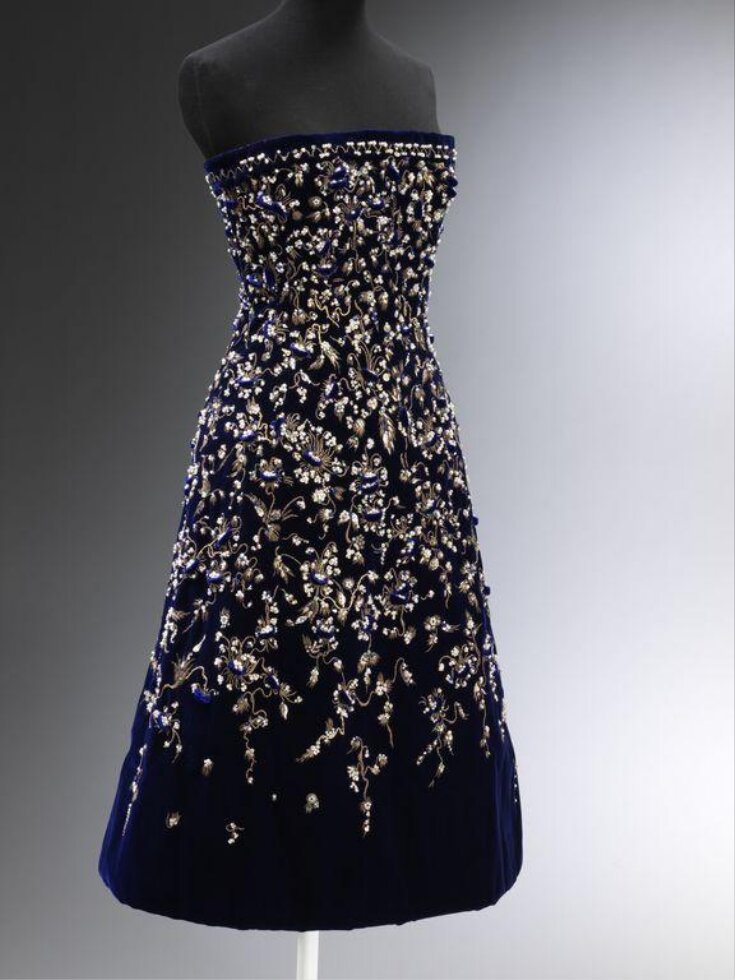
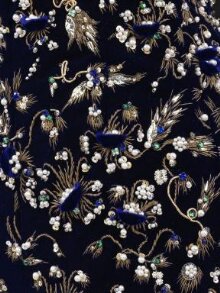
This dress, designed by Christian Dior (1905-57) in 1956, is short and strapless in midnight-blue velvet with delicate embroidery by Rébé, which includes velvet birds’ nests with clusters of pearl eggs.
The dress is simply cut, to show off its sumptuous surface detail. Such embellishment required meticulous patience for, as Dior explained, ‘a ball dress may be entirely covered with millions of paillettes, or pearls, each one of which has to be put on separately’.
The dress is simply cut, to show off its sumptuous surface detail. Such embellishment required meticulous patience for, as Dior explained, ‘a ball dress may be entirely covered with millions of paillettes, or pearls, each one of which has to be put on separately’.
Object details
| Categories | |
| Object type | |
| Titles |
|
| Materials and techniques | Embroidered velvet with gold thread, sequins, pearls and pastes, and net, silk and boned |
| Brief description | Strapless sheath evening dress 'Bosphore' from 'La Ligne Aimant ' in embroidered velvet, designed by Christian Dior, embroidered by Rébé, Paris, A/W1956 |
| Physical description | Strapless and short sheath evening dress of dark royal blue velvet with embroidery of gold thread, sequins, pearls and green and blue pastes in a design of sprays and tendrils springing from nests of pearls in velvet. The dress has two attached petticoats, one of black net and one of navy blue silk, and the net liner bodice is boned. There is a zip down the back of the dress and the inner bodice fastens with hooks and eyes. |
| Dimensions |
|
| Production type | Haute couture |
| Marks and inscriptions | 'Christian Dior Paris Automne-Hiver 1956 84193' (Label inside bodice) |
| Gallery label | EMBROIDERY
Paris was the home of a luxury trade in fashion goods. Entire streets were devoted to glove makers, shoe makers and furriers while feathers, floral accessories and ribbon work were worked by hand in small workshops, much as they had been since the 18th century.
Embroidery specialists created a range of samples each season. Once selected, a design remained for the exclusive use of the couturier. Hubert de Givenchy said these samples served as ‘the springboard to creation’.
Gowns that were to be embroidered were usually simply cut to show off their sumptuous surface detail. Their embellishment required meticulous patience, for as Dior explained, ‘a ball dress may be entirely covered with millions of paillettes, or pearls, each one of which has to be put on separately’.
'Bosphore' short evening dress
Christian Dior (1905-57)
Paris
1956 autumn/winter
The midnight blue velvet has delicate embroidery by Rébé which, on closer inspection, reveals velvet birds' nests with clusters of pearl eggs.
Silk velvet, embroidered by Rébé with pearls, gold thread and cabochons
Worn by Mrs Eugenia Niarchos and given by Mr Stavros Niarchos III
V&A: T.119-1974(22/09/2007) |
| Credit line | Given by Mr Stavros Niarchos III |
| Object history | The dress was originally designed with a plain velvet bolero, which was not given. Worn by Mrs Eugenia Niarchos and given by Mr Stavros Niarchos III |
| Production | The Aimant (Magnet) line |
| Subjects depicted | |
| Association | |
| Summary | This dress, designed by Christian Dior (1905-57) in 1956, is short and strapless in midnight-blue velvet with delicate embroidery by Rébé, which includes velvet birds’ nests with clusters of pearl eggs. The dress is simply cut, to show off its sumptuous surface detail. Such embellishment required meticulous patience for, as Dior explained, ‘a ball dress may be entirely covered with millions of paillettes, or pearls, each one of which has to be put on separately’. |
| Bibliographic references |
|
| Other number | 84193 - Dior label number |
| Collection | |
| Accession number | T.119-1974 |
About this object record
Explore the Collections contains over a million catalogue records, and over half a million images. It is a working database that includes information compiled over the life of the museum. Some of our records may contain offensive and discriminatory language, or reflect outdated ideas, practice and analysis. We are committed to addressing these issues, and to review and update our records accordingly.
You can write to us to suggest improvements to the record.
Suggest feedback
You can write to us to suggest improvements to the record.
Suggest feedback
| Record created | October 17, 2005 |
| Record URL |
Download as: JSON
