
Study of ash trees
Drawing
1817 (drawn)
1817 (drawn)
| Artist/Maker | |
| Place of origin |
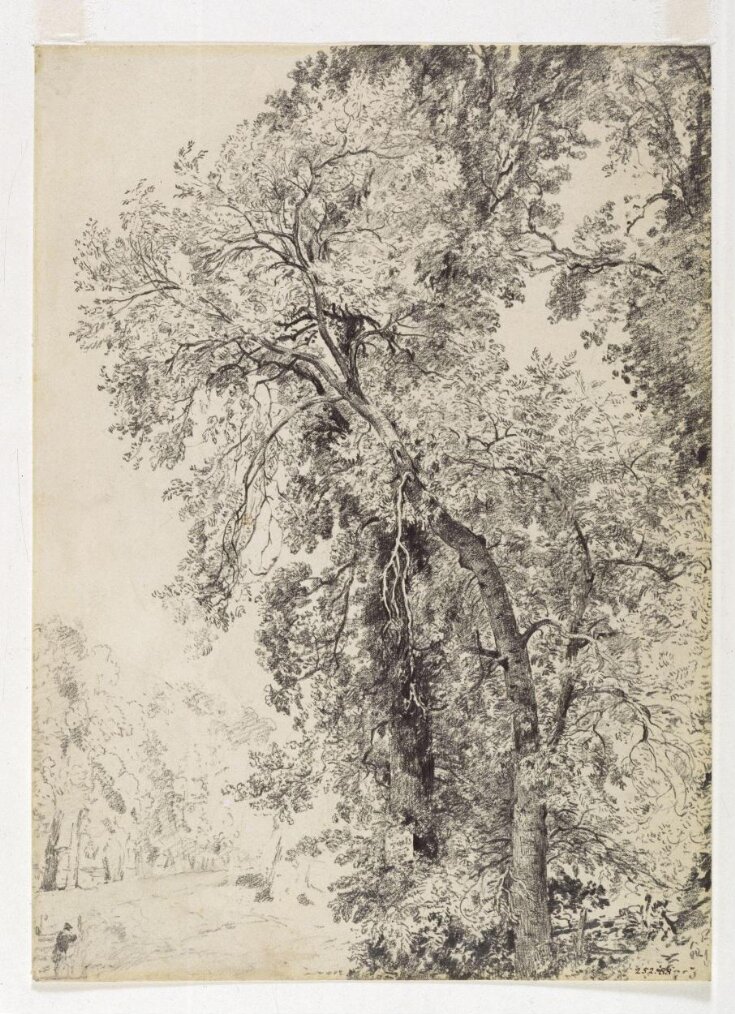
Constable usually made studies directly from nature for his large oil paintings, and this study of ash trees may be an example of his working method: the foremost tree, with a dead branch hanging against its trunk, appears to be the same as that in the right foreground of a painting owned by Tate Britain, The Valley Farm. However, the sketch's resemblance to studies of ash trees at Hampstead may suggest that this is an independent drawing, done after the completion of the painting.
Object details
| Category | |
| Object type | |
| Title | Study of ash trees (popular title) |
| Materials and techniques | Pencil and paper |
| Brief description | Drawing 'Study of ash trees' by John Constable |
| Physical description | Pencil drawing of two ash trees with dramatically shadowed trunks and sunlit crowns. The tree in the foreground has a dead branch hanging down two-thirds of the way up the trunk. |
| Dimensions |
|
| Marks and inscriptions | 'J WHATMAN' (Watermark) |
| Credit line | Given by Isabel Constable, daughter of the artist |
| Object history | Historical significance: In 1818 Constable first exhibited one of his tree studies at the Royal Academy; previously he had exhibited oil paintings almost exclusively there. |
| Historical context | In 1817 Constable exhibited four works at the Royal Academy: 'Scene on a navigable river' ('Flatford Mill on the River Stour') (Tate Gallery No. 1273); 'A Cottage' (see No. 352 [1631-1888]); 'Wivenhoe Park, Essex, the seat of Major-General Rebow' (National Gallery of Art, Washington: Widener Collection); and a portrait of John Fisher, still in the Fisher family collection. He spent ten weeks of the summer at East Bergholt. His first child, John Charles, was born on 4 December. [G Reynolds, 1973, p. 115] |
| Subject depicted | |
| Summary | Constable usually made studies directly from nature for his large oil paintings, and this study of ash trees may be an example of his working method: the foremost tree, with a dead branch hanging against its trunk, appears to be the same as that in the right foreground of a painting owned by Tate Britain, The Valley Farm. However, the sketch's resemblance to studies of ash trees at Hampstead may suggest that this is an independent drawing, done after the completion of the painting. |
| Bibliographic references |
|
| Other number | 163, plate 132 - Reynolds catalogue no. |
| Collection | |
| Accession number | 252-1888 |
About this object record
Explore the Collections contains over a million catalogue records, and over half a million images. It is a working database that includes information compiled over the life of the museum. Some of our records may contain offensive and discriminatory language, or reflect outdated ideas, practice and analysis. We are committed to addressing these issues, and to review and update our records accordingly.
You can write to us to suggest improvements to the record.
Suggest feedback
You can write to us to suggest improvements to the record.
Suggest feedback
| Record created | October 13, 2005 |
| Record URL |
Download as: JSONIIIF Manifest
