
A ruined cottage at Capel, Suffolk
Drawing
1796 (drawn)
1796 (drawn)
| Artist/Maker | |
| Place of origin |
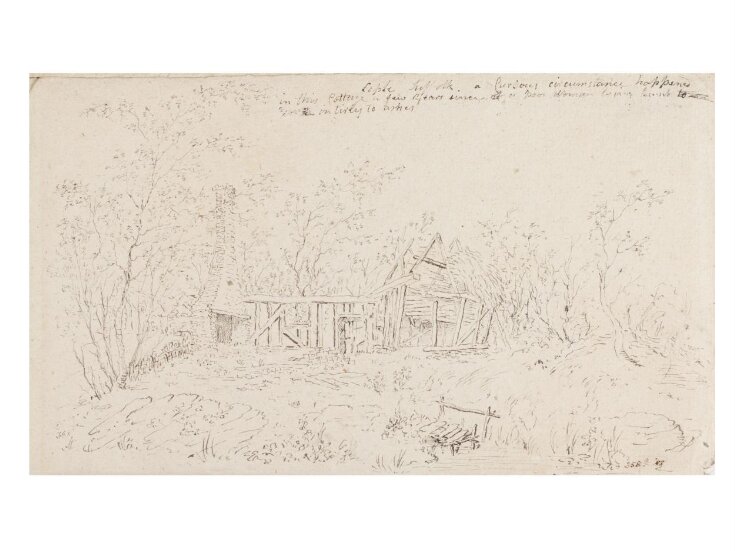
Constable's inscription at the top of the drawing notes that this cottage was the subject of a local legend. A few years previously, an old woman had burned to death inside, leaving the rest of the cottage unscathed by the flames; apparently witchcraft was suspected.
This drawing comes from Constable's earliest known sketchbook. In 1796, he had not yet committed himself to an artistic career and it was assumed that he would enter his father's business in Suffolk. That year he met the writer J. T. 'Antiquity' Smith, who was collecting material for a book on rural scenery, and showed him several drawings of local cottages -- perhaps including this one -- for possible inclusion. Although Smith responded positively, he ultimately did not use any of Constable's sketches in the published book.
This drawing comes from Constable's earliest known sketchbook. In 1796, he had not yet committed himself to an artistic career and it was assumed that he would enter his father's business in Suffolk. That year he met the writer J. T. 'Antiquity' Smith, who was collecting material for a book on rural scenery, and showed him several drawings of local cottages -- perhaps including this one -- for possible inclusion. Although Smith responded positively, he ultimately did not use any of Constable's sketches in the published book.
Object details
| Categories | |
| Object type | |
| Title | A ruined cottage at Capel, Suffolk (popular title) |
| Materials and techniques | pen and ink |
| Brief description | Drawing,, A ruined cottage at Capel, Suffolk, by John Constable, pen and ink, 1796 358-1888 on reverse |
| Physical description | A pen and ink drawing of a ruined cottage, backed by trees, on the bank of a stream. The stone chimney survives intact; the roof is gone; some of the wall timbers and part of the gable opposite the chimney remain, but lean precariously. |
| Dimensions |
|
| Marks and inscriptions | 'Caple Suffolk. a Curious circumstance happened in this Cottage a few years since of a poor Woman being burnt to death ['to death' crossed out] intirely to ashes . . .' [the rest erased] (Inscribed at top right in ink by the artist (with deletions as indicated above).) |
| Credit line | Given by Isabel Constable, daughter of the artist |
| Object history | This drawing is one of the thirteen earliest dated drawings by Constable whose whereabouts are known. A visitor to the Museum from the neighbourhood of Capel St. Mary said (c.1920-30) that the tradition about the old woman being burnt still persisted although the cottage had disappeared. The peculiar circumstance was that nothing in the cottage except the old woman was burnt; apparently witchcraft was suspected. [Reynolds, p. 35] |
| Historical context | John Constable was born in East Bergholt, Suffolk, on 11 June 1776, the second son of Golding Constable, a well-to-do mill-owner, and Ann Watts. His fondness for painting, without any marked precocity, had already declared itself by the time he was 16 or 17: and he was encouraged in this taste by his friendship with John Dunthorne, a plumber and glazier of East Bergholt, who was an amateur painter. Excluding copies after engravings, 358A-1888 is among the earliest dated drawings by Constable of which the whereabouts are now known. In 1796, Constable, not yet firmly committed to an artistic career, met the writer J. T. 'Antiquity' Smith, who was compiling Remarks on Rural Scenery; With twenty etchings of Cottages, from Nature; and some observations and precepts relative to the pictoresque (published June 1797). Constable wrote to Smith in October 1796, offering to send him several drawings of cottages, perhaps from this sketchbook, which he might find suitable for his purposes. Although Smith apparently responded positively, none of Constable's drawings appears in the published edition. In 1797 Constable was following his father's business in Suffolk. In 1799 he went to London to pursue his career in the arts, and on Farington's recommendation he was admitted as a probationer to the Academy Schools in March of that year. Lt.-Col. C. A. Brooks considers that this drawing represents a cottage at Marsh Farm, Brantham, which was demolished in 1958 (G. Reynolds, Catalogue of the Constable Collection in the Victoria and Albert Museum, London, 1973, p.34)In 1796, Constable, not yet firmly committed to an artistic career, met the writer J. T. 'Antiquity' Smith, who was compiling Remarks on Rural Scenery; With twenty etchings of Cottages, from Nature; and some observations and precepts relative to the pictoresque (published June 1797). Constable wrote to Smith in October 1796, offering to send him several drawings of cottages, perhaps from this sketchbook, which he might find suitable for his purposes. Although Smith apparently responded positively, none of Constable's drawings appears in the published edition. |
| Subject depicted | |
| Places depicted | |
| Association | |
| Summary | Constable's inscription at the top of the drawing notes that this cottage was the subject of a local legend. A few years previously, an old woman had burned to death inside, leaving the rest of the cottage unscathed by the flames; apparently witchcraft was suspected. This drawing comes from Constable's earliest known sketchbook. In 1796, he had not yet committed himself to an artistic career and it was assumed that he would enter his father's business in Suffolk. That year he met the writer J. T. 'Antiquity' Smith, who was collecting material for a book on rural scenery, and showed him several drawings of local cottages -- perhaps including this one -- for possible inclusion. Although Smith responded positively, he ultimately did not use any of Constable's sketches in the published book. |
| Bibliographic reference | G. Reynolds, Victoria and Albert Museum: Catalogue of the Constable Collection, 1973, p. 35, no. 13. |
| Collection | |
| Accession number | 358A-1888 |
About this object record
Explore the Collections contains over a million catalogue records, and over half a million images. It is a working database that includes information compiled over the life of the museum. Some of our records may contain offensive and discriminatory language, or reflect outdated ideas, practice and analysis. We are committed to addressing these issues, and to review and update our records accordingly.
You can write to us to suggest improvements to the record.
Suggest feedback
You can write to us to suggest improvements to the record.
Suggest feedback
| Record created | September 22, 2005 |
| Record URL |
Download as: JSONIIIF Manifest
