Brooch
ca. 1880 (made)
| Artist/Maker | |
| Place of origin |
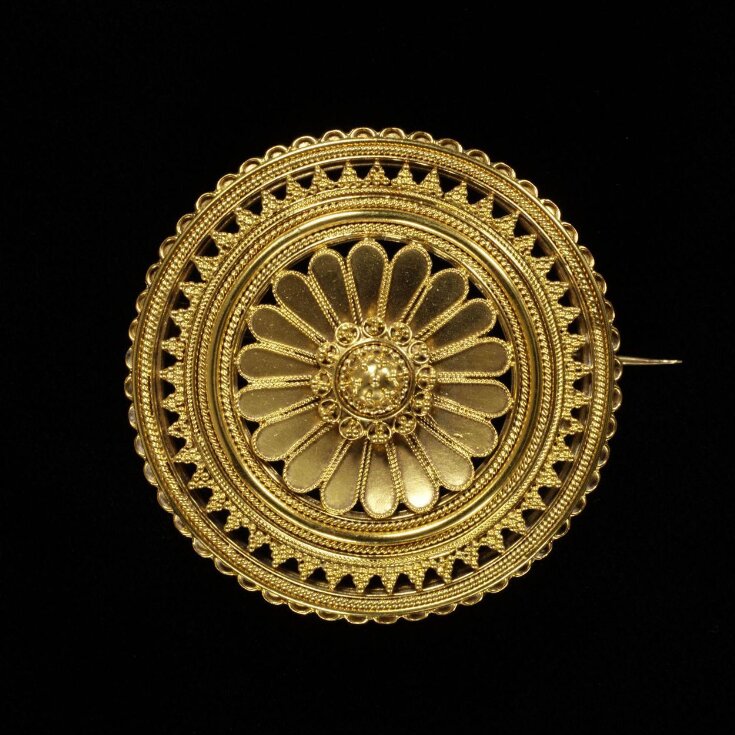
The brooch was given to the Museum in 1925 by the daughter of the artist Pasquale Novissimo who died in 1914. Although this brooch is in the antique taste, Novissimo largely supplied the jeweller Carlo Giuliano with Renaissance rather than classical designs for jewellery.
The granulation, or fine surface texture of minute grains of gold on this brooch, was copied from the Etruscan technique. Although the precise method was not mastered by 19th century goldsmiths a similar effect was achieved.
The archaeological discoveries of the 19th century led to a greater understanding of ancient jewellery. For the first time, experts could collect, study and publish works on these intricate gold pieces. Intellectuals particularly admired archaeological-style jewellery, often closely copied from surviving finds, from around 1860 until at least the 1880s.
Carlo Giuliano, a Neapolitan by birth, worked for the great Castellani firm in Italy before moving to London in about 1860. His early work in London closely resembles Castellani's productions in the classical manner. He later evolved a distinctive style of his own, using stones and enamel to create rich polychromatic effects. Carlo Giuliano's first mark, 'CG' in monogram, was based on the monogram of the Castellani firm. His early work in London closely resembles the Castellani pieces in the classical style.
The granulation, or fine surface texture of minute grains of gold on this brooch, was copied from the Etruscan technique. Although the precise method was not mastered by 19th century goldsmiths a similar effect was achieved.
The archaeological discoveries of the 19th century led to a greater understanding of ancient jewellery. For the first time, experts could collect, study and publish works on these intricate gold pieces. Intellectuals particularly admired archaeological-style jewellery, often closely copied from surviving finds, from around 1860 until at least the 1880s.
Carlo Giuliano, a Neapolitan by birth, worked for the great Castellani firm in Italy before moving to London in about 1860. His early work in London closely resembles Castellani's productions in the classical manner. He later evolved a distinctive style of his own, using stones and enamel to create rich polychromatic effects. Carlo Giuliano's first mark, 'CG' in monogram, was based on the monogram of the Castellani firm. His early work in London closely resembles the Castellani pieces in the classical style.
Object details
| Category | |
| Object type | |
| Materials and techniques | Gold openwork with filigree decoration |
| Brief description | Brooch, gold openwork with filigree decoration, designed by Pasquale Novissimo, England (London), about 1880 |
| Physical description | Brooch, gold openwork with filigree decoration. |
| Dimensions |
|
| Style | |
| Credit line | Given by the artist's daughter, Linda Novissimo |
| Subjects depicted | |
| Summary | The brooch was given to the Museum in 1925 by the daughter of the artist Pasquale Novissimo who died in 1914. Although this brooch is in the antique taste, Novissimo largely supplied the jeweller Carlo Giuliano with Renaissance rather than classical designs for jewellery. The granulation, or fine surface texture of minute grains of gold on this brooch, was copied from the Etruscan technique. Although the precise method was not mastered by 19th century goldsmiths a similar effect was achieved. The archaeological discoveries of the 19th century led to a greater understanding of ancient jewellery. For the first time, experts could collect, study and publish works on these intricate gold pieces. Intellectuals particularly admired archaeological-style jewellery, often closely copied from surviving finds, from around 1860 until at least the 1880s. Carlo Giuliano, a Neapolitan by birth, worked for the great Castellani firm in Italy before moving to London in about 1860. His early work in London closely resembles Castellani's productions in the classical manner. He later evolved a distinctive style of his own, using stones and enamel to create rich polychromatic effects. Carlo Giuliano's first mark, 'CG' in monogram, was based on the monogram of the Castellani firm. His early work in London closely resembles the Castellani pieces in the classical style. |
| Collection | |
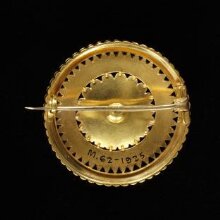
| Accession number | M.62-1925 |
About this object record
Explore the Collections contains over a million catalogue records, and over half a million images. It is a working database that includes information compiled over the life of the museum. Some of our records may contain offensive and discriminatory language, or reflect outdated ideas, practice and analysis. We are committed to addressing these issues, and to review and update our records accordingly.
You can write to us to suggest improvements to the record.
Suggest feedback
You can write to us to suggest improvements to the record.
Suggest feedback
| Record created | August 31, 2005 |
| Record URL |
Download as: JSONIIIF Manifest
