
Bridal Costume
1780-1800 (made), 1520 (made), (made), 1600-1800 (made)
| Artist/Maker | |
| Place of origin |
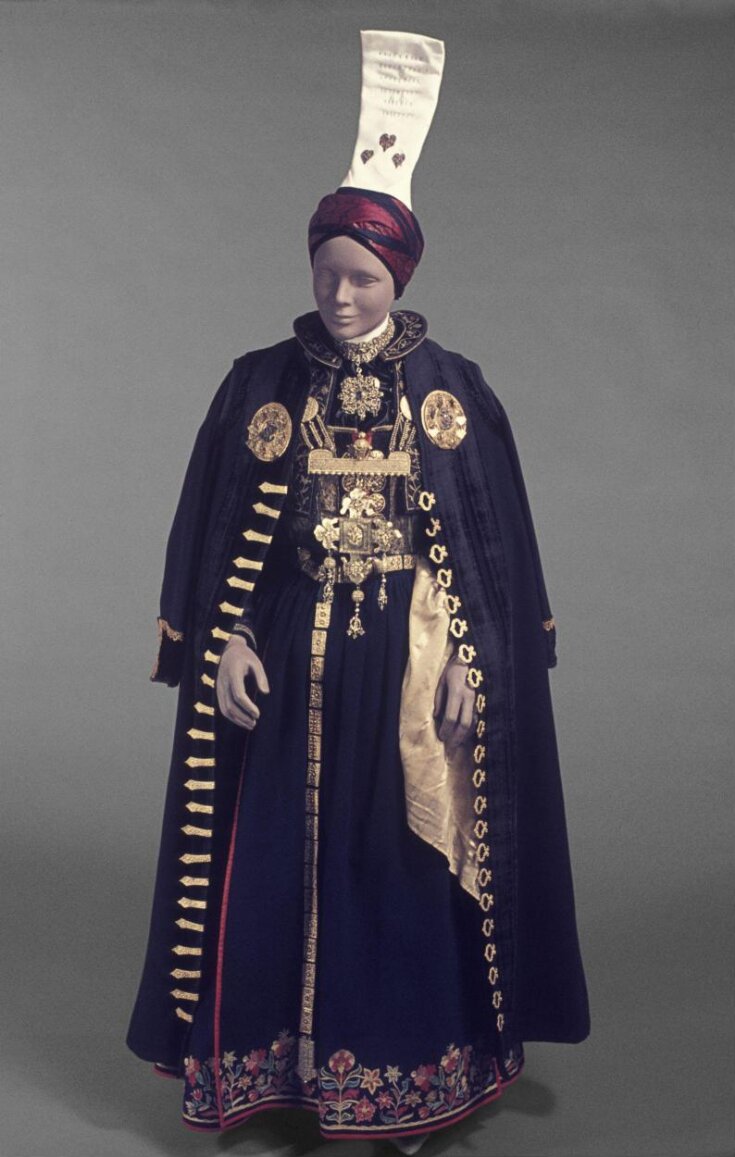
This bridal outfit is the oldest known more or less complete Icelandic woman's costume in existence. It is in the general style of Icelandic festive costumes from the late 18th century to about 1800, but is extremely rich in decoration and silver jewellery.
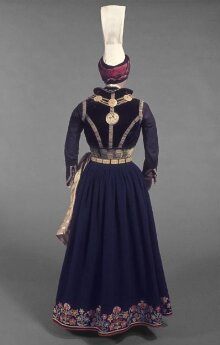
The outfit consists of a green velvet bodice decorated with gilt braid, which is attached to a petticoat of green worsted. A short black velvet jacket goes over the bodice, ornamented with gilt braid and gilt metal thread embroidery. From the openings of the long, tight-fitting sleeves hang spherical ornamented silver gilt buttons of filigree work with pendant leaves. A pleated full skirt of heavy dark blue broadcloth is bound with red wool tape at the bottom, above which is a wide floral border embroidered in polychrome wools. The skirt has a long front opening, which is covered by the matching apron which is held in place by the long pendant girdle made of dark green velvet onto which are sewn 31 closely spaced silver gilt plaques of filigree work together with an ornate silver gilt buckle of cast work.
A chain wound around the neck consists of 53 ornate links of cast work from which is suspended a medallion of filigree work with five pendant letters: B A B H B (three letters are now missing). A blue stone in the centre is surrounded by the inscribed letters H H D and the date 1782. The heavy silver gilt shoulder chain, linking together seven circular pieces and a bar, all of filigree work, is of Scandinavian 17th- or 18th-century workmanship. It is terminated at the back by a large medal carrying the date 1537 and in front by a large cross reliquary from about 1520, both by German or Dutch workmanship.
It is possible that parts of the outfit once belonged to Sigríður Magnúsdóttir and were originally worn at her wedding in 1761, and then passed on to her daughters: Þórunn and Ragnheiður Ólafsdóttir, who wore at least part of the costume at their weddings, in 1780 to Bishop Hannes Finnson and sheriff Jónas Scheving in 1804 respectively.
The outfit consists of a green velvet bodice decorated with gilt braid, which is attached to a petticoat of green worsted. A short black velvet jacket goes over the bodice, ornamented with gilt braid and gilt metal thread embroidery. From the openings of the long, tight-fitting sleeves hang spherical ornamented silver gilt buttons of filigree work with pendant leaves. A pleated full skirt of heavy dark blue broadcloth is bound with red wool tape at the bottom, above which is a wide floral border embroidered in polychrome wools. The skirt has a long front opening, which is covered by the matching apron which is held in place by the long pendant girdle made of dark green velvet onto which are sewn 31 closely spaced silver gilt plaques of filigree work together with an ornate silver gilt buckle of cast work.
A chain wound around the neck consists of 53 ornate links of cast work from which is suspended a medallion of filigree work with five pendant letters: B A B H B (three letters are now missing). A blue stone in the centre is surrounded by the inscribed letters H H D and the date 1782. The heavy silver gilt shoulder chain, linking together seven circular pieces and a bar, all of filigree work, is of Scandinavian 17th- or 18th-century workmanship. It is terminated at the back by a large medal carrying the date 1537 and in front by a large cross reliquary from about 1520, both by German or Dutch workmanship.
It is possible that parts of the outfit once belonged to Sigríður Magnúsdóttir and were originally worn at her wedding in 1761, and then passed on to her daughters: Þórunn and Ragnheiður Ólafsdóttir, who wore at least part of the costume at their weddings, in 1780 to Bishop Hannes Finnson and sheriff Jónas Scheving in 1804 respectively.
Object details
| Categories | |
| Parts | This object consists of 13 parts.
|
| Title | Bridal Costume |
| Brief description | Bridal costume, wool, velvet, gold braid, metalwork, Iceland, 1800s. |
| Physical description | The costume consists of the following elements, as described by Elsa E. Guðjónsson (Curator of Textiles at the National Museum of Iceland) in 1985: Pelisse (Hempa) of black cloth, bordered with velvet and fastened in front with silver gilt clasps. Two circular silver gilt disks on the breast, with cord and pendent ornaments and the monogram 'S. N. D.' in white paste. Bodice (Upphlutur) of green velvet, with five silver gilt clasps, attached to a petticoat (Fat) of green cloth. Petticoat (Fat) of dark blue cloth, with flowers in coloured worsted tamboured around the skirt. Jacket (Treja) of black velvet with gold embroidery and silver-gilt buttons of globular openwork; collar (Kraga) of black velvet and gold embroidery. Apron (Svynta) of dark blue cloth tamboured with flowers in coloured worsted, fastened with silver gilt openwork bosses. Silver gilt neck chain (Hals festi) of open work scroll links, from which is hung a medallion (Nisti). The medallion is silver gilt cordate with a blue stone in its centre, around which are engraved the initials 'H.H.D. 1782'. Silver gilt shoulder chain (Herðafesti) composed of seven circular disks of cord ornament connected by triple chains, and joined to a transverse bar, on the centre of which stands a vase-shaped ornament, and from which is hung a cross with foliated ends decorated with a figure of the Trinity & the Evangelistic symbols. To the central disk is likewise suspended a medallion (by Heinrich Ritz?) showing on the one side the Crucifixion, on the other the sacrifice of Isaac. Girdle (Lyndi) of green velvet, with oblong silver- gilt plates of openwork corded ornament (32 in all, two missing,) with a pendant of similar character. |
| Dimensions |
|
| Credit line | Purchased from Dr Hooker for £105. |
| Object history | The bridal costume may have belonged to Ragnheiður Ólafsdóttir, who married her cousin sheriff Jónas Scheving in 1804, or her elder sister, Þórunn, who wore at least part of the costume at her wedding in 1780 to Bishop Hannes Finnson. Their mother, Sigríður Magnúsdóttir, seems to have been the original owner of the breastplates of the coat at least in 1772, when the coat was depicted by James Miller, a member of Sir Joseph Bank's expedition. It was likely worn at Sigríður Magnúsdóttir's wedding in 1761. Historical significance: In the Summer of 1809 a young English botanist, William Jackson Hooker, spent about two months travelling Iceland, studying the natural history of the island, but also got interested in the dress of Icelandic women. In his journal, he gave a detailed description of an Icelandic wedding dress, one of the richest in the island [which he] had the good fortune to bring safe to England. The V&A Museum bought an Icelandic wedding dress on 18 March 1869 from a 'Dr. Hooker'. Although not identified further, Dr Hooker most likely was Joseph D. Hooker, the distinguished naturalist and eldest son of William Hooker. The costume is likely to have remained in the possession of William Hooker until his death in 1865, before being passed on to his son. |
| Historical context | The 'Hooker' costume is in the general style of Icelandic festive costumes from the 16th to the 18th centuries. Richly decorated costumes of this type, usually made from wool and decorated with embroidery and silver, were frequently described by 18th-century travellers to Iceland. For the most part these 18th-century garments no longer survive. This type of costume stopped being made from around 1800, in tandem with a simplification of Icelandic women's dress. This wedding dress is the oldest known more or less complete Icelandic woman's costume in existence. Women wore a long-sleeved shirt, skyrta, of either wool or linen fabric under the bodice; for a costume of this quality, the shirt would no doubt have been of linen. No such garment came with the costume. Also several undergarments of wadmal, besides the bodice and petticoat, would have been worn. Thor Magnusson describes how on top of the head-dress (skautafaldur), the wealthiest women in Iceland would wear a shielded cap decorated with silver disks (skildahufa) as part of their wedding costume. This element of the costume dates from the 17th century or the beginning of the 18th, and only two are known to exist (Magnusson 1987, pp.73-74). In 1998, the curator of textiles at the Reykjavik Museum published a leaflet questioning whether there could be a third skildahufa in a British museum or private collection, citing correspondence between an Icelandic and British family relating to a 'very old headdress' that had been sent to the British family (Gudjonsson 1998). |
| Production | Head-dress and head scarf of later date. |
| Summary | This bridal outfit is the oldest known more or less complete Icelandic woman's costume in existence. It is in the general style of Icelandic festive costumes from the late 18th century to about 1800, but is extremely rich in decoration and silver jewellery. The outfit consists of a green velvet bodice decorated with gilt braid, which is attached to a petticoat of green worsted. A short black velvet jacket goes over the bodice, ornamented with gilt braid and gilt metal thread embroidery. From the openings of the long, tight-fitting sleeves hang spherical ornamented silver gilt buttons of filigree work with pendant leaves. A pleated full skirt of heavy dark blue broadcloth is bound with red wool tape at the bottom, above which is a wide floral border embroidered in polychrome wools. The skirt has a long front opening, which is covered by the matching apron which is held in place by the long pendant girdle made of dark green velvet onto which are sewn 31 closely spaced silver gilt plaques of filigree work together with an ornate silver gilt buckle of cast work. A chain wound around the neck consists of 53 ornate links of cast work from which is suspended a medallion of filigree work with five pendant letters: B A B H B (three letters are now missing). A blue stone in the centre is surrounded by the inscribed letters H H D and the date 1782. The heavy silver gilt shoulder chain, linking together seven circular pieces and a bar, all of filigree work, is of Scandinavian 17th- or 18th-century workmanship. It is terminated at the back by a large medal carrying the date 1537 and in front by a large cross reliquary from about 1520, both by German or Dutch workmanship. It is possible that parts of the outfit once belonged to Sigríður Magnúsdóttir and were originally worn at her wedding in 1761, and then passed on to her daughters: Þórunn and Ragnheiður Ólafsdóttir, who wore at least part of the costume at their weddings, in 1780 to Bishop Hannes Finnson and sheriff Jónas Scheving in 1804 respectively. |
| Bibliographic references |
|
| Collection | |
| Accession number | 258 to M-1869 |
About this object record
Explore the Collections contains over a million catalogue records, and over half a million images. It is a working database that includes information compiled over the life of the museum. Some of our records may contain offensive and discriminatory language, or reflect outdated ideas, practice and analysis. We are committed to addressing these issues, and to review and update our records accordingly.
You can write to us to suggest improvements to the record.
Suggest feedback
You can write to us to suggest improvements to the record.
Suggest feedback
| Record created | August 31, 2005 |
| Record URL |
Download as: JSONIIIF Manifest
