Vase
ca. 1520 (made)
| Artist/Maker | |
| Place of origin |
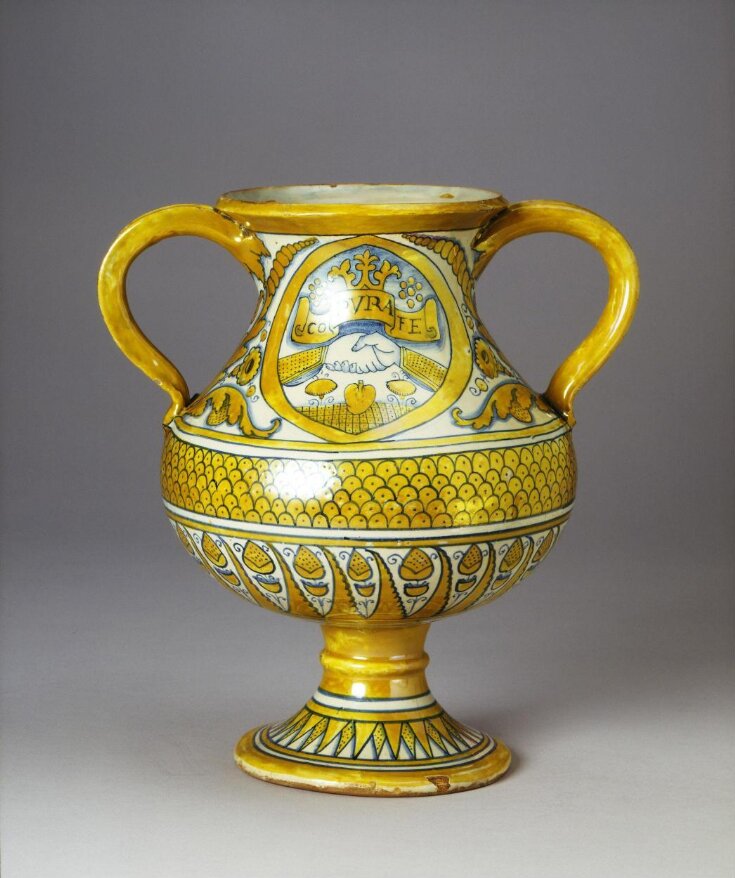
This type of two-handled vase, often fitted with a shallow conical cover and mostly decorated in blue and pale lustre, was part of the standard repertoire of the potters of Deruta. It is not exactly known what they were used for but they may have been made for banquets and wedding feasts. The inscription and the symbols of love, certainly suggest that this particular vase was intended to celebrate an engagement or a wedding. By 1500 the small town of Deruta had developed into a well known pottery production centre. A speciality of the town was golden-yellow lustre decoration. This was achieved by introducing brushwood into the kiln towards the end of the firing process. The resulting thick smoke creates an oxygen-starved 'reducing' atmosphere, which reacted with the lustre pigments. The process required highly specialised skills and the kiln losses were considerable, which explains the high price commanded by lustred earthenware.
Object details
| Categories | |
| Object type | |
| Materials and techniques | Tin-glazed earthenware (maiolica), with painted decoration in blue and lustre |
| Brief description | Two-handled vase, tin-glazed earthenware painted in blue and lustre, Deruta, Italy, ca. 1520 |
| Physical description | Double-handled vase, tin-glazed earthenware, with painted decoration in blue and lustre. Decorative medallion to the centre displaying shaking hands above a heart, surmounted by a scroll with an inscription, 'Co pura fe', and a crown |
| Dimensions |
|
| Marks and inscriptions | Inscribed: 'Co pura fe'
|
| Gallery label | British Galleries:
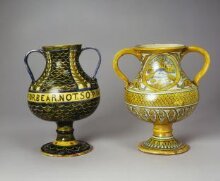
A VASE AND ITS RENAISSANCE MODEL The Della Robbia pottery of Birkenhead, Merseyside, took its name from a famous family of sculptors working in Florence in the 15th century. Some of the work it produced was closely based on Renaissance pottery. There is a direct comparison between the shape and decoration of this vase and the 16th-century vase from Deruta, Italy to the left.(27/03/2003) |
| Summary | This type of two-handled vase, often fitted with a shallow conical cover and mostly decorated in blue and pale lustre, was part of the standard repertoire of the potters of Deruta. It is not exactly known what they were used for but they may have been made for banquets and wedding feasts. The inscription and the symbols of love, certainly suggest that this particular vase was intended to celebrate an engagement or a wedding. By 1500 the small town of Deruta had developed into a well known pottery production centre. A speciality of the town was golden-yellow lustre decoration. This was achieved by introducing brushwood into the kiln towards the end of the firing process. The resulting thick smoke creates an oxygen-starved 'reducing' atmosphere, which reacted with the lustre pigments. The process required highly specialised skills and the kiln losses were considerable, which explains the high price commanded by lustred earthenware. |
| Other number | 460 - Rackham (1940) |
| Collection | |
| Accession number | 4392-1857 |
About this object record
Explore the Collections contains over a million catalogue records, and over half a million images. It is a working database that includes information compiled over the life of the museum. Some of our records may contain offensive and discriminatory language, or reflect outdated ideas, practice and analysis. We are committed to addressing these issues, and to review and update our records accordingly.
You can write to us to suggest improvements to the record.
Suggest feedback
You can write to us to suggest improvements to the record.
Suggest feedback
| Record created | July 19, 1999 |
| Record URL |
Download as: JSONIIIF Manifest
