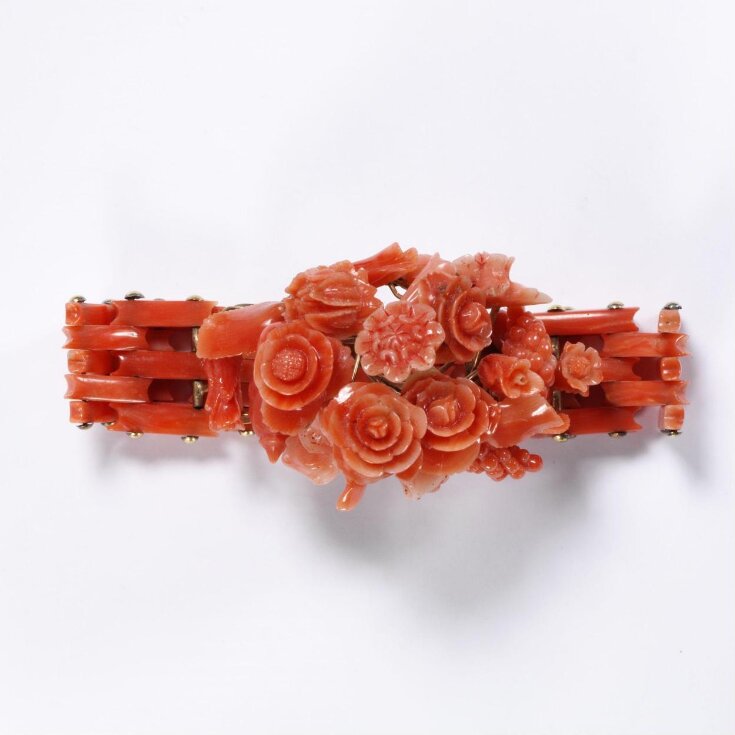
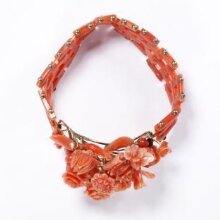
Bracelet
ca. 1850 (made)
| Artist/Maker | |
| Place of origin |
Coral, formed by the skeletons of marine creatures, has been used in jewellery since antiquity. It was originally used as an amulet, believed to protect the wearer against the evil eye and was often worn by small children. In the mid 19th century, it began to be used in conventional jewellery.
This jewel, with intricately carved flowers and woven basket-like bracelet is a good example of the type of naturalistic jewellery popular in the mid 19th century. Coral could be carved or used in its natural form, exploiting the appeal of its spiky branches.
Most coral in Europe came from the sea around Naples and nearby Torre del Greco. In the 19th century it became a fashionable souvenir, partly because people could travel more once the Napoleonic wars had ended in 1815.
This jewel, with intricately carved flowers and woven basket-like bracelet is a good example of the type of naturalistic jewellery popular in the mid 19th century. Coral could be carved or used in its natural form, exploiting the appeal of its spiky branches.
Most coral in Europe came from the sea around Naples and nearby Torre del Greco. In the 19th century it became a fashionable souvenir, partly because people could travel more once the Napoleonic wars had ended in 1815.
Object details
| Categories | |
| Object type | |
| Materials and techniques | Carved coral and gold |
| Brief description | Bracelet, carved coral and gold. Italy, about 1850. |
| Physical description | Bracelet, carved coral held together with gold pins. |
| Dimensions |
|
| Credit line | Given by Mrs W. Le Roy |
| Subject depicted | |
| Summary | Coral, formed by the skeletons of marine creatures, has been used in jewellery since antiquity. It was originally used as an amulet, believed to protect the wearer against the evil eye and was often worn by small children. In the mid 19th century, it began to be used in conventional jewellery. This jewel, with intricately carved flowers and woven basket-like bracelet is a good example of the type of naturalistic jewellery popular in the mid 19th century. Coral could be carved or used in its natural form, exploiting the appeal of its spiky branches. Most coral in Europe came from the sea around Naples and nearby Torre del Greco. In the 19th century it became a fashionable souvenir, partly because people could travel more once the Napoleonic wars had ended in 1815. |
| Collection | |
| Accession number | M.126-1984 |
About this object record
Explore the Collections contains over a million catalogue records, and over half a million images. It is a working database that includes information compiled over the life of the museum. Some of our records may contain offensive and discriminatory language, or reflect outdated ideas, practice and analysis. We are committed to addressing these issues, and to review and update our records accordingly.
You can write to us to suggest improvements to the record.
Suggest feedback
You can write to us to suggest improvements to the record.
Suggest feedback
| Record created | August 24, 2005 |
| Record URL |
Download as: JSONIIIF Manifest
