
Tiara
ca. 1835 (made)
| Artist/Maker | |
| Place of origin |
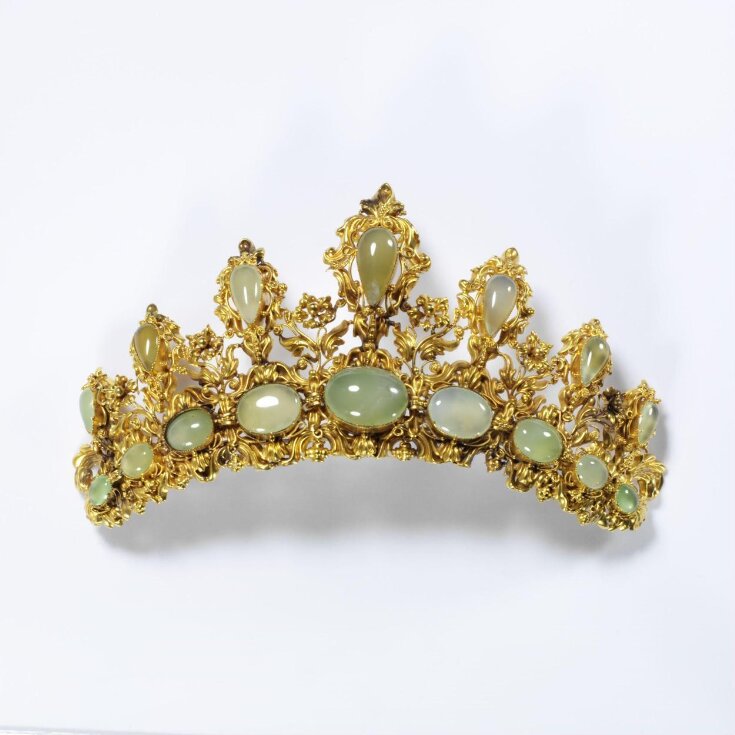
This tiara has been made by pressing the gold into the required shape using a steel die stamping machine.
By the 1850s the jewellery trade had been transformed by consumer demand and technological innovation. Traditional techniques such as casting, chasing and engraving continued in high fashion pieces, but newer industrial methods created cheaper products for a mass market.
Flatted gold, rolled through machinery to a very thin sheet, could be stamped to make multiple standard components. Through the use of stamped collets, even the setting of gemstones required less handwork.
The expansion of the jewellery trade in Britain also benefited from the legalisation of three lower standards of gold alloys in 1854.
By the 1850s the jewellery trade had been transformed by consumer demand and technological innovation. Traditional techniques such as casting, chasing and engraving continued in high fashion pieces, but newer industrial methods created cheaper products for a mass market.
Flatted gold, rolled through machinery to a very thin sheet, could be stamped to make multiple standard components. Through the use of stamped collets, even the setting of gemstones required less handwork.
The expansion of the jewellery trade in Britain also benefited from the legalisation of three lower standards of gold alloys in 1854.
Object details
| Categories | |
| Object type | |
| Materials and techniques | Gold and chrysoprase |
| Brief description | Tiara, stamped gold, set with chrysoprase, England, about 1835 |
| Physical description | Tiara , gold, set with chrysoprase. |
| Dimensions |
|
| Credit line | Given by Dame Joan Evans |
| Summary | This tiara has been made by pressing the gold into the required shape using a steel die stamping machine. By the 1850s the jewellery trade had been transformed by consumer demand and technological innovation. Traditional techniques such as casting, chasing and engraving continued in high fashion pieces, but newer industrial methods created cheaper products for a mass market. Flatted gold, rolled through machinery to a very thin sheet, could be stamped to make multiple standard components. Through the use of stamped collets, even the setting of gemstones required less handwork. The expansion of the jewellery trade in Britain also benefited from the legalisation of three lower standards of gold alloys in 1854. |
| Bibliographic reference | Shirley Bury, Jewellery 1789-1910, The International Era, Vol. 1. p.294, colour plate 72 |
| Collection | |
| Accession number | M.146-1975 |
About this object record
Explore the Collections contains over a million catalogue records, and over half a million images. It is a working database that includes information compiled over the life of the museum. Some of our records may contain offensive and discriminatory language, or reflect outdated ideas, practice and analysis. We are committed to addressing these issues, and to review and update our records accordingly.
You can write to us to suggest improvements to the record.
Suggest feedback
You can write to us to suggest improvements to the record.
Suggest feedback
| Record created | August 11, 2005 |
| Record URL |
Download as: JSONIIIF Manifest
