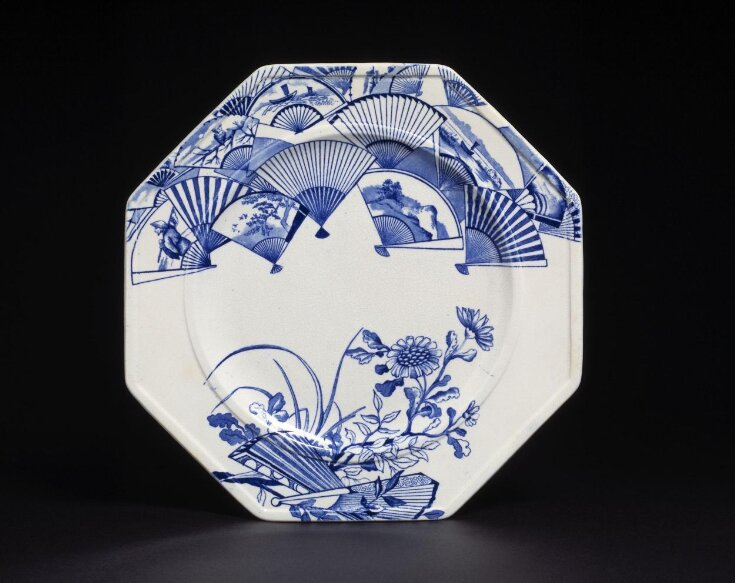

Plate
ca. 1875-1885 (made)
| Artist/Maker | |
| Place of origin |
Object Type
Traditional blue and white ceramics from China and Japan were enthusiastically collected by adherents of Aestheticism. More generally, although Japanese images were popular, the genuine artefact or image was often misinterpreted or adopted at several removes from the original. The design of this transfer-printed pattern includes an owl, a bird not immediately associated with Japan. However, the asymmetrical arrangement was generally recognised as in Japanese taste. The design name, as marked in the reverse of the plate, is 'Andalusia'. The irrelevance of name to pattern was common in Victorian ceramics; indeed, relevance was extremely uncommon.
People
Brown-Westhead, Moore & Co. operated at the Cauldon Place works, Hanley, establised in about 1802 by Job Ridgway. By the 1870s the company was one of the largest in the area, with over 1000 employees. It made a wide variety of table and toilet wares in earthenware and porcelain, and ornamental Parian, eggshell porcelain and majolica wares, and it supplied both the British and Russian Royal families.
Traditional blue and white ceramics from China and Japan were enthusiastically collected by adherents of Aestheticism. More generally, although Japanese images were popular, the genuine artefact or image was often misinterpreted or adopted at several removes from the original. The design of this transfer-printed pattern includes an owl, a bird not immediately associated with Japan. However, the asymmetrical arrangement was generally recognised as in Japanese taste. The design name, as marked in the reverse of the plate, is 'Andalusia'. The irrelevance of name to pattern was common in Victorian ceramics; indeed, relevance was extremely uncommon.
People
Brown-Westhead, Moore & Co. operated at the Cauldon Place works, Hanley, establised in about 1802 by Job Ridgway. By the 1870s the company was one of the largest in the area, with over 1000 employees. It made a wide variety of table and toilet wares in earthenware and porcelain, and ornamental Parian, eggshell porcelain and majolica wares, and it supplied both the British and Russian Royal families.
Object details
| Categories | |
| Object type | |
| Materials and techniques | White earthenware, printed |
| Brief description | Plate, made by Brown Westead Moore & Co, Cauldon Place, Hanley, Staffordshire, England, about 1875-85 |
| Physical description | This white earthenware plate has transfer-printed decoration in blue with a pattern of fans and flowers with views of mountains, lakes, trees, and a fisherman, embellished with chrysanthemums and leaves in 'Japanese' style |
| Dimensions |
|
| Marks and inscriptions | Marked 'BWM & C ANDALUSIA' with shield and badge surmounted by a crown 'S' printed in blue; 'BROWN WESTHEAD MOORE & CO 5' impressed
|
| Gallery label |
|
| Object history | Made by Brown-Westhead, Moore & Co., Hanley, Staffordshire Made in England |
| Subjects depicted | |
| Summary | Object Type Traditional blue and white ceramics from China and Japan were enthusiastically collected by adherents of Aestheticism. More generally, although Japanese images were popular, the genuine artefact or image was often misinterpreted or adopted at several removes from the original. The design of this transfer-printed pattern includes an owl, a bird not immediately associated with Japan. However, the asymmetrical arrangement was generally recognised as in Japanese taste. The design name, as marked in the reverse of the plate, is 'Andalusia'. The irrelevance of name to pattern was common in Victorian ceramics; indeed, relevance was extremely uncommon. People Brown-Westhead, Moore & Co. operated at the Cauldon Place works, Hanley, establised in about 1802 by Job Ridgway. By the 1870s the company was one of the largest in the area, with over 1000 employees. It made a wide variety of table and toilet wares in earthenware and porcelain, and ornamental Parian, eggshell porcelain and majolica wares, and it supplied both the British and Russian Royal families. |
| Collection | |
| Accession number | C.216-1984 |
About this object record
Explore the Collections contains over a million catalogue records, and over half a million images. It is a working database that includes information compiled over the life of the museum. Some of our records may contain offensive and discriminatory language, or reflect outdated ideas, practice and analysis. We are committed to addressing these issues, and to review and update our records accordingly.
You can write to us to suggest improvements to the record.
Suggest feedback
You can write to us to suggest improvements to the record.
Suggest feedback
| Record created | July 1, 1999 |
| Record URL |
Download as: JSONIIIF Manifest
