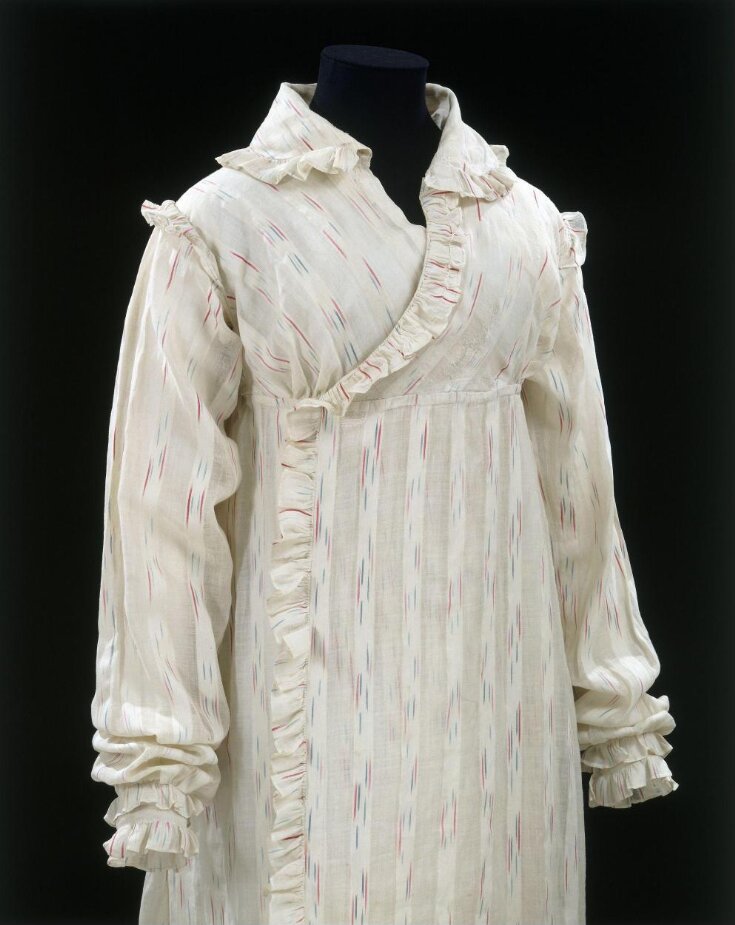

Peignoir
1812-1814 (made)
| Artist/Maker | |
| Place of origin |
The fabric used in this stylish wrap-over gown is an unusual example of Indian ikat, purposely made to attract the European market. Ikat is a Malay term for a complex tie-resist dyeing technique in which the warp (or the weft) threads are dyed to form the pattern before weaving. The soft and blurred transition between the different coloured parts of the pattern is created by the displacement of the threads while weaving. The gown has a round, slightly raised collar and it is adorned with gathered trimmings and narrow shoulder frills.
Object details
| Categories | |
| Object type | |
| Materials and techniques | Muslin dyed in the ikat technique |
| Brief description | Wrap-over gown of Indian ikat, in white with blue and red blurred warps. |
| Physical description | Wrap-over gown made of Indian ikat, with round, slightly raised collar, adorned with gathered trimmings and narrow shoulder frills. Excessively long sleeves with wristbands. Bodice only lined at the back with white cotton and excess of skirt gathered at back. Fastening bands at waist now missing. Length of skirt been adjusted at some point with a tuck around the hem. |
| Dimensions |
|
| Credit line | Given by Messrs Harrods Ltd. |
| Object history | Textile of Indian ikat was purposely made to attract the European market. |
| Production | The fabric is of Indian ikat |
| Summary | The fabric used in this stylish wrap-over gown is an unusual example of Indian ikat, purposely made to attract the European market. Ikat is a Malay term for a complex tie-resist dyeing technique in which the warp (or the weft) threads are dyed to form the pattern before weaving. The soft and blurred transition between the different coloured parts of the pattern is created by the displacement of the threads while weaving. The gown has a round, slightly raised collar and it is adorned with gathered trimmings and narrow shoulder frills. |
| Collection | |
| Accession number | T.798-1913 |
About this object record
Explore the Collections contains over a million catalogue records, and over half a million images. It is a working database that includes information compiled over the life of the museum. Some of our records may contain offensive and discriminatory language, or reflect outdated ideas, practice and analysis. We are committed to addressing these issues, and to review and update our records accordingly.
You can write to us to suggest improvements to the record.
Suggest feedback
You can write to us to suggest improvements to the record.
Suggest feedback
| Record created | July 29, 2005 |
| Record URL |
Download as: JSONIIIF Manifest
