Towel
1830-1870 (made)
| Artist/Maker | |
| Place of origin |
At the end of the 18th century embroidery designs began to develop into rigid and heavily stylised borders for towels and napkins. The colours of 18th and 19th century embroideries were originally very bright but many have faded to pleasing pastel shades; often great quantities of metal thread were used. Napkins were mainly used to clean fingers during meals, but were also used as decoration and as covers. Their designs were consistently inventive.
Object details
| Categories | |
| Object type | |
| Materials and techniques | Cotton, embroidered with silk in double darning, double running in a line and musabak, with metal thread in double darning, fishbone and slanted satin stitch, and with plate in fishbone and satin stitch; edging of needle lace along each end |
| Brief description | Cotton towel embroidered with silk and metal thread, Ottoman Turkey, 19th century |
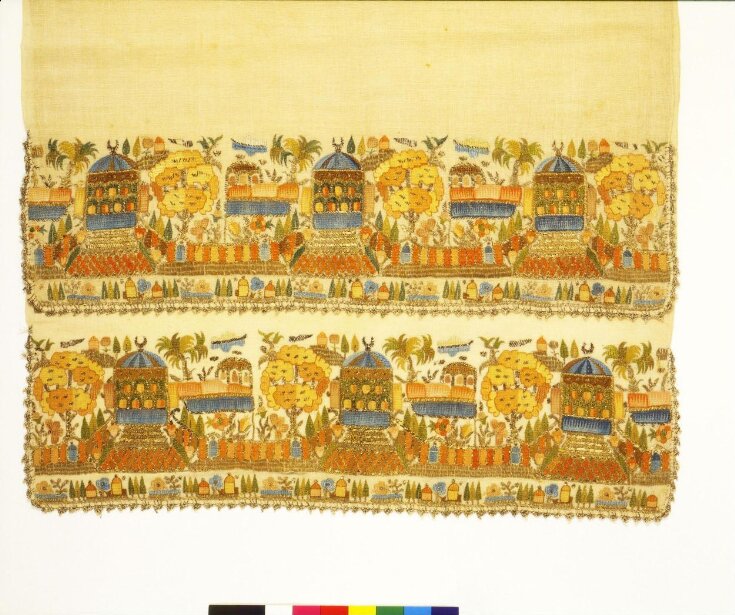
| Physical description | Towel/Napkin, cotton embroidered with silk in double darning, double running in a line and musabak stitch, and metal thread in double darning, fishbone and slanted satin stitch and in plate in fishbone and satin stitch. There is an edging of needlelace along the ends. There is a narrow border along both ends in which small domed buildings are nestled between cypress trees. The main border is decorated with a series of two-storey domed buildings in blue and pink in front of which is a walled or hedged garden enclosing small pointed bushes, flowers,a small pavillion, palm tree and blossom tree. |
| Dimensions |
|
| Style | |
| Gallery label | Jameel Gallery
7, 8 Embroidered napkins
Turkey
1830–70
Embroidery was a popular form of decoration in the Ottoman home. Items such as napkins were embroidered with great quantities of colourful silk and metal thread in inventive designs. Images of ornate houses and gardens (the ideal Ottoman home) were fashionable in the 19th century.
These napkins are embroidered with various stitches including muşabak, meaning ‘netted’, a type of openwork found only on Ottoman embroidery. This can be seen most clearly in the green walls of the buildings in the napkin on the left.
Cotton embroidered with silk and metal thread
Museum nos. T.458, 460-1950
Given by Prof. R.M. Dawkins
(20/09/2012) |
| Credit line | Given by Prof. R. M. Dawkins |
| Subjects depicted | |
| Summary | At the end of the 18th century embroidery designs began to develop into rigid and heavily stylised borders for towels and napkins. The colours of 18th and 19th century embroideries were originally very bright but many have faded to pleasing pastel shades; often great quantities of metal thread were used. Napkins were mainly used to clean fingers during meals, but were also used as decoration and as covers. Their designs were consistently inventive. |
| Bibliographic reference | Illustrated in 'Ottoman Embroidery' by Marianne Ellis and Jennifer Wearden (V&A Publication, 2001); plate 100 |
| Collection | |
| Accession number | T.458-1950 |
About this object record
Explore the Collections contains over a million catalogue records, and over half a million images. It is a working database that includes information compiled over the life of the museum. Some of our records may contain offensive and discriminatory language, or reflect outdated ideas, practice and analysis. We are committed to addressing these issues, and to review and update our records accordingly.
You can write to us to suggest improvements to the record.
Suggest feedback
You can write to us to suggest improvements to the record.
Suggest feedback
| Record created | June 24, 1999 |
| Record URL |
Download as: JSONIIIF Manifest
