Coffer
| Artist/Maker | |
| Place of origin |
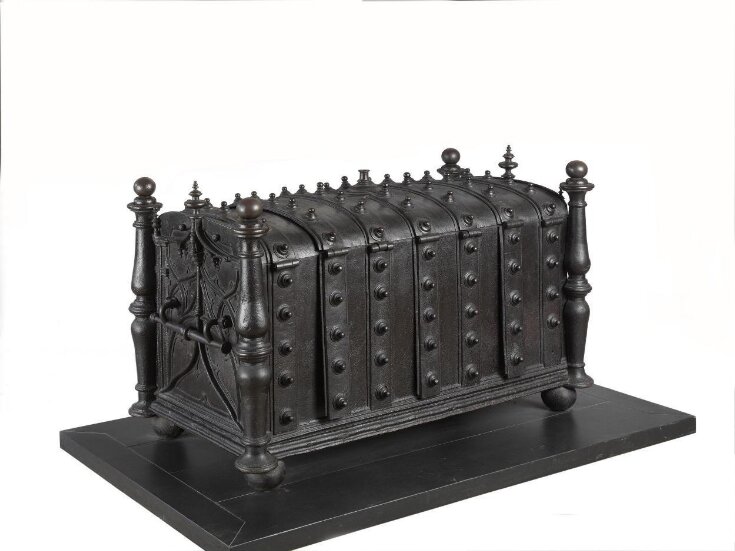
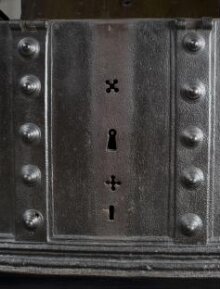
From the medieval period until around 1700, large chests for storage and seating were the commonest pieces of furniture in any household. Before the establishment of banks in the 17th century, chests had also to serve as safes, suitably reinforced with iron straps and formidable locks. This massive chest weighs around 200 kg. and is extremely sturdy. Its three separate locks suggest that it had three key-holders. To open it, a secret catch reveals a dummy hinge strap, revealing three keyholes, one of which releases a long internal bolt. A further level of security is provided by an internal safe.
Within the home, a large chest might store clothing and bedding, gold and silver plate and coinage. Institutions and churches also used chests to hold valuables, including documents and parish records.
Within the home, a large chest might store clothing and bedding, gold and silver plate and coinage. Institutions and churches also used chests to hold valuables, including documents and parish records.
Object details
| Categories | |
| Object type | |
| Parts | This object consists of 2 parts.
|
| Materials and techniques | Wrought iron |
| Brief description | Coffer, wrought iron, oblong with slightly domed hinged lid, Flanders, early 16th century |
| Physical description | Wrought iron chest, oblong with slightly domed hinged lid, a handle at each end within decorative Gothic style tracery and four ball feet. At each corner is a massive iron baluster. The body and lid are further strengthened by seven wide bands attached by moulded rivets. The real hinges along the back of the lid are matched by fake hinges along the front. The associated key is much later in date. |
| Dimensions |
|
| Marks and inscriptions | Unmarked |
| Gallery label |
|
| Object history | Bought in 1912 for £70 from a Mr E. de W. Holding, Corn Exchange, Northampton. Historical significance: This is a rare example of a Netherlandish chest made entirely from wrought iron. Large chests were usually made with a wooden carcase, reinforced with iron bands, locks and hinges. |
| Historical context | From the medieval period until around 1700, large chests for storage and seating were the commonest pieces of furniture in any household. Before the establishment of banks in the 17th century, chests had also to serve as safes, suitably reinforced with iron straps and formidable locks. Within the home, a large chest might store clothing and bedding, gold and silver plate and coinage. Institutions and churches also used chests to hold valuables, including documents and parish records. [Campbell, An Introduction to Ironwork, 1985, p. 46] Late medieval and 16th century Netherlandish and German ironworkers were famous for their elaborately designed lockwork and door furniture (hinges, escutcheon plates etc). The method of opening this chest is not immediately apparent, with fake hinges along the front of the lid cleverly concealing the opening. Northern European ironworkers continued to make objects in the late medieval Gothic style well into the 16th century. |
| Subject depicted | |
| Summary | From the medieval period until around 1700, large chests for storage and seating were the commonest pieces of furniture in any household. Before the establishment of banks in the 17th century, chests had also to serve as safes, suitably reinforced with iron straps and formidable locks. This massive chest weighs around 200 kg. and is extremely sturdy. Its three separate locks suggest that it had three key-holders. To open it, a secret catch reveals a dummy hinge strap, revealing three keyholes, one of which releases a long internal bolt. A further level of security is provided by an internal safe. Within the home, a large chest might store clothing and bedding, gold and silver plate and coinage. Institutions and churches also used chests to hold valuables, including documents and parish records. |
| Bibliographic references |
|
| Collection | |
| Accession number | M.295:1 to 2-1912 |
About this object record
Explore the Collections contains over a million catalogue records, and over half a million images. It is a working database that includes information compiled over the life of the museum. Some of our records may contain offensive and discriminatory language, or reflect outdated ideas, practice and analysis. We are committed to addressing these issues, and to review and update our records accordingly.
You can write to us to suggest improvements to the record.
Suggest feedback
You can write to us to suggest improvements to the record.
Suggest feedback
| Record created | June 30, 2005 |
| Record URL |
Download as: JSONIIIF Manifest
