
Armchair
1764-1765 (made), after 1765 (restored)
| Artist/Maker | |
| Place of origin |
Object Type
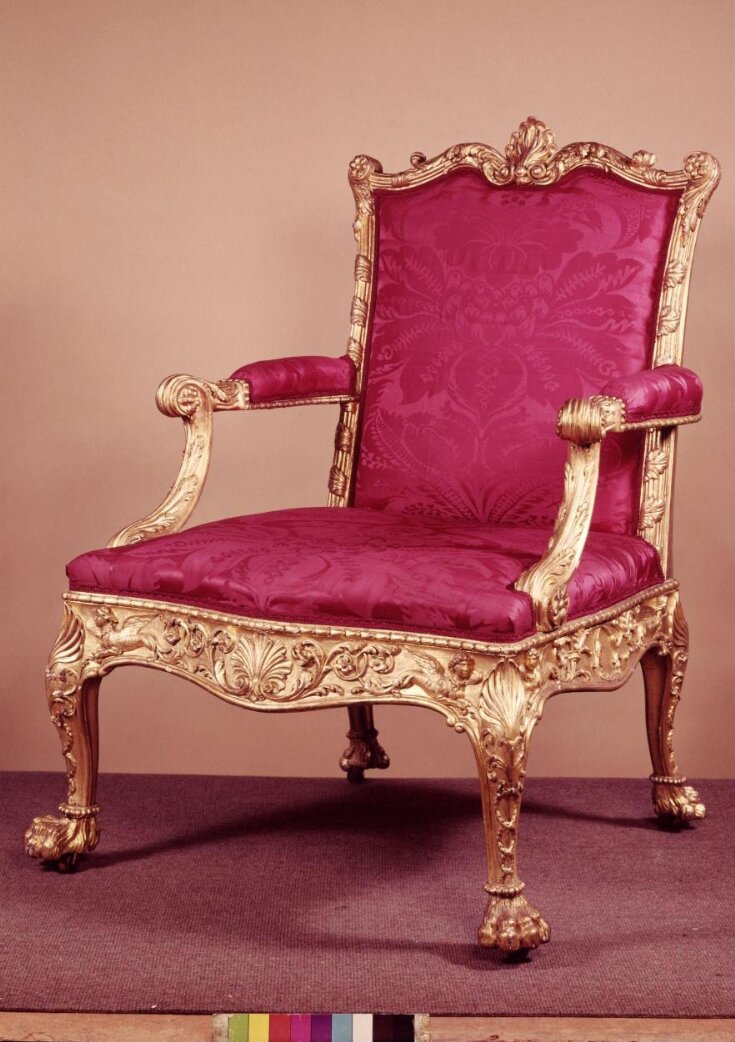
This chair was originally part of a set of eight armchairs and four sofas commissioned for the grandest room for entertaining in a great London house. As the most important seating furniture in the house, it was designed by the architect responsible for the alterations and decoration of the house, Robert Adam (1728-1792). The chair's legs have castors (small wheels), thus it could easily be moved into the required place for group conversation.
Design & Designing
Adam's watercolour design for one of the sofas is dated 1764 and preserved in Sir John Soane's Museum, London. The design - inscribed 'Sopha chairs for the Salon' - cost Sir Lawrence Dundas £5. It is the only example to survive of an Adam design on paper that was executed by Chippendale.
Materials & Making
The supplier, Thomas Chippendale (1718-1779), charged œ20 for each chair. His bill described the chairs as 'exceedingly Richly Carv'd in the Antick manner and Gilt in oil Gold Stuff'd and cover'd with your own Damask and strong Castors on the feet'. Dundas, who patronised both Chippendale and Adam on a number of occasions, provided the silk damask fabric for the top covers. The use of oil gold is curious. It was cheaper than water gilding, because it could not take burnishing. But it provided a more consistent appearance, since it did not result in contrasting matt and burnished areas, so characteristic of water gilding.
This chair was originally part of a set of eight armchairs and four sofas commissioned for the grandest room for entertaining in a great London house. As the most important seating furniture in the house, it was designed by the architect responsible for the alterations and decoration of the house, Robert Adam (1728-1792). The chair's legs have castors (small wheels), thus it could easily be moved into the required place for group conversation.
Design & Designing
Adam's watercolour design for one of the sofas is dated 1764 and preserved in Sir John Soane's Museum, London. The design - inscribed 'Sopha chairs for the Salon' - cost Sir Lawrence Dundas £5. It is the only example to survive of an Adam design on paper that was executed by Chippendale.
Materials & Making
The supplier, Thomas Chippendale (1718-1779), charged œ20 for each chair. His bill described the chairs as 'exceedingly Richly Carv'd in the Antick manner and Gilt in oil Gold Stuff'd and cover'd with your own Damask and strong Castors on the feet'. Dundas, who patronised both Chippendale and Adam on a number of occasions, provided the silk damask fabric for the top covers. The use of oil gold is curious. It was cheaper than water gilding, because it could not take burnishing. But it provided a more consistent appearance, since it did not result in contrasting matt and burnished areas, so characteristic of water gilding.
Object details
| Categories | |
| Object type | |
| Parts | This object consists of 2 parts.
|
| Materials and techniques | Gilded beechwood and walnut, with modern scarlet damask upholstery |
| Brief description | Armchair designed by Robert Adam for Sir Lawrence Dundas, made by Thomas Chippendale, gilded beechwood and walnut, upholstery not original, London, Britain, 1764-65. |
| Physical description | Armchair of gilded beechwood and walnut; scarlet damask upholstery modern. The chair is inscribed with a chisel on the front rail 'VII' indicating that it is number seven from a set of eight armchairs and four sofas for the Great Room at 19 Arlington Street. |
| Dimensions |
|
| Style | |
| Marks and inscriptions | 'VII' (The chair is inscribed with a chisel on the front rail.; inscribed) |
| Gallery label |
|
| Object history | Commissioned by Sir Lawrence Dundas, 1st Baronet. Sold Christie's 26 April 1934, lot .., from the collection of the Marquess of Zetland. The set was purchased by the collector Ronal Tree and later dispersed. Purchased January 1937 from Messrs Moss Harris & Sons, 44 New Oxford Street, London WC1 for £100 (Nominal File MA/1/H857, Harris M. Sons). At the time the Museum was planning to show its best Adam furniture under the newly acquired ceiling from the Adelphi (W.43-1936), and rightly considered that this would be a very significant addition to that group of objects. |
| Historical context | In the early days of Neo-classicism the style was often combined with earlier styles. While the decoration of this chair is Neo-classical, its overall form has the curved shapes of the earlier Rococo style, combined with a back taken from furniture in the Palladian style. Sir Lawrence Dundas was the son of an Edinburgh woollen-draper. Described by his contemporary, the writer James Boswell as a 'shrewd man of the world', Dundas made a fortune as merchant contractor to the army. He employed Robert Adam to redecorate the interiors of his London house in Arlington Street, and his country house, Moor Park in Hertfordshire. Other leading London furniture makers supplied furniture for these interiors. |
| Subjects depicted | |
| Summary | Object Type This chair was originally part of a set of eight armchairs and four sofas commissioned for the grandest room for entertaining in a great London house. As the most important seating furniture in the house, it was designed by the architect responsible for the alterations and decoration of the house, Robert Adam (1728-1792). The chair's legs have castors (small wheels), thus it could easily be moved into the required place for group conversation. Design & Designing Adam's watercolour design for one of the sofas is dated 1764 and preserved in Sir John Soane's Museum, London. The design - inscribed 'Sopha chairs for the Salon' - cost Sir Lawrence Dundas £5. It is the only example to survive of an Adam design on paper that was executed by Chippendale. Materials & Making The supplier, Thomas Chippendale (1718-1779), charged œ20 for each chair. His bill described the chairs as 'exceedingly Richly Carv'd in the Antick manner and Gilt in oil Gold Stuff'd and cover'd with your own Damask and strong Castors on the feet'. Dundas, who patronised both Chippendale and Adam on a number of occasions, provided the silk damask fabric for the top covers. The use of oil gold is curious. It was cheaper than water gilding, because it could not take burnishing. But it provided a more consistent appearance, since it did not result in contrasting matt and burnished areas, so characteristic of water gilding. |
| Bibliographic references |
|
| Collection | |
| Accession number | W.1-1937 |
About this object record
Explore the Collections contains over a million catalogue records, and over half a million images. It is a working database that includes information compiled over the life of the museum. Some of our records may contain offensive and discriminatory language, or reflect outdated ideas, practice and analysis. We are committed to addressing these issues, and to review and update our records accordingly.
You can write to us to suggest improvements to the record.
Suggest feedback
You can write to us to suggest improvements to the record.
Suggest feedback
| Record created | June 18, 1999 |
| Record URL |
Download as: JSONIIIF Manifest
