Teapot
ca. 1740 (made)
| Artist/Maker | |
| Place of origin |
Object Type
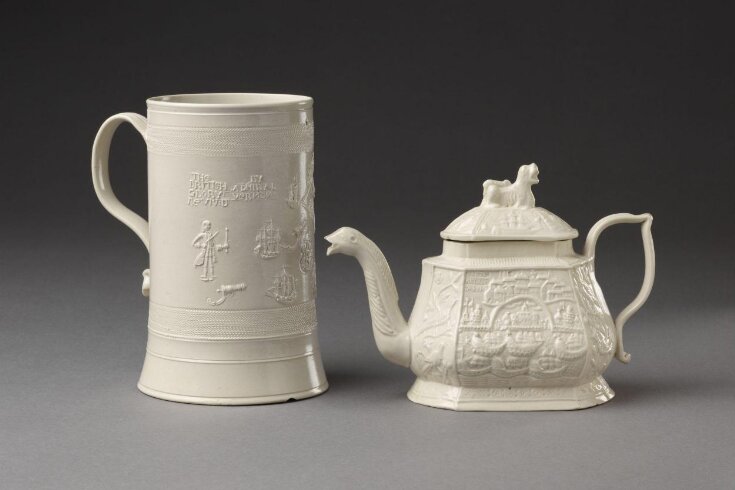
Teapots were invariably small during the first half of the 18th century, not because of technical limitations of the ceramic material but because of the very high price of tea and the common practice of re-filling teapots with boiling water. This example is typical of the innovative slip-cast ceramic teapots made in Staffordshire after about 1740.
Time
Friction caused by the Spanish searching British ships trading with the West Indies led to Admiral Edward Vernon's boast in 1739 that he could capture the heavily defended fort of Puerto Bello with six ships of the line. This he did on 20 November 1739. He went on to capture in March 1740 the port of Chagres in Panama, an important depot for the trans-shipment of gold and silver bullion from South America to Spain.
Vernon returned to Britain to a hero's welcome, and was remembered in the names of streets and public houses, as well as in commemorative Staffordshire pottery and in delftware. His victories came as a great boost to British morale, at a time when European politics were still seen in terms of the 'Protestant North' versus the 'Catholic South' (the Holy Roman Empire). This was probably the last naval engagement between Britain and Spain. It heralded a period of British expansion in the 1750s, during which India and Canada were added to the British empire at the expense of the French.
Teapots were invariably small during the first half of the 18th century, not because of technical limitations of the ceramic material but because of the very high price of tea and the common practice of re-filling teapots with boiling water. This example is typical of the innovative slip-cast ceramic teapots made in Staffordshire after about 1740.
Time
Friction caused by the Spanish searching British ships trading with the West Indies led to Admiral Edward Vernon's boast in 1739 that he could capture the heavily defended fort of Puerto Bello with six ships of the line. This he did on 20 November 1739. He went on to capture in March 1740 the port of Chagres in Panama, an important depot for the trans-shipment of gold and silver bullion from South America to Spain.
Vernon returned to Britain to a hero's welcome, and was remembered in the names of streets and public houses, as well as in commemorative Staffordshire pottery and in delftware. His victories came as a great boost to British morale, at a time when European politics were still seen in terms of the 'Protestant North' versus the 'Catholic South' (the Holy Roman Empire). This was probably the last naval engagement between Britain and Spain. It heralded a period of British expansion in the 1750s, during which India and Canada were added to the British empire at the expense of the French.
Object details
| Categories | |
| Object type | |
| Parts | This object consists of 2 parts.
|
| Materials and techniques | Salt-glazed and slip-cast white stoneware |
| Brief description | Teapot and cover of salt-glazed stoneware, maker unknown , probably made in Burslem, ca. 1740. |
| Physical description | Teapot and cover of salt-glazed stoneware with rouletted and sprigged decoration. |
| Dimensions |
|
| Gallery label | British Galleries:
The writer and collector Lady Charlotte Schreiber (1812-1895) enthusiastically described this teapot as 'very desirable, very ugly, and very dear' in her diary in 1884. She bought it for œ5 from Kerridge's shop in Great Portland Street, London.(27/03/2003) |
| Credit line | Given by Lady Charlotte Schreiber |
| Subjects depicted | |
| Summary | Object Type Teapots were invariably small during the first half of the 18th century, not because of technical limitations of the ceramic material but because of the very high price of tea and the common practice of re-filling teapots with boiling water. This example is typical of the innovative slip-cast ceramic teapots made in Staffordshire after about 1740. Time Friction caused by the Spanish searching British ships trading with the West Indies led to Admiral Edward Vernon's boast in 1739 that he could capture the heavily defended fort of Puerto Bello with six ships of the line. This he did on 20 November 1739. He went on to capture in March 1740 the port of Chagres in Panama, an important depot for the trans-shipment of gold and silver bullion from South America to Spain. Vernon returned to Britain to a hero's welcome, and was remembered in the names of streets and public houses, as well as in commemorative Staffordshire pottery and in delftware. His victories came as a great boost to British morale, at a time when European politics were still seen in terms of the 'Protestant North' versus the 'Catholic South' (the Holy Roman Empire). This was probably the last naval engagement between Britain and Spain. It heralded a period of British expansion in the 1750s, during which India and Canada were added to the British empire at the expense of the French. |
| Bibliographic reference | Hildyard, Robin. European Ceramics. London : V&A Publications, 1999. 144 p., ill. ISBN 185177260X |
| Other number | Sch. II 99&A - Schreiber number |
| Collection | |
| Accession number | 414:984/&A-1885 |
About this object record
Explore the Collections contains over a million catalogue records, and over half a million images. It is a working database that includes information compiled over the life of the museum. Some of our records may contain offensive and discriminatory language, or reflect outdated ideas, practice and analysis. We are committed to addressing these issues, and to review and update our records accordingly.
You can write to us to suggest improvements to the record.
Suggest feedback
You can write to us to suggest improvements to the record.
Suggest feedback
| Record created | June 17, 1999 |
| Record URL |
Download as: JSONIIIF Manifest
