Susannah and the Elders at the Well
Roundel
ca. 1520-1540 (made)
ca. 1520-1540 (made)
| Artist/Maker | |
| Place of origin |
The story of Susannah and the Elders forms the 13th chapter of the Book of Daniel in the Catholic Bible. The Protestant churches do not consider it canonical, and thus is not included in their Bible, although it did appear in the King James version of 1611.
Susannah was the righteous wife of Joachim of Babylon, a wealthy man. Joachim permitted the wise elders of the community to use his garden to meet and discuss the legal matters of the land. It was there that Susannah came to the notice of two elders, who hid in the garden until Susannah’s maids left to fetch her washing things. The elders threatened to accuse Susannah of adultery if she did not sleep with them. She chose not to sin and refused their advances, so the two elders denounced her in a public assembly. The assembly called for her death, for they did not believe that the elders could lie, because of their age and their position. Susannah prayed to God, who sent the wise young Daniel to arbitrate on her behalf. By separating the two elders and getting contradictory testimony during cross-examination, Daniel was able to
demonstrate that they had lied. The assembly then condemned the elders to death, and Susannah was exonerated.
This scene is often displayed in government-related contexts as a reminder to judge wisely and honestly.
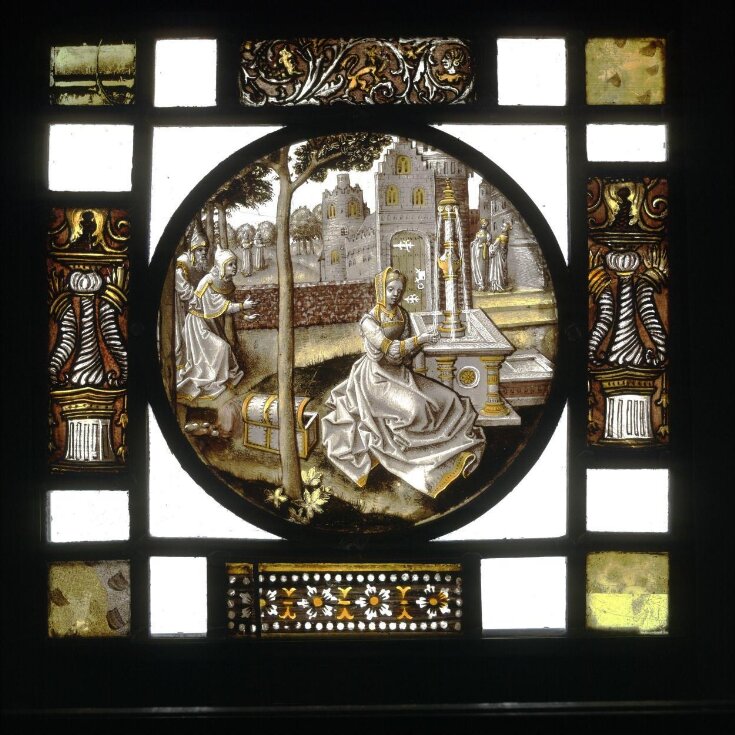
Susannah is depicted fully clothed, which is the medieval tradition. In Renaissance depictions, she is usually depicted naked.
Susannah was the righteous wife of Joachim of Babylon, a wealthy man. Joachim permitted the wise elders of the community to use his garden to meet and discuss the legal matters of the land. It was there that Susannah came to the notice of two elders, who hid in the garden until Susannah’s maids left to fetch her washing things. The elders threatened to accuse Susannah of adultery if she did not sleep with them. She chose not to sin and refused their advances, so the two elders denounced her in a public assembly. The assembly called for her death, for they did not believe that the elders could lie, because of their age and their position. Susannah prayed to God, who sent the wise young Daniel to arbitrate on her behalf. By separating the two elders and getting contradictory testimony during cross-examination, Daniel was able to
demonstrate that they had lied. The assembly then condemned the elders to death, and Susannah was exonerated.
This scene is often displayed in government-related contexts as a reminder to judge wisely and honestly.
Susannah is depicted fully clothed, which is the medieval tradition. In Renaissance depictions, she is usually depicted naked.
Object details
| Category | |
| Object type | |
| Title | Susannah and the Elders at the Well (generic title) |
| Materials and techniques | Stained glass with painted details |
| Brief description | Painted and stained glass roundel depicting Susannah and the Elders at the Well. Made in the Netherlands, c.1520-40. |
| Physical description | Susannah is seen in the foreground, off centre, sitting in front of a well, her right hand catching water spilling from the top of the fountain. To her left is an opened chest. Emerging from the left with hands raised towards Susannah are two elders in pointed headwear. Behind the main scene is a castellated townscape with two women in long gowns talking to each other in the back right. The whole roundel executed in black/brown pigment and yellow stain. |
| Dimensions |
|
| Credit line | Soulages Collection |
| Object history | Formerly in the Soulages collection. |
| Historical context | The story of Susannah and the Elders forms the 13th chapter of the Book of Daniel in the Catholic (Vulgate) Bible. It is considered non-canonical by the Protestant church and thus is not included in their Bible, although it did appear in the King James version in the early 16th century. Susannah was the notably righteous wife of Joachim of Babylon, a wealthy man. Joachim permitted his garden to be used by the wise elders of the community as a place where they could meet and discuss the legal matters of the land. It was there that Susannah came to the notice of two of these elders who hid in the garden until Susannah's two maids left to fetch her washing things. The elders threatened to expose Susannah, falsely, as an adulteress if she did not sleep with them. Susannah chose not to sin and refused their advances. The two elders denounced her in a public assembly. The assembly called for her death for they believed that the judges could never lie because of their age and their position. Susannah prayed to God who sent the wise young Daniel to arbitrate on her behalf. By separating the two elders and getting contradictory testimony during cross-examination, Daniel was able to demonstrate that they had lied. The assembly then called for the death of the elders which was carried out and Susannah was exonerated. This scene is often displayed in government-related contexts as a reminder to judge wisely and honestly. Susannah is depicted fully clothed which is the medieval tradition. In Renaissance depictions, she is depicted mostly naked. |
| Subjects depicted | |
| Literary references |
|
| Summary | The story of Susannah and the Elders forms the 13th chapter of the Book of Daniel in the Catholic Bible. The Protestant churches do not consider it canonical, and thus is not included in their Bible, although it did appear in the King James version of 1611. Susannah was the righteous wife of Joachim of Babylon, a wealthy man. Joachim permitted the wise elders of the community to use his garden to meet and discuss the legal matters of the land. It was there that Susannah came to the notice of two elders, who hid in the garden until Susannah’s maids left to fetch her washing things. The elders threatened to accuse Susannah of adultery if she did not sleep with them. She chose not to sin and refused their advances, so the two elders denounced her in a public assembly. The assembly called for her death, for they did not believe that the elders could lie, because of their age and their position. Susannah prayed to God, who sent the wise young Daniel to arbitrate on her behalf. By separating the two elders and getting contradictory testimony during cross-examination, Daniel was able to demonstrate that they had lied. The assembly then condemned the elders to death, and Susannah was exonerated. This scene is often displayed in government-related contexts as a reminder to judge wisely and honestly. Susannah is depicted fully clothed, which is the medieval tradition. In Renaissance depictions, she is usually depicted naked. |
| Bibliographic references |
|
| Collection | |
| Accession number | 5636-1859 |
About this object record
Explore the Collections contains over a million catalogue records, and over half a million images. It is a working database that includes information compiled over the life of the museum. Some of our records may contain offensive and discriminatory language, or reflect outdated ideas, practice and analysis. We are committed to addressing these issues, and to review and update our records accordingly.
You can write to us to suggest improvements to the record.
Suggest feedback
You can write to us to suggest improvements to the record.
Suggest feedback
| Record created | June 16, 1999 |
| Record URL |
Download as: JSONIIIF Manifest
