Christ in the House of Simon
Roundel
ca. 1520-1530 (made)
ca. 1520-1530 (made)
| Artist/Maker | |
| Place of origin |
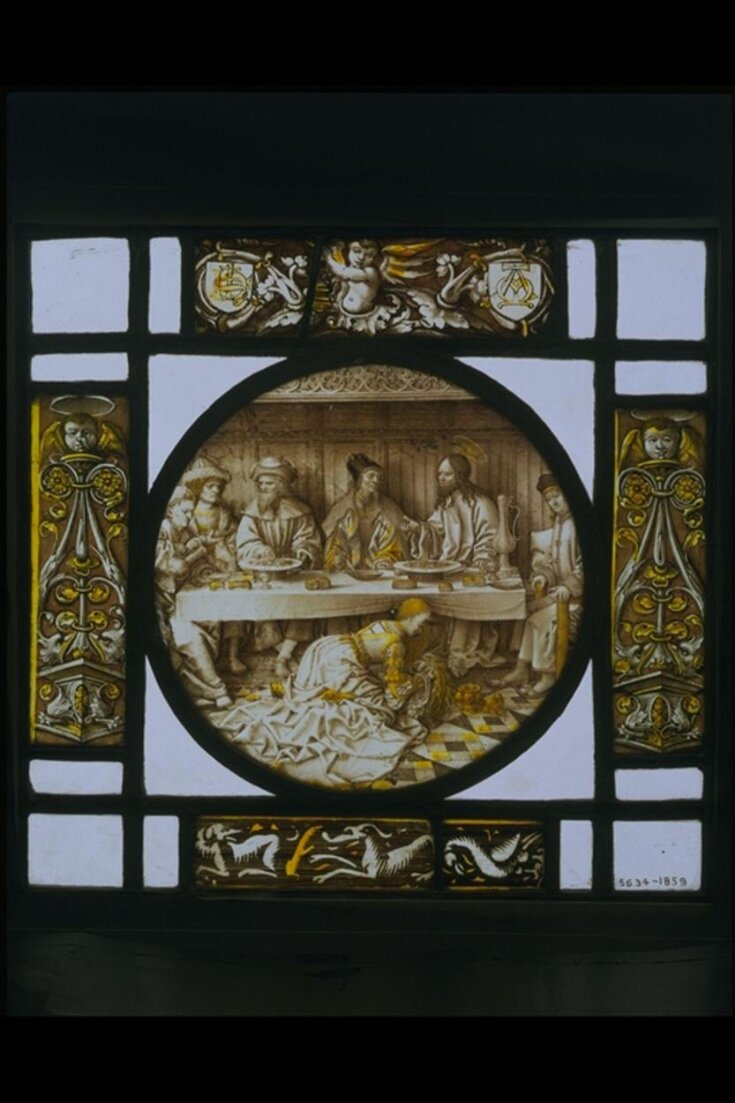
A sinful woman is seen kneeling in front of Jesus Christ at the table in the house of Simon the Pharisee. In the words of the Gospel of St Luke, she was 'washing his feet with her tears, and drying them with her hair, kissing his feet, and anointing them with the ointment' (Luke 7: 36-50).
Simon asks Christ why he allows such a woman to do this. Christ explains that the greatest repentant sinners were more deserving of forgiveness than those who had sinned and repented less. Christ is making his point forcefully to Simon, who sits next to him. A man at the end of the table on the right looks taken aback at the female penitent. Others partake of the feast.
Themes of charity and Christian forgiveness were commonplace in roundels. They provided moral exemplars for the domestic, civic or institutional viewer.
The imagery on this panel has often been confused with similar representations showing Mary Magdalene washing Christ's feet as he sat at table. But this refers to a different story related by the other Gospel writers, and Mary Magdalene is not described as a sinful woman.
Simon asks Christ why he allows such a woman to do this. Christ explains that the greatest repentant sinners were more deserving of forgiveness than those who had sinned and repented less. Christ is making his point forcefully to Simon, who sits next to him. A man at the end of the table on the right looks taken aback at the female penitent. Others partake of the feast.
Themes of charity and Christian forgiveness were commonplace in roundels. They provided moral exemplars for the domestic, civic or institutional viewer.
The imagery on this panel has often been confused with similar representations showing Mary Magdalene washing Christ's feet as he sat at table. But this refers to a different story related by the other Gospel writers, and Mary Magdalene is not described as a sinful woman.
Object details
| Categories | |
| Object type | |
| Title | Christ in the House of Simon (generic title) |
| Materials and techniques | Stained glass with painted details |
| Brief description | Stained and painted glass roundel, in a later setting, depicting Christ in the House of Simon. Made in the Netherlands, about 1520-30. |
| Physical description | Six men, including Christ, are seated behind and on the ends of a long trestle table. Christ is the figure with a halo seated second from the right. A woman in a luxurious gown kneels in the foreground. She is drying the feet of Christ with her hair. A multi-lobed ointment pot with the lid off lies on the chequered marble floor to her right. On the table is a range of metal dishes, salts and a large flagon. Behind the diners is a wall covered with linen-fold panelling. The whole executed in black/brown pigment and silver stain on clear glass. |
| Dimensions |
|
| Gallery label | Christ in the House of Simon
A prostitute - represented as St Mary Magdalene with an ointment jar - kneels in front of Christ, washing his feet with her tears, and drying them with her hair, kissing his feet, and anointing them with the ointment. Christ, meanwhile, explains to the Pharisee Simon that a sinful person is more in need of forgiveness than a good one.
Amsterdam or Leiden, the Netherlands, about 1520
Clear glass, with paint and silver stain; set in a modern square panel with borders
of later date.
Museum no.5634-1859((PW) 2004) |
| Credit line | Soulages Collection |
| Object history | Formerly in the Soulages Collection. |
| Historical context | The imagery on this panel has often been confused with similar representations showing Mary Magdalene washing Christ's feet as he sat at table. The panel here illustrates the story related by Luke when Christ was invited to a meal in the house of Simon the Pharisee in the city of Nain. The woman who came in to attend to Christ was described as a 'sinner'. Tradition ascribes the sin of adultery to her. The message related here is one of forgiveness of sins - the greater the sin, the greater the repentance. Although the details are confused, the other gospel writers record another story that has many similarities to the one by Luke but has a very different message to tell. In these, Christ and his disciples are in Bethany at Simon the Leper's house or at the house of Lazarus, brother of Martha and Mary Magdalene. In this story, Mary Magdalene washes and annoints Christ's feet with costly ointments. The disciples (especially Judas) object as the money could have been better spent on the poor. Christ informs them that 'the poor will always be with you but I shall not'. |
| Production | Painted by the same hand as 1015-1905 |
| Subjects depicted | |
| Literary references |
|
| Summary | A sinful woman is seen kneeling in front of Jesus Christ at the table in the house of Simon the Pharisee. In the words of the Gospel of St Luke, she was 'washing his feet with her tears, and drying them with her hair, kissing his feet, and anointing them with the ointment' (Luke 7: 36-50). Simon asks Christ why he allows such a woman to do this. Christ explains that the greatest repentant sinners were more deserving of forgiveness than those who had sinned and repented less. Christ is making his point forcefully to Simon, who sits next to him. A man at the end of the table on the right looks taken aback at the female penitent. Others partake of the feast. Themes of charity and Christian forgiveness were commonplace in roundels. They provided moral exemplars for the domestic, civic or institutional viewer. The imagery on this panel has often been confused with similar representations showing Mary Magdalene washing Christ's feet as he sat at table. But this refers to a different story related by the other Gospel writers, and Mary Magdalene is not described as a sinful woman. |
| Associated object | 1015-1905 (Object) |
| Bibliographic references |
|
| Collection | |
| Accession number | 5634-1859 |
About this object record
Explore the Collections contains over a million catalogue records, and over half a million images. It is a working database that includes information compiled over the life of the museum. Some of our records may contain offensive and discriminatory language, or reflect outdated ideas, practice and analysis. We are committed to addressing these issues, and to review and update our records accordingly.
You can write to us to suggest improvements to the record.
Suggest feedback
You can write to us to suggest improvements to the record.
Suggest feedback
| Record created | June 15, 1999 |
| Record URL |
Download as: JSONIIIF Manifest
