The Story of Sorgheloos
Roundel
ca. 1520 (made)
ca. 1520 (made)
| Artist/Maker | |
| Place of origin |
The tale of Sorgheloos is a secular version of the New Testament parable of the Prodigal Son (Luke 15: 11–32). This type of story stemmed from Morality Plays, which were sponsored by trade and professional guilds in towns throughout medieval Europe.
Although the Sorgheloos story was a popular one, few designs or roundels depicting it survive. There are several roundels in collections with the same images as the two in the Victoria and Albert Museum (Museum numbers: C.65 & 66-1929), but we do not know their design sources.
The story concerns a young man (Sorgheloos, or ‘Carefree’ in English) who squanders his fortune on gambling, loose woman and corrupt friends. When he becomes penniless, his friends desert him and he ends up destitute. So, unlike the parable related by St Luke, the story of Sorgheloos does not have a happy ending.
The other characters in the story are Weelde (Luxury), a woman; Gemack (Ease/Comfort), a male companion; Pouer (Poverty), a male beggar; Aermoede (Want), a woman; and Lichte Fortune (Fickle Fortune).
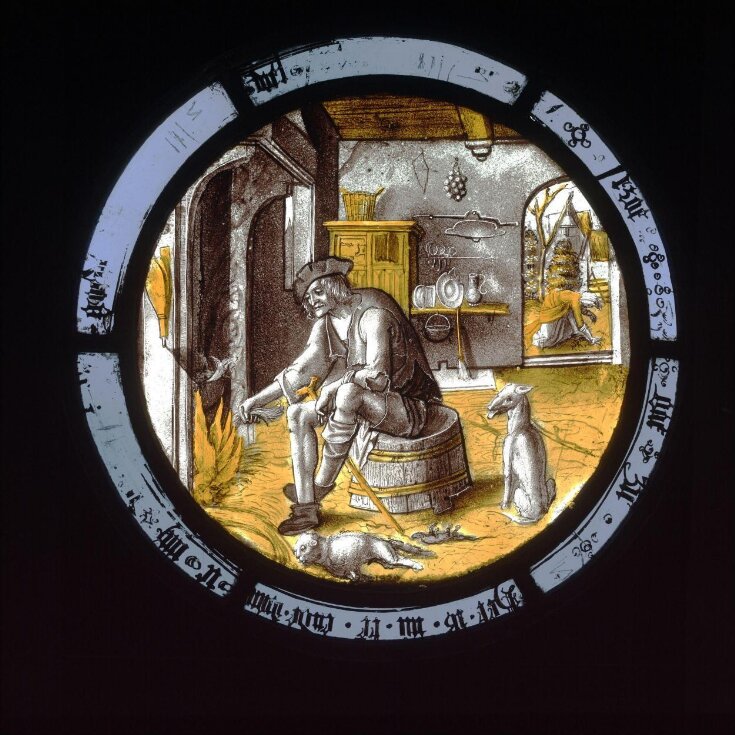
This roundel shows the final episode in the story. Penniless and alone, except for Aermoede, Sorgheloos sits in front of a fire with only grass to fuel it, cooking his fishtail supper. Aermoede is outside gathering straw.
Although the Sorgheloos story was a popular one, few designs or roundels depicting it survive. There are several roundels in collections with the same images as the two in the Victoria and Albert Museum (Museum numbers: C.65 & 66-1929), but we do not know their design sources.
The story concerns a young man (Sorgheloos, or ‘Carefree’ in English) who squanders his fortune on gambling, loose woman and corrupt friends. When he becomes penniless, his friends desert him and he ends up destitute. So, unlike the parable related by St Luke, the story of Sorgheloos does not have a happy ending.
The other characters in the story are Weelde (Luxury), a woman; Gemack (Ease/Comfort), a male companion; Pouer (Poverty), a male beggar; Aermoede (Want), a woman; and Lichte Fortune (Fickle Fortune).
This roundel shows the final episode in the story. Penniless and alone, except for Aermoede, Sorgheloos sits in front of a fire with only grass to fuel it, cooking his fishtail supper. Aermoede is outside gathering straw.
Object details
| Categories | |
| Object type | |
| Title | The Story of Sorgheloos (generic title) |
| Materials and techniques | Clear glass with painted details and yellow (silver) stain |
| Brief description | Stained and painted glass roundel depicting an episode in the story of Sorgheloos ('Sorgheloos in Poverty'). Made in the Netherlands, c.1520. |
| Physical description | In the centre of the roundel a man is seated on an up-turned banded wooden barrel. He is wearing ragged shorts and he has only one stocking (on his left leg). He is wearing a ragged shirt, torn at one elbow, over which is a waistcoat. He is wearing what appears to be a felt hat. He is in a stone cottage with a wooden ceiling and sits in front of a fire which is in a large stone fireplace. He is putting straw onto the fire. There is a stewpot in the fire with a fish tail hanging out of it. A dog sits behind him panting while a cat and a rat, possibly dead, lie at his feet. A bellows hangs on the side of the fireplace. On the back wall there is a storage cupboard which is next to some open shelving. There is a jug, some dishes and some cutlery or cooking implements on the shelves. The jug and dishes appear to be made of pewter. In the back right of the roundel a door opens onto a yard and there can be seen a woman bending down gathering grass. The whole executed in brown/black pigment and silver stain and set in a border of blue glass with a painted inscription: Het is nu te ende wan ic mij...goede...[in nu] wel...serve got zie |
| Dimensions |
|
| Marks and inscriptions | Het is nu te ende wan ic mij...goede...[in nu] wel...serve got zie (On border) |
| Gallery label | TWO SCENES FROM THE STORY OF SORGHELOOS
The cautionary tale of Sorgheloos ('Carefree' or 'Reckless') is a version of the parable of the Prodigal Son, illustrating the consequences of dissolute living. These roundels show the two final scenes of a larger cycle. In the first, Sorgheloos is shown carrying Aermoede ('Indigence') and being rejected by his former friends and relatives. In the second, the once-wealthy Sorgheloos' final fate is revealed: shivering before a feeble fire in a run-down hovel.
North Netherlands, about 1520
Museum nos. C.65-1929 (Sorgheloos in Poverty), C.66-1929 (Sorgheloos and Aermoede)((PW) 2004) |
| Object history | Purchased from Wilfrid Drake from a sale at Sotheby's. |
| Historical context | The tale of Sorgheloos is a secular version of the Biblical story of the Prodigal Son (Luke 15: 11-32). This type of story will have stemmed from the Morality plays sponsored by the trade and professional guilds of the towns throughout Medieval Europe. Although the Sorgheloos story was a popular one, not many designs or roundels depicting the story survive. There are several roundels in collections that have the same images as the two V&A ones (C.65 & 66-1929) but their design sources have not been identified. The story concerns a young man (Sorgheloos or Carefree in English) who squanders his fortune on gambling, loose woman and corrupt friends. When he becomes penniless, his friends desert him and he ends up destitute. So, unlike the parable related by St. Luke, the story of Sorgheloos does not have a happy ending. The characters in the story are Sorgheloos, Weelde (Luxury) - a woman, Gemack (Ease/Comfort), Pouer (Poverty), Aermoede (Wordly Pleasure) - a woman, and Lichte Fortune (Fickle Fortune). This roundel shows the final episode in the story of Sorgheloos. Penniless and alone, except for Aermoede, he sits in front of a fire with nothing but grass to fuel it to cook his fishtail supper. Aermoede is outside gathering straw. |
| Production | North Lowlands |
| Subjects depicted | |
| Summary | The tale of Sorgheloos is a secular version of the New Testament parable of the Prodigal Son (Luke 15: 11–32). This type of story stemmed from Morality Plays, which were sponsored by trade and professional guilds in towns throughout medieval Europe. Although the Sorgheloos story was a popular one, few designs or roundels depicting it survive. There are several roundels in collections with the same images as the two in the Victoria and Albert Museum (Museum numbers: C.65 & 66-1929), but we do not know their design sources. The story concerns a young man (Sorgheloos, or ‘Carefree’ in English) who squanders his fortune on gambling, loose woman and corrupt friends. When he becomes penniless, his friends desert him and he ends up destitute. So, unlike the parable related by St Luke, the story of Sorgheloos does not have a happy ending. The other characters in the story are Weelde (Luxury), a woman; Gemack (Ease/Comfort), a male companion; Pouer (Poverty), a male beggar; Aermoede (Want), a woman; and Lichte Fortune (Fickle Fortune). This roundel shows the final episode in the story. Penniless and alone, except for Aermoede, Sorgheloos sits in front of a fire with only grass to fuel it, cooking his fishtail supper. Aermoede is outside gathering straw. |
| Associated object | |
| Bibliographic references |
|
| Collection | |
| Accession number | C.65-1929 |
About this object record
Explore the Collections contains over a million catalogue records, and over half a million images. It is a working database that includes information compiled over the life of the museum. Some of our records may contain offensive and discriminatory language, or reflect outdated ideas, practice and analysis. We are committed to addressing these issues, and to review and update our records accordingly.
You can write to us to suggest improvements to the record.
Suggest feedback
You can write to us to suggest improvements to the record.
Suggest feedback
| Record created | June 15, 1999 |
| Record URL |
Download as: JSONIIIF Manifest
