Pier Table
ca. 1745 (made)
| Artist/Maker | |
| Place of origin |
Object Type
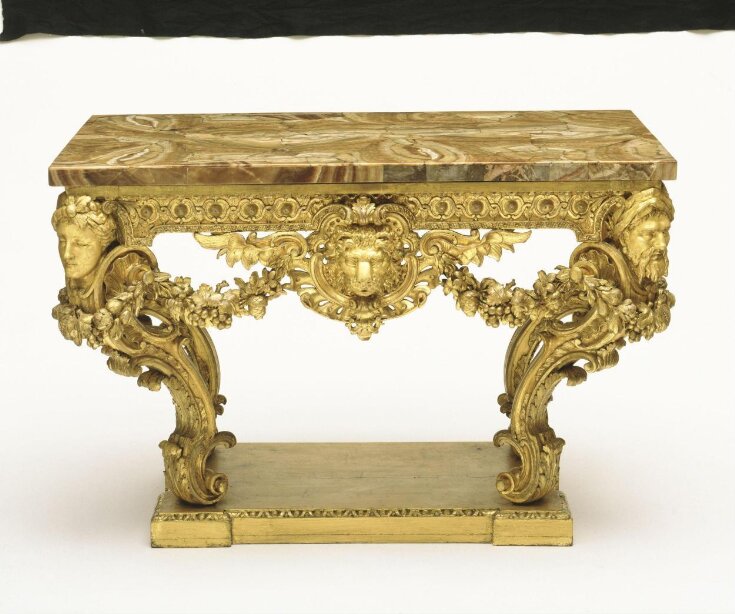
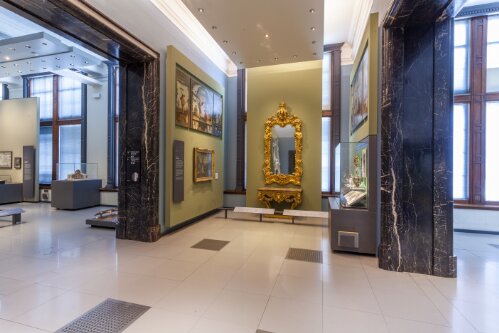
From the late 17th century, side tables were designed for the pier wall separating two windows. They were often matched with a mirror and a pair of candlestands, as here. Carved and gilded pier furniture was often made to match other interior decorative features.
Place
The rustic caryatids (supports in the form of sculptured figures) which carry the table top match those flanking the mirror, and may have been inspired by the borders of the 16th-century Brussels tapestries illustrating the 'Story of Cyrus'. These hung in the Tapestry Room at Hinton House in Hampshire. Their borders were embellished with caryatids, allegorical figures and groups of birds.
Design & Designing
Like the matching mirror, the table design was also inspired by French prints in books of designs, such as J.B. Toro's Livre de Table de diverses formes of about 1716 and Nicholas Pineau's Nouveau desseins de Pieds de Tables (1737). Pineau's designs were reissued in London by William Jones in The Gentlemens' and Builders' Companion (1739) and by Batty Langley in The City and Country Builder's and Workman's Treasury of Designs (1740). Matthias Lock (born about 1710; died 1765) understood the Rococo idiom (a style imported from France) more fully than any other English furniture designer.
Materials & Making
Lock worked on the table for 15 days, and was probably responsible for the carving, which cost £21. The joiner's costs came to £22 5s 5d.
From the late 17th century, side tables were designed for the pier wall separating two windows. They were often matched with a mirror and a pair of candlestands, as here. Carved and gilded pier furniture was often made to match other interior decorative features.
Place
The rustic caryatids (supports in the form of sculptured figures) which carry the table top match those flanking the mirror, and may have been inspired by the borders of the 16th-century Brussels tapestries illustrating the 'Story of Cyrus'. These hung in the Tapestry Room at Hinton House in Hampshire. Their borders were embellished with caryatids, allegorical figures and groups of birds.
Design & Designing
Like the matching mirror, the table design was also inspired by French prints in books of designs, such as J.B. Toro's Livre de Table de diverses formes of about 1716 and Nicholas Pineau's Nouveau desseins de Pieds de Tables (1737). Pineau's designs were reissued in London by William Jones in The Gentlemens' and Builders' Companion (1739) and by Batty Langley in The City and Country Builder's and Workman's Treasury of Designs (1740). Matthias Lock (born about 1710; died 1765) understood the Rococo idiom (a style imported from France) more fully than any other English furniture designer.
Materials & Making
Lock worked on the table for 15 days, and was probably responsible for the carving, which cost £21. The joiner's costs came to £22 5s 5d.
Object details
| Categories | |
| Object type | |
| Parts | This object consists of 2 parts.
|
| Materials and techniques | Gilded pine, with agate veneered slab |
| Brief description | Side table from Tapestry Room at Hinton House, designed by Matthias Lock, carved, bronzed and gilded, the slab top veneered with onyx, Britain, ca.1745. |
| Physical description | Side table, carved, bronzed and gilded, the slab top veneered with onyx. Gilt pine possibly with agate veneered slab. The supporting rectangular frame has a guilloche and feather frieze with a central winged lion mask cartouche. The frame is supported on four acanthus scroll legs which curve inwards to the base plinth. The front legs are formed of rustic caryatid/atlantes figures (matching those on the accompanying mirror - W.8-1960) which are connected to the central lion mask by a fruit and flower festoon. Analysis of paint and gilding layer stratification on this table and the pier glass, W.8-1960, carried out by Pascale Patris, Metropolitan Museum of Art, New York, December 2003; report in curatorial file for W.8-1960 |
| Dimensions |
|
| Gallery label |
|
| Credit line | Given by Mrs F. E. Rhodes |
| Object history | Designed and made in London by Matthias Lock (born in London, about 1710, died there in 1765) |
| Subjects depicted | |
| Summary | Object Type From the late 17th century, side tables were designed for the pier wall separating two windows. They were often matched with a mirror and a pair of candlestands, as here. Carved and gilded pier furniture was often made to match other interior decorative features. Place The rustic caryatids (supports in the form of sculptured figures) which carry the table top match those flanking the mirror, and may have been inspired by the borders of the 16th-century Brussels tapestries illustrating the 'Story of Cyrus'. These hung in the Tapestry Room at Hinton House in Hampshire. Their borders were embellished with caryatids, allegorical figures and groups of birds. Design & Designing Like the matching mirror, the table design was also inspired by French prints in books of designs, such as J.B. Toro's Livre de Table de diverses formes of about 1716 and Nicholas Pineau's Nouveau desseins de Pieds de Tables (1737). Pineau's designs were reissued in London by William Jones in The Gentlemens' and Builders' Companion (1739) and by Batty Langley in The City and Country Builder's and Workman's Treasury of Designs (1740). Matthias Lock (born about 1710; died 1765) understood the Rococo idiom (a style imported from France) more fully than any other English furniture designer. Materials & Making Lock worked on the table for 15 days, and was probably responsible for the carving, which cost £21. The joiner's costs came to £22 5s 5d. |
| Collection | |
| Accession number | W.35:1, 2-1964 |
About this object record
Explore the Collections contains over a million catalogue records, and over half a million images. It is a working database that includes information compiled over the life of the museum. Some of our records may contain offensive and discriminatory language, or reflect outdated ideas, practice and analysis. We are committed to addressing these issues, and to review and update our records accordingly.
You can write to us to suggest improvements to the record.
Suggest feedback
You can write to us to suggest improvements to the record.
Suggest feedback
| Record created | June 10, 1999 |
| Record URL |
Download as: JSONIIIF Manifest
