
Vase and Cover
ca. 1850 (made)
| Artist/Maker | |
| Place of origin |
Object Type
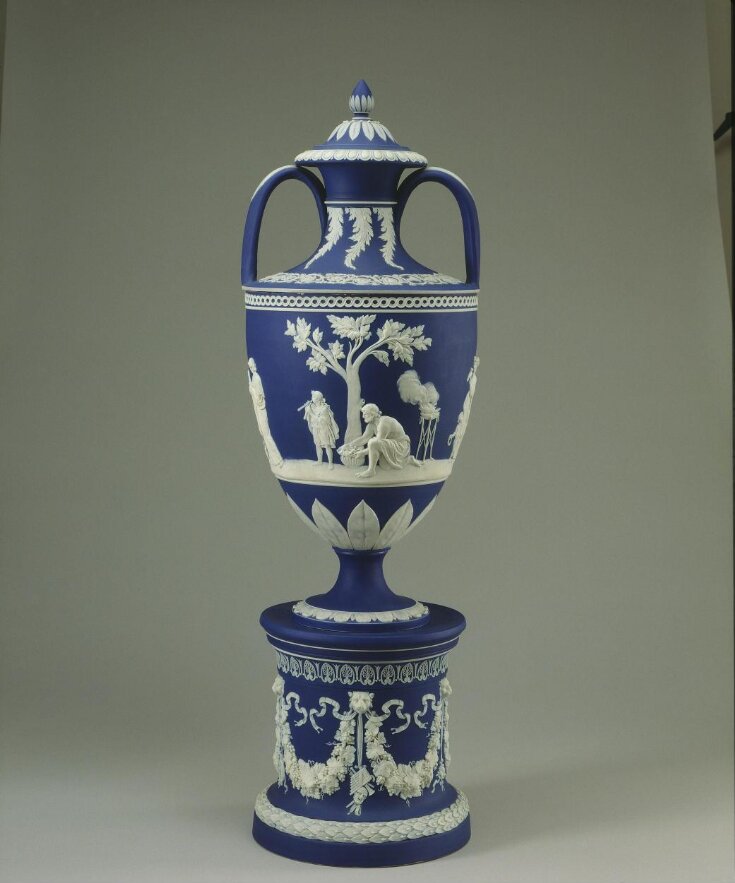
This tall vase and pedestal are very much in the manner of the Wedgwood factory's neo-classical-style jasper ware. They are not, however,made with the traditional solid jasper body stained blue, but from ordinary stoneware, coated with a dip of blue jasper.
Materials & Making
Jasper was a dense white stoneware stained in a wide choice of colours. It was invented by Josiah Wedgwood in the 1770s. It took him over 5000 experiments, lasting several years, to perfect his method and he then used it to produce a large variety of vessels as well as plaques and even jewellery. Strangely, at the beginning of the 19th century, for various reasons, the factory apparently lost the ability to make large objects from jasper. There is no record of jasper vase production between 1817 and 1845, and those vases which were made in the first half of the century, such as this one, were just dipped in jasper. In 1860, after about fifteen years of experiment, the solid jasper body was reintroduced into general production.
Subject Depicted
The scene on the vase represents a Sacrifice to Cupid 'from the antique' according to the catalogue of the Great Exhibition. On one side, a priest follows a man with an axe over his shoulder who leads a bull to Cupid's temple. On the other side , a boy plays a double flute while a kneeling man gathers fruit in a basket. Behind them is a brazier and a child with a garland.
This tall vase and pedestal are very much in the manner of the Wedgwood factory's neo-classical-style jasper ware. They are not, however,made with the traditional solid jasper body stained blue, but from ordinary stoneware, coated with a dip of blue jasper.
Materials & Making
Jasper was a dense white stoneware stained in a wide choice of colours. It was invented by Josiah Wedgwood in the 1770s. It took him over 5000 experiments, lasting several years, to perfect his method and he then used it to produce a large variety of vessels as well as plaques and even jewellery. Strangely, at the beginning of the 19th century, for various reasons, the factory apparently lost the ability to make large objects from jasper. There is no record of jasper vase production between 1817 and 1845, and those vases which were made in the first half of the century, such as this one, were just dipped in jasper. In 1860, after about fifteen years of experiment, the solid jasper body was reintroduced into general production.
Subject Depicted
The scene on the vase represents a Sacrifice to Cupid 'from the antique' according to the catalogue of the Great Exhibition. On one side, a priest follows a man with an axe over his shoulder who leads a bull to Cupid's temple. On the other side , a boy plays a double flute while a kneeling man gathers fruit in a basket. Behind them is a brazier and a child with a garland.
Object details
| Categories | |
| Object type | |
| Parts | This object consists of 4 parts.
|
| Materials and techniques | Blue Jasper dip, with white cameo decoration |
| Brief description | Large Wedgwood vase and cover with pedestal and base, blue Jasper dip ware with white cameo decoration, Etruria, Staffordshire, ca. 1850 |
| Dimensions |
|
| Marks and inscriptions | 'WEDGWOOD' (Impressed) |
| Gallery label | British Galleries:
Josiah Wedgwood & Sons had been making jasperware since the 18th century and it was one of their most famous products. The jury awarded a prize medal to this piece on the basis that the beauty of their designs 'has never since been surpassed or equalled'.(27/03/2003) |
| Credit line | Transferred from the Museum of Practical Geology, Jermyn Street |
| Object history | Obtained from the Great Exhibition of 1851. Transferred from the Museum of Practical Geology, Jermyn Street. |
| Subjects depicted | |
| Association | |
| Summary | Object Type This tall vase and pedestal are very much in the manner of the Wedgwood factory's neo-classical-style jasper ware. They are not, however,made with the traditional solid jasper body stained blue, but from ordinary stoneware, coated with a dip of blue jasper. Materials & Making Jasper was a dense white stoneware stained in a wide choice of colours. It was invented by Josiah Wedgwood in the 1770s. It took him over 5000 experiments, lasting several years, to perfect his method and he then used it to produce a large variety of vessels as well as plaques and even jewellery. Strangely, at the beginning of the 19th century, for various reasons, the factory apparently lost the ability to make large objects from jasper. There is no record of jasper vase production between 1817 and 1845, and those vases which were made in the first half of the century, such as this one, were just dipped in jasper. In 1860, after about fifteen years of experiment, the solid jasper body was reintroduced into general production. Subject Depicted The scene on the vase represents a Sacrifice to Cupid 'from the antique' according to the catalogue of the Great Exhibition. On one side, a priest follows a man with an axe over his shoulder who leads a bull to Cupid's temple. On the other side , a boy plays a double flute while a kneeling man gathers fruit in a basket. Behind them is a brazier and a child with a garland. |
| Collection | |
| Accession number | 2793 to C-1901 |
About this object record
Explore the Collections contains over a million catalogue records, and over half a million images. It is a working database that includes information compiled over the life of the museum. Some of our records may contain offensive and discriminatory language, or reflect outdated ideas, practice and analysis. We are committed to addressing these issues, and to review and update our records accordingly.
You can write to us to suggest improvements to the record.
Suggest feedback
You can write to us to suggest improvements to the record.
Suggest feedback
| Record created | May 25, 1999 |
| Record URL |
Download as: JSONIIIF Manifest
