
Ewer
ca. 1850 (made)
| Artist/Maker | |
| Place of origin |
Object Type
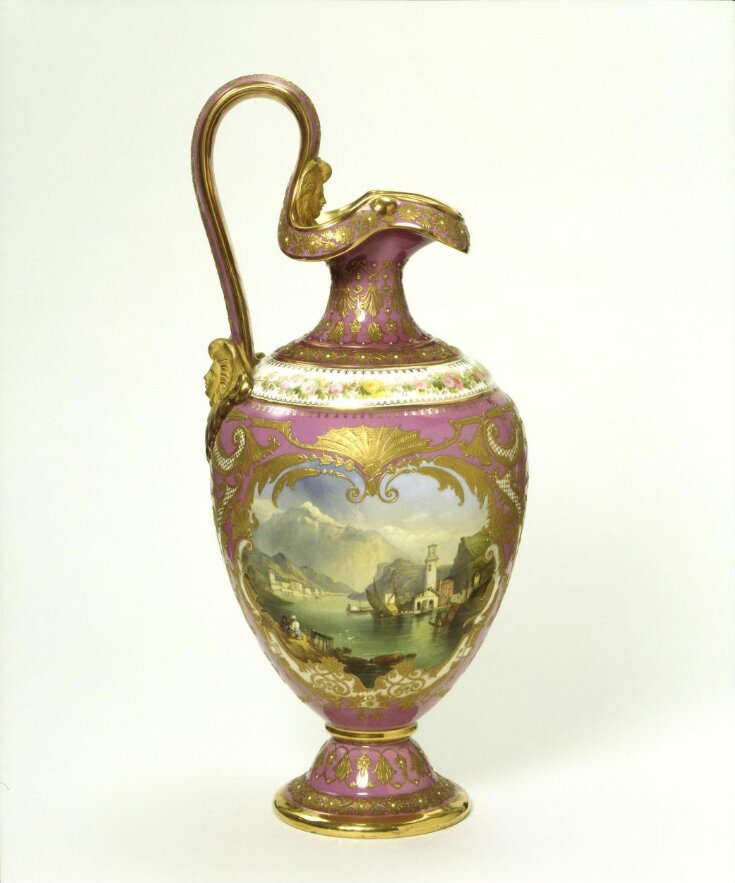
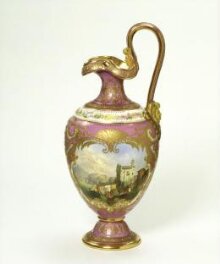
This ornate ewer was intended primarily for display and also served as a vehicle for Copeland to show off the skill of his decorators. The classical shape is reminiscent of French Renaissance forms. Different views of Italian lakeside scenery are painted on each side.
People
The firm of W.T. Copeland was awarded a prize medal for the 'general excellence' of its porcelain at the Great Exhibition. Daniel Lucas senior (1788-1867) painted landscapes, particularly for the Derby porcelain factory. His youngest son, also Daniel (born about 1818), who had been apprenticed at Derby, also became a scenic painter on china. He worked for periods at the Coalport and Copeland factories, and later became a freelance artist.
Places
Although this particular object does not appear in the catalogue illustrations of Copeland's exhibits at the Great Exhibition, a vase with similar gilt ornamentation and with scenes similar to the paintings of the French artist Watteau (1684-1721) is shown. For the next 50 years the ewer was in the collection of the Museum of Practical Geology, Jermyn Street, London, before being transferred with many other items to the Victoria and Albert Museum in 1901. It is listed in an 1855 catalogue of pottery and porcelain as 'a single-handled porcelain vase, gilt and painted with landscapes. The ground was in a colour called 'Queen's'.
This ornate ewer was intended primarily for display and also served as a vehicle for Copeland to show off the skill of his decorators. The classical shape is reminiscent of French Renaissance forms. Different views of Italian lakeside scenery are painted on each side.
People
The firm of W.T. Copeland was awarded a prize medal for the 'general excellence' of its porcelain at the Great Exhibition. Daniel Lucas senior (1788-1867) painted landscapes, particularly for the Derby porcelain factory. His youngest son, also Daniel (born about 1818), who had been apprenticed at Derby, also became a scenic painter on china. He worked for periods at the Coalport and Copeland factories, and later became a freelance artist.
Places
Although this particular object does not appear in the catalogue illustrations of Copeland's exhibits at the Great Exhibition, a vase with similar gilt ornamentation and with scenes similar to the paintings of the French artist Watteau (1684-1721) is shown. For the next 50 years the ewer was in the collection of the Museum of Practical Geology, Jermyn Street, London, before being transferred with many other items to the Victoria and Albert Museum in 1901. It is listed in an 1855 catalogue of pottery and porcelain as 'a single-handled porcelain vase, gilt and painted with landscapes. The ground was in a colour called 'Queen's'.
Object details
| Categories | |
| Object type | |
| Materials and techniques | Porcelain, painted in enamels and gilded |
| Brief description | Ewer of porcelain, painted in enamels and gilded, the scenic panels painted by Daniel Lucas junor, made by Copeland & Co., Stoke-on-Trent, ca. 1850 |
| Physical description | Ewer of porcelain. Oenochoe-shaped. Decorated on either side of the body with an Italian lake-scene, in a panel outlined by gilt scrolls and reserved on a lilac-coloured ground. round the shoulder is a wreath of flowers in colours on a white band. The remaining surface is covered with conventional ornament in gold and enamel. The handle has a gilt female mask in relief at either end. |
| Dimensions |
|
| Marks and inscriptions | Double 'C' and 'COPELAND' (Printed in green) |
| Gallery label | British Galleries:
Copeland & Co. showed many elaborately decorated pieces at the Exhibition. The ancient Greek shape of this jug is combined with rich decoration which is based on the style of the French SŠvres porcelain factory. The pink ground colour, finely-detailed gilt decoration and detailed landscape painting enclosed within a panel were typical of the fashionable French Style.(27/03/2003) |
| Credit line | Transferred from the Museum of Practical Geology, Jermyn Street |
| Object history | Made by Copeland & Co., Stoke-on-Trent, Staffordshire; the scenic panel painted by Daniel Lucas jnr. |
| Subjects depicted | |
| Summary | Object Type This ornate ewer was intended primarily for display and also served as a vehicle for Copeland to show off the skill of his decorators. The classical shape is reminiscent of French Renaissance forms. Different views of Italian lakeside scenery are painted on each side. People The firm of W.T. Copeland was awarded a prize medal for the 'general excellence' of its porcelain at the Great Exhibition. Daniel Lucas senior (1788-1867) painted landscapes, particularly for the Derby porcelain factory. His youngest son, also Daniel (born about 1818), who had been apprenticed at Derby, also became a scenic painter on china. He worked for periods at the Coalport and Copeland factories, and later became a freelance artist. Places Although this particular object does not appear in the catalogue illustrations of Copeland's exhibits at the Great Exhibition, a vase with similar gilt ornamentation and with scenes similar to the paintings of the French artist Watteau (1684-1721) is shown. For the next 50 years the ewer was in the collection of the Museum of Practical Geology, Jermyn Street, London, before being transferred with many other items to the Victoria and Albert Museum in 1901. It is listed in an 1855 catalogue of pottery and porcelain as 'a single-handled porcelain vase, gilt and painted with landscapes. The ground was in a colour called 'Queen's'. |
| Collection | |
| Accession number | 2775-1901 |
About this object record
Explore the Collections contains over a million catalogue records, and over half a million images. It is a working database that includes information compiled over the life of the museum. Some of our records may contain offensive and discriminatory language, or reflect outdated ideas, practice and analysis. We are committed to addressing these issues, and to review and update our records accordingly.
You can write to us to suggest improvements to the record.
Suggest feedback
You can write to us to suggest improvements to the record.
Suggest feedback
| Record created | May 25, 1999 |
| Record URL |
Download as: JSONIIIF Manifest
