
Rebozo
1875-1890 (made)
| Artist/Maker | |
| Place of origin |
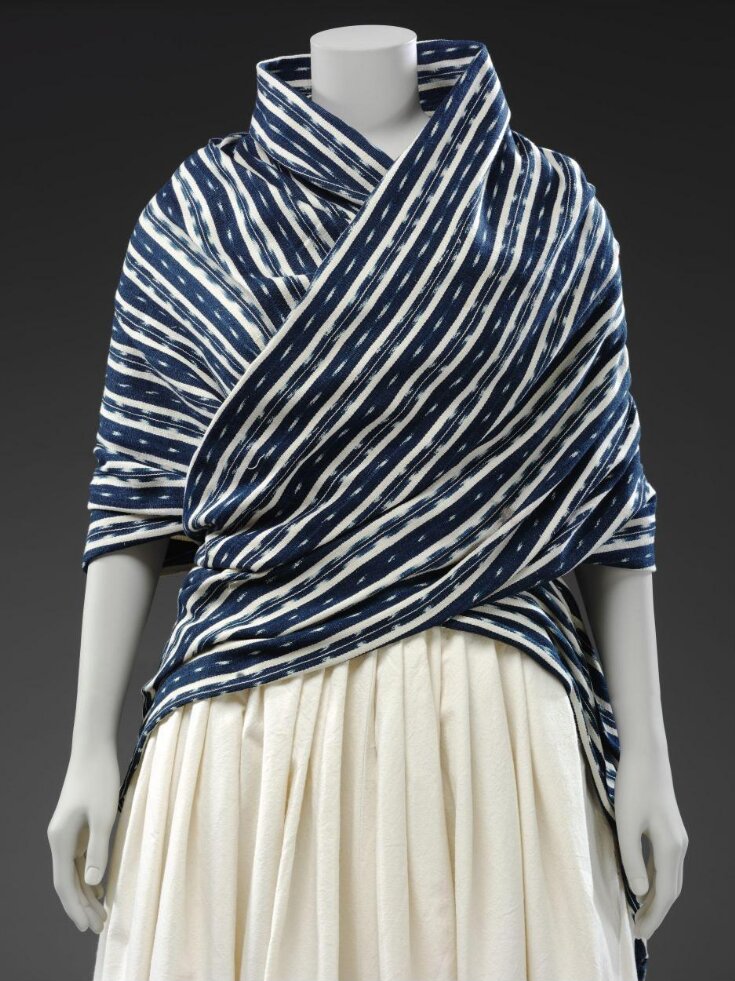
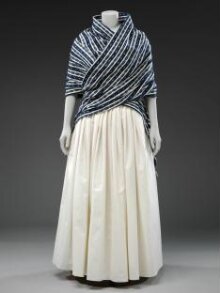
The resist-dyed pattern in some of the warp threads is known as jaspe and was a popular way of decorating fabric used for shawls and for skirts. Shawls such as this would have been woven commercially on a treadle loom (introduced by the Spaniards in the 16th century) and would have been sold by merchants in village markets.
Delve deeper
Discover more about this object

Object details
| Categories | |
| Object type | |
| Materials and techniques | Plain weave cotton, warp ikat |
| Brief description | Woven cotton; Mexico; 1875-1890 |
| Physical description | Cotton rebozo woven with a pattern of alternating stripes of blue, blue/white ikat, blue, white, blue/white ikat, blue, narrow white, blue, blue/white ikat and white. At either end there is a warp fringe formed by single knots. 1931 description: Scarf, woven with a tinted cotton warp. 1975 description: Perraje Jaspeado (tied-dyed shawl). This is a typical example of a two colour (indigo blue/white) perraje where some stripes have simple jaspe patterning. The weft in this example is white cotton; the weave is warp-faced. JASPE is the Indian term for tied-dyed yarns; JASPEADO describes the cloth woven from these yarns. |
| Dimensions |
|
| Gallery label | Shawl, with blue and white cotton warp and white cotton weft.
The resist-dyed pattern in some of the warp threads is known as jaspe and was a popular way of decorating fabric used for shawls and for skirts. Shawls such as this would have been woven commercially on a treadle loom (introduced by the Spaniards in the 16th century) and would have been sold by merchants in village markets. |
| Credit line | Bequeathed by Alfred Percival Maudslay |
| Object history | Registered File no. 2743/1931. |
| Production | When acquired by the Museum in 1931 it was thought possible that this textile might have been woven in Switzerland, or that the yarn might have been dyed/printed in Switzerland. Ann P Rowe (Curator of Western Hemisphere Textiles, The Textile Museum, Washington DC: personal communication 1997) said this and other rebozos in the Maudslay Collection look more like Mexican than Guatemalan products and the presence of other Mexican textiles in his Collection means that such an attribution would not be out of line. Mexican rebozos, both old and new, use more finely spun yarms and have narrower stripes than do Guatemalan ones. The Eisen Collection made in Guatemala in 1902 contains nothing similar although a shawl that might be similar to this was illustrated by Josephine Wood in 'Indian Costumes of Guatemala', Austria, 1966 p.42). |
| Subject depicted | |
| Summary | The resist-dyed pattern in some of the warp threads is known as jaspe and was a popular way of decorating fabric used for shawls and for skirts. Shawls such as this would have been woven commercially on a treadle loom (introduced by the Spaniards in the 16th century) and would have been sold by merchants in village markets. |
| Collection | |
| Accession number | T.21-1931 |
About this object record
Explore the Collections contains over a million catalogue records, and over half a million images. It is a working database that includes information compiled over the life of the museum. Some of our records may contain offensive and discriminatory language, or reflect outdated ideas, practice and analysis. We are committed to addressing these issues, and to review and update our records accordingly.
You can write to us to suggest improvements to the record.
Suggest feedback
You can write to us to suggest improvements to the record.
Suggest feedback
| Record created | May 20, 1999 |
| Record URL |
Download as: JSONIIIF Manifest
