
Waistcoat
1610-1615 (made), 1620 (altered)
| Artist/Maker | |
| Place of origin |
Object Type
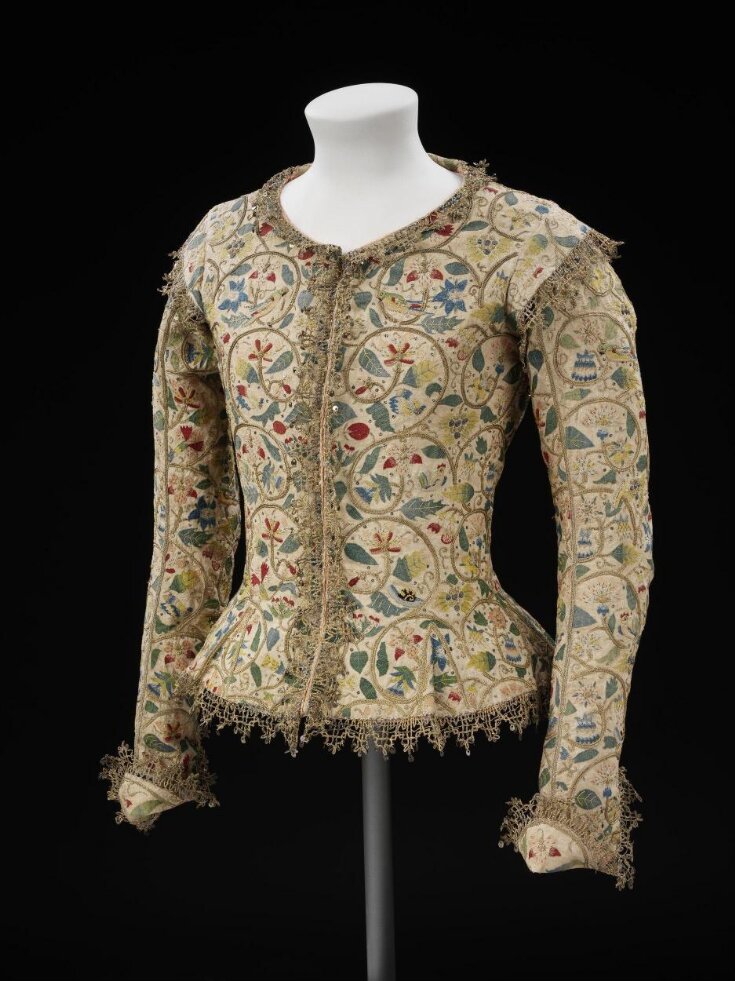
This fine early 17th-century woman's waistcoat is particularly significant because it is shown being worn in the Portrait of Margaret Layton (museum no. E.214-1994), attributed to Marcus Gheeraerts the Younger (1561-1636) and displayed alongside it. Waistcoats were long-sleeved upper garments, opening down the front and fitted at the waist using inserted gores. They were often made of linen and splendidly decorated as in this example.
Ownership & Use
Margaret Laton or Margaret Layton – What's in a name? When the V&A acquired the jacket and portrait of Margaret Layton in 1994, we used the version ‘Laton’ following the example set in 1933 by V&A curator Albert Kendrick. However, according to documents and monuments of the Layton family in Rawdon, Yorkshire, and the Dictionary of National Biography, the name was always spelled with a ‘y’. We are now making corrections in V&A labels, brochures, publications and on the V&A website.
In the portrait, Margaret Layton wears the waistcoat with an Italian needlelace collar and cuffs, a black velvet gown, a red silk petticoat and a whitework apron. As with many women of this period, we know very little about her life, other than her recorded connections to her father and husband.
Materials & Making
The waistcoat has long, tight sleeves, narrow shoulder wings, semi-circular cuffs and a small curved collar at the back neck, dating it to about 1610. Made of linen, it is hand sewn and lined with coral silk taffeta. Originally the jacket was fastened with pink silk ribbons. In the 1620s, an edging of spangled silver-gilt bobbin lace was added. Fragments remain of the original silk ribbons used for fastening. The waistcoat is embroidered in detached buttonhole, stem, plaited braid, chain, couching and dot stitches, with knots and speckling, with coloured silk threads, silver-gilt threads and spangles.
Time
Although the waistcoat was made about 1610, the portrait was painted more than 10 years later. By this time, waistlines had risen. Margaret Layton adapted to the new style by raising her petticoat and covering the lower half of the waistcoat.
This fine early 17th-century woman's waistcoat is particularly significant because it is shown being worn in the Portrait of Margaret Layton (museum no. E.214-1994), attributed to Marcus Gheeraerts the Younger (1561-1636) and displayed alongside it. Waistcoats were long-sleeved upper garments, opening down the front and fitted at the waist using inserted gores. They were often made of linen and splendidly decorated as in this example.
Ownership & Use
Margaret Laton or Margaret Layton – What's in a name? When the V&A acquired the jacket and portrait of Margaret Layton in 1994, we used the version ‘Laton’ following the example set in 1933 by V&A curator Albert Kendrick. However, according to documents and monuments of the Layton family in Rawdon, Yorkshire, and the Dictionary of National Biography, the name was always spelled with a ‘y’. We are now making corrections in V&A labels, brochures, publications and on the V&A website.
In the portrait, Margaret Layton wears the waistcoat with an Italian needlelace collar and cuffs, a black velvet gown, a red silk petticoat and a whitework apron. As with many women of this period, we know very little about her life, other than her recorded connections to her father and husband.
Materials & Making
The waistcoat has long, tight sleeves, narrow shoulder wings, semi-circular cuffs and a small curved collar at the back neck, dating it to about 1610. Made of linen, it is hand sewn and lined with coral silk taffeta. Originally the jacket was fastened with pink silk ribbons. In the 1620s, an edging of spangled silver-gilt bobbin lace was added. Fragments remain of the original silk ribbons used for fastening. The waistcoat is embroidered in detached buttonhole, stem, plaited braid, chain, couching and dot stitches, with knots and speckling, with coloured silk threads, silver-gilt threads and spangles.
Time
Although the waistcoat was made about 1610, the portrait was painted more than 10 years later. By this time, waistlines had risen. Margaret Layton adapted to the new style by raising her petticoat and covering the lower half of the waistcoat.
Object details
| Categories | |
| Object type | |
| Materials and techniques | Linen, embroidered with coloured silks, silver and silver-gilt thread, lined with silk |
| Brief description | Margaret Layton's waistcoat of linen, embroidered with coloured silks, silver and silver-gilt thread, made 1610-1615, altered 1620, England |
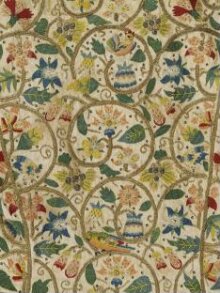
| Physical description | A woman's waistcoat with long, close-fitting sleeves, narrow shoulder wings, semi-circular cuffs and a small curved collar at the back neck. The torso is cut in three pieces: two front side pieces and one back panel with five gores inserted at the lower edge to give ease over the hips. The sleeves are cut in two pieces with a slit at the wrist. The whole garment is lined with coral silk taffeta. The whole garment is embroidered in an all over pattern of scrolling vines in silver-gilt plaited braid stitch from which spring a variety of flowers, fruits and insects worked in coloured silks and silver-gilt thread. In the 1620s, an edging of spangled silver-gilt bobbin lace was added. Fragments remain of the original silk ribbons used to fasten the waistcoat. Embroidered using detached buttonhole, stem, plaited braid, chain, couching and dot stitches, with knots and speckling, with coloured silk threads, silver-gilt threads and spangles.. |
| Dimensions |
|
| Style | |
| Production type | Unique |
| Gallery label | British Galleries:
This jacket is an example of formal daywear worn by wealthy Englishwomen in the early 17th century. The embroidery is based on designs from pattern books, herbals and emblem books. It is of a very high quality and probably professional work. Although this one was luxurious, a jacket of this type would not have been the most formal or expensive garment in Margaret Laton's wardrobe.(27/03/2003) |
| Credit line | Acquired with the assistance of the National Heritage Memorial Fund, The Art Fund and contributors to the Margaret Layton Fund |
| Object history | This waiscoat was owned and worn by Margaret Layton (probably born about 1590, died 1641), wife of Francis Layton (born 1577, died 1661), Yeoman of the Jewel House during the reign of James I, Charles I and Charles II. An portrait by an unknown artist, dating from the 1620s, shows Margaret Layton wearing this waistcoat. When the V&A acquired the waistcoat and portrait of Margaret Layton in 1994, the version ‘Laton’ was used following the example set in 1933 by V&A curator Albert Kendrick. However, according to documents and monuments of the Layton family in Rawdon, Yorkshire, and the Dictionary of National Biography, the name was always spelled with a ‘y’. Purchased. Registered File number 1994/644. Historical significance: This demonstrates very high quality embroidery, most likely professional. The fact that the waistcoat is complete and unaltered is unusual |
| Historical context | This waistcoat is a fine example of the type of garment worn for formal day wear for Englishwomen of the late 16th and early 17th century. In the portrait, the waistcoat is worn with an Italian needlelace collar and cuffs, a black velvet gown, a red silk petticoat and a whitework apron. The embroidery pattern is typically English of the late 16th and early 17th century featuring a variety of plants, flowers, birds and insects based on images in pattern books, herbals and emblem books. |
| Subjects depicted | |
| Summary | Object Type This fine early 17th-century woman's waistcoat is particularly significant because it is shown being worn in the Portrait of Margaret Layton (museum no. E.214-1994), attributed to Marcus Gheeraerts the Younger (1561-1636) and displayed alongside it. Waistcoats were long-sleeved upper garments, opening down the front and fitted at the waist using inserted gores. They were often made of linen and splendidly decorated as in this example. Ownership & Use Margaret Laton or Margaret Layton – What's in a name? When the V&A acquired the jacket and portrait of Margaret Layton in 1994, we used the version ‘Laton’ following the example set in 1933 by V&A curator Albert Kendrick. However, according to documents and monuments of the Layton family in Rawdon, Yorkshire, and the Dictionary of National Biography, the name was always spelled with a ‘y’. We are now making corrections in V&A labels, brochures, publications and on the V&A website. In the portrait, Margaret Layton wears the waistcoat with an Italian needlelace collar and cuffs, a black velvet gown, a red silk petticoat and a whitework apron. As with many women of this period, we know very little about her life, other than her recorded connections to her father and husband. Materials & Making The waistcoat has long, tight sleeves, narrow shoulder wings, semi-circular cuffs and a small curved collar at the back neck, dating it to about 1610. Made of linen, it is hand sewn and lined with coral silk taffeta. Originally the jacket was fastened with pink silk ribbons. In the 1620s, an edging of spangled silver-gilt bobbin lace was added. Fragments remain of the original silk ribbons used for fastening. The waistcoat is embroidered in detached buttonhole, stem, plaited braid, chain, couching and dot stitches, with knots and speckling, with coloured silk threads, silver-gilt threads and spangles. Time Although the waistcoat was made about 1610, the portrait was painted more than 10 years later. By this time, waistlines had risen. Margaret Layton adapted to the new style by raising her petticoat and covering the lower half of the waistcoat. |
| Associated object | |
| Bibliographic references |
|
| Other number | 83 (unknown exhibition) - Exhibition number |
| Collection | |
| Accession number | T.228-1994 |
About this object record
Explore the Collections contains over a million catalogue records, and over half a million images. It is a working database that includes information compiled over the life of the museum. Some of our records may contain offensive and discriminatory language, or reflect outdated ideas, practice and analysis. We are committed to addressing these issues, and to review and update our records accordingly.
You can write to us to suggest improvements to the record.
Suggest feedback
You can write to us to suggest improvements to the record.
Suggest feedback
| Record created | May 18, 1999 |
| Record URL |
Download as: JSONIIIF Manifest
