
Doublet and Breeches
1625-1635 (made)
| Artist/Maker | |
| Place of origin |
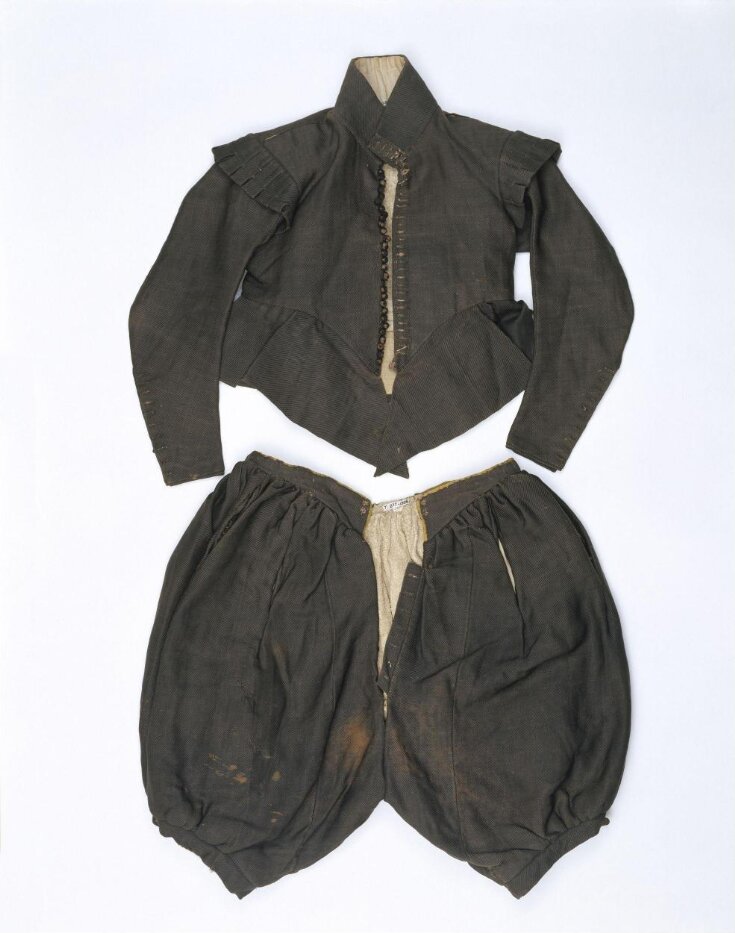
This ensemble of plain wool serge, probably once black, now faded to brown, is a rare example of everyday men’s dress of the early 17th century. It is lined for warmth with a linen pile fabric, similar to modern towelling. The doublet openings are faced with shot silk, perhaps to deceive a casual observer that the whole garment was lined with a more luxurious fabric.
The cut of the ensemble may represent the rather old-fashioned tastes of someone from a rural area or an older man. By 1625 slashed or paned sleeves were coming into fashion and a longer, slimmer cut of breeches replacing the full style seen here.
The cut of the ensemble may represent the rather old-fashioned tastes of someone from a rural area or an older man. By 1625 slashed or paned sleeves were coming into fashion and a longer, slimmer cut of breeches replacing the full style seen here.
Object details
| Categories | |
| Object type | |
| Parts | This object consists of 2 parts.
|
| Materials and techniques | Wool, silk, linen, wood, pasteboard, hand-woven, hand-sewn |
| Brief description | Man's doublet and breeches, 1625-1635, English; dark brown wool twill, linen shag lining |
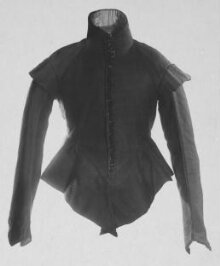
| Physical description | Man’s doublet and breeches of dark brown wool twill, interlined with stiffened linen and lined with linen shag. The doublet has a 3⅝-inch (9.2 cm) standing collar, 3¼-inch (8 cm) deep shoulder wings and curving 2-piece sleeves. The belly pieces, underneath the linen shag lining, are probably made of pasteboard stitched into layers of linen. The front openings and sleeve ends are faced with changeable [shot] pink and blue silk taffeta. There are 10 cut, but not worked, buttonholes on each sleeve, 29 on the left front and 5 on the left side of the collar. The buttons have a domed wooden core, covered with dark brown linen thread; 41 remain. A lacing band of linen, with 37 worked eyelets is sewn into the waist seam on the inside. There were originally 8 large, deep laps below the waist; one is missing and has been replaced with modern fabric. The breeches are made of the same wool twill and linen shag as the doublet. The legs are very full, gathered into the waistband and a band at each knee. There are pocket openings on each side at the front; the pocket bags are missing. The breeches fasten with a pair of worked eyelets on each side at centre front, a buttonhole stand on the left with 7 cut, but unworked buttonholes, and 5 buttons (2 missing) on the right. The waistband is bound with ⅜ (8 mm) wide green striped satin ribbon. There are no worked eyelets in the waistband, but a series of holes where points were pushed through the fabric. |
| Dimensions |
|
| Credit line | Given by Lady Spickernell |
| Object history | Given by Lady Spickernell in 1938 and said to have belonged to the Cotton family of Etwall Hall in Derbyshire. |
| Summary | This ensemble of plain wool serge, probably once black, now faded to brown, is a rare example of everyday men’s dress of the early 17th century. It is lined for warmth with a linen pile fabric, similar to modern towelling. The doublet openings are faced with shot silk, perhaps to deceive a casual observer that the whole garment was lined with a more luxurious fabric. The cut of the ensemble may represent the rather old-fashioned tastes of someone from a rural area or an older man. By 1625 slashed or paned sleeves were coming into fashion and a longer, slimmer cut of breeches replacing the full style seen here. |
| Bibliographic reference | Patterson, Angus, Fashion and Armour in Renaissance Europe: Proud Lookes and Brave Attire, V&A Publishing, London, 2009, ISBN 9781851775811, p. 54, ill. |
| Collection | |
| Accession number | T.29&A-1938 |
About this object record
Explore the Collections contains over a million catalogue records, and over half a million images. It is a working database that includes information compiled over the life of the museum. Some of our records may contain offensive and discriminatory language, or reflect outdated ideas, practice and analysis. We are committed to addressing these issues, and to review and update our records accordingly.
You can write to us to suggest improvements to the record.
Suggest feedback
You can write to us to suggest improvements to the record.
Suggest feedback
| Record created | March 23, 2005 |
| Record URL |
Download as: JSONIIIF Manifest
