
Carpet
1550-1600 (made)
| Artist/Maker | |
| Place of origin |
Object Type
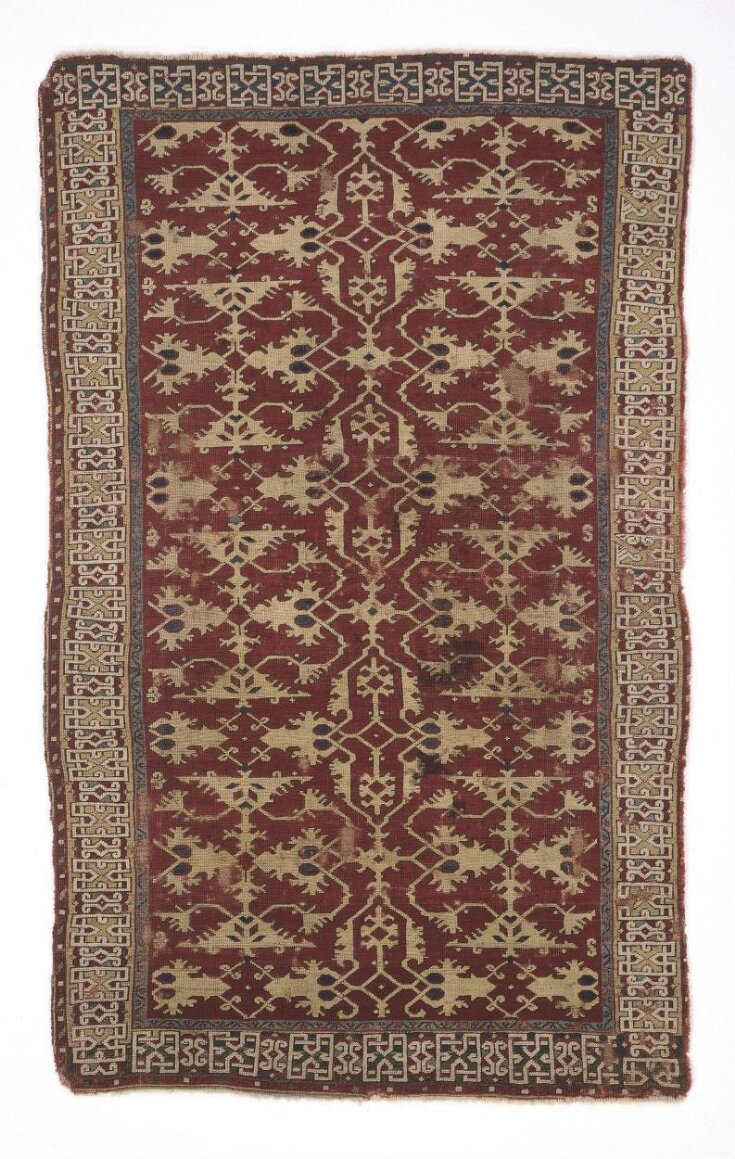
From the evidence of 16th and 17th century paintings, this type of small, brightly coloured Turkish carpet remained popular in Europe for almost 200 years. Although variations are known, the design is characterised by a grid-like arrangement of stylised octagons and crosses in red and yellow.
Trading
'Lotto' carpets were woven in commercial workshops in western Turkey, probably near the port of Smyrna (modern Izmir), from about 1516 to about 1700. They were exported in large numbers to central and western Europe along two main trade routes: across the Mediterranean to Italy and Spain, and along the rivers Danube and Rhine to the Low Countries.
Materials and Making
In a pile fabric, such as this carpet, the foundation consists of two sets of threads, warp and weft, which interlace at right angles. The pile is created by tying a knot of coloured thread around two adjacent warp threads, building up the design row by row while the foundation is being woven by the insertion of weft. It requires only a simple loom and is easily done by hand. In this carpet there are 1,474 knots per square decimetre.
From the evidence of 16th and 17th century paintings, this type of small, brightly coloured Turkish carpet remained popular in Europe for almost 200 years. Although variations are known, the design is characterised by a grid-like arrangement of stylised octagons and crosses in red and yellow.
Trading
'Lotto' carpets were woven in commercial workshops in western Turkey, probably near the port of Smyrna (modern Izmir), from about 1516 to about 1700. They were exported in large numbers to central and western Europe along two main trade routes: across the Mediterranean to Italy and Spain, and along the rivers Danube and Rhine to the Low Countries.
Materials and Making
In a pile fabric, such as this carpet, the foundation consists of two sets of threads, warp and weft, which interlace at right angles. The pile is created by tying a knot of coloured thread around two adjacent warp threads, building up the design row by row while the foundation is being woven by the insertion of weft. It requires only a simple loom and is easily done by hand. In this carpet there are 1,474 knots per square decimetre.
Object details
| Categories | |
| Object type | |
| Materials and techniques | Hand-knotted woollen pile on woollen warp and weft |
| Brief description | Middle East, Carpet; Lotto carpet |
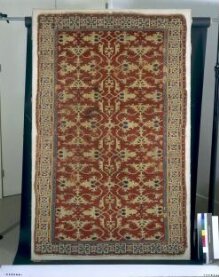
| Physical description | Carpet, Lotto design, hand knotted woollen pile on woollen warp and weft, Turkish, 16th/17th century. Warp: white wool' Z2S' 17 threads per inch/67 per dm Weft: red wool; Z2S; 2 shoots after every row of knots; 11 knots per inch/44 per dm. Pile: wool; 7 colours: red, light yellow, green, dark blue, blue, dark brown, white; symmetrical knot tied around two warp threads; 93 knots per sq. inch/ 1474 per sq.dm Side Finish: missing End Finish: missing Design: Field: red ground with light yellow 'Lotto' design outlined in dark brown and with dark blue details. The pattern is formed with one vertical row, of three and a half elements along the centre, with ahorizontal motifs to either side. The 'Lotto' design is a combination of foliate and 'kelim' edges. Main Border: blue [lower] and green [upper] ground with a box-like kufeque pattern in white outlined with dark brown and with red and some dark blue and light yellow details. The sides have a light yellow ground with details in red and blue. Inner border: blue ground with dark brown meander. Outer border: upper: red ground with dark brown meander linking rectangles in green, white and blue. Lower: missing but evidence that the border was like the upper outer border. The left side outer border is missing. The right side outer border has a red ground with dark brown meander linking squares and diamonds in white, blue and light yellow. |
| Dimensions |
|
| Gallery label | British Galleries:
This carpet is from an easily identifiable group of Turkish carpets with a red and yellow pattern of octagons and crosses. They appear in many paintings including those by the Italian artist Lorenzo Lotto (about 1480-1556). They were named after this painter in the 19th century. Turkish carpets were very popular in Europe in the 16th century and were generally used as table carpets.(27/03/2003) |
| Object history | Purchased (as a "Persian Rug, worn and repaired") from Giuseppe Salvadori in Florence, by Arthur Skinner, then Assistant Director of the Museum. Memo of 16 November 1897 to Sir John Donnelly asks permission for Mr Skinner "to purchase objects to the value of £100 during his holiday in Italy with "expenses for eight days (£8.8s)." 24/9 Mr Skinner to Mr Clarke reports: "Salvadori, Florence, embroideries, carpets (paid) frs. 760. Minute paper: "The following amounts written off Mr Skinner's imprest account 4th January 1898 Amount paid to G. Salvadori Lire 240 @ 26.40 = £ 9. 1. 9d. 520 @ 26.41 19.13. 9 |
| Summary | Object Type From the evidence of 16th and 17th century paintings, this type of small, brightly coloured Turkish carpet remained popular in Europe for almost 200 years. Although variations are known, the design is characterised by a grid-like arrangement of stylised octagons and crosses in red and yellow. Trading 'Lotto' carpets were woven in commercial workshops in western Turkey, probably near the port of Smyrna (modern Izmir), from about 1516 to about 1700. They were exported in large numbers to central and western Europe along two main trade routes: across the Mediterranean to Italy and Spain, and along the rivers Danube and Rhine to the Low Countries. Materials and Making In a pile fabric, such as this carpet, the foundation consists of two sets of threads, warp and weft, which interlace at right angles. The pile is created by tying a knot of coloured thread around two adjacent warp threads, building up the design row by row while the foundation is being woven by the insertion of weft. It requires only a simple loom and is easily done by hand. In this carpet there are 1,474 knots per square decimetre. |
| Collection | |
| Accession number | 903-1897 |
About this object record
Explore the Collections contains over a million catalogue records, and over half a million images. It is a working database that includes information compiled over the life of the museum. Some of our records may contain offensive and discriminatory language, or reflect outdated ideas, practice and analysis. We are committed to addressing these issues, and to review and update our records accordingly.
You can write to us to suggest improvements to the record.
Suggest feedback
You can write to us to suggest improvements to the record.
Suggest feedback
| Record created | May 10, 1999 |
| Record URL |
Download as: JSONIIIF Manifest
