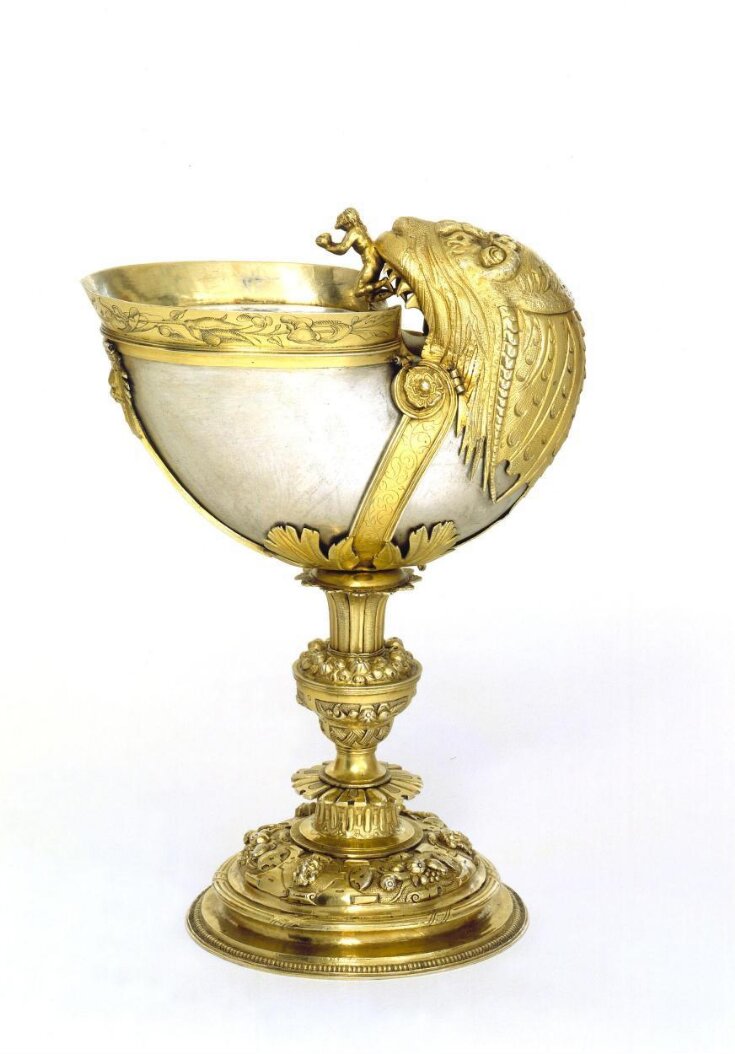

Nautilus Cup
1557-1558 (hallmarked), 1625-1675 (altered)
| Artist/Maker | |
| Place of origin |
Object Type
This beautiful cup was originally made from a nautilus shell, but at some point the shell must have been damaged. It was replaced in the mid-17th century by a silver facsimile.
Shells from the sea mollusc Nautilus pompilius that lived in the Pacific and Indian oceans were valued for their rarity and beauty. Either in their natural state, or worked into elaborate objects, they were often found in the 'cabinets of curiosities' that contained the small treasures of a princely collection.
Design & Designing
Nautilus cups were particularly popular in Germany and The Netherlands, but they gradually became fashionable in England. This cup has London hallmarks, but the crisp quality of the decoration and in particular the basket ornament on the stem are characteristic of Antwerp, Belgium. It is possible that the cup was made by an 'alien' or foreign goldsmith based in London. Equally, the style may have spread through engraved prints and the cup been made by a court goldsmith such as Affabel Partridge (active 1550, died 1568).
Subjects Depicted
The decoration of nautilus cups often refers to the marine origins of the shell. In this case, the end of the bowl is shaped like the gaping jaws of a sea monster. The small figure of Jonah kneels over the lip. According to the Bible, Jonah, attempting to escape from God, was swallowed by a great fish and lived in its belly for three days and nights before repenting and gaining his release.
This beautiful cup was originally made from a nautilus shell, but at some point the shell must have been damaged. It was replaced in the mid-17th century by a silver facsimile.
Shells from the sea mollusc Nautilus pompilius that lived in the Pacific and Indian oceans were valued for their rarity and beauty. Either in their natural state, or worked into elaborate objects, they were often found in the 'cabinets of curiosities' that contained the small treasures of a princely collection.
Design & Designing
Nautilus cups were particularly popular in Germany and The Netherlands, but they gradually became fashionable in England. This cup has London hallmarks, but the crisp quality of the decoration and in particular the basket ornament on the stem are characteristic of Antwerp, Belgium. It is possible that the cup was made by an 'alien' or foreign goldsmith based in London. Equally, the style may have spread through engraved prints and the cup been made by a court goldsmith such as Affabel Partridge (active 1550, died 1568).
Subjects Depicted
The decoration of nautilus cups often refers to the marine origins of the shell. In this case, the end of the bowl is shaped like the gaping jaws of a sea monster. The small figure of Jonah kneels over the lip. According to the Bible, Jonah, attempting to escape from God, was swallowed by a great fish and lived in its belly for three days and nights before repenting and gaining his release.
Object details
| Categories | |
| Object type | |
| Materials and techniques | Parcel-gilt silver, the silver shell replacing the original nautilus |
| Brief description | Silver, English |
| Physical description | Cup, Nautilus |
| Dimensions |
|
| Marks and inscriptions | Marked with a bird in a shaped shield |
| Gallery label | British Galleries:
LUXURY IMPORTED MATERIALS Aristocrats and wealthy merchants used decorative and expensive tableware to demonstrate their wealth and social status to guests. Splendid rarities, such as the pieces here, created lavish settings for a dessert of wine and sweetmeats. The weight and high quality of the silver mounts indicated the prestige associated with imported Chinese porcelain and other exotic materials.(27/03/2003) |
| Object history | Once owned by the Trenchard family of Wolfeton House, Charminster, Dorset Made in London; probably by Affabel Partridge (active 1550, died 1568) |
| Production | Hallmarked for 1557 - 1558; possibly modified 1625 - 1675 |
| Summary | Object Type This beautiful cup was originally made from a nautilus shell, but at some point the shell must have been damaged. It was replaced in the mid-17th century by a silver facsimile. Shells from the sea mollusc Nautilus pompilius that lived in the Pacific and Indian oceans were valued for their rarity and beauty. Either in their natural state, or worked into elaborate objects, they were often found in the 'cabinets of curiosities' that contained the small treasures of a princely collection. Design & Designing Nautilus cups were particularly popular in Germany and The Netherlands, but they gradually became fashionable in England. This cup has London hallmarks, but the crisp quality of the decoration and in particular the basket ornament on the stem are characteristic of Antwerp, Belgium. It is possible that the cup was made by an 'alien' or foreign goldsmith based in London. Equally, the style may have spread through engraved prints and the cup been made by a court goldsmith such as Affabel Partridge (active 1550, died 1568). Subjects Depicted The decoration of nautilus cups often refers to the marine origins of the shell. In this case, the end of the bowl is shaped like the gaping jaws of a sea monster. The small figure of Jonah kneels over the lip. According to the Bible, Jonah, attempting to escape from God, was swallowed by a great fish and lived in its belly for three days and nights before repenting and gaining his release. |
| Bibliographic reference | Cooper, John K. D. An assessment of Tudor Plate Design, 1530-1560. The Burlington Magazine, vol. 121, no. 915, June 1979. pp. 360-64. |
| Collection | |
| Accession number | M.117-1984 |
About this object record
Explore the Collections contains over a million catalogue records, and over half a million images. It is a working database that includes information compiled over the life of the museum. Some of our records may contain offensive and discriminatory language, or reflect outdated ideas, practice and analysis. We are committed to addressing these issues, and to review and update our records accordingly.
You can write to us to suggest improvements to the record.
Suggest feedback
You can write to us to suggest improvements to the record.
Suggest feedback
| Record created | May 5, 1999 |
| Record URL |
Download as: JSONIIIF Manifest
