
Waistcoat
1640s (made)
| Artist/Maker | |
| Place of origin |
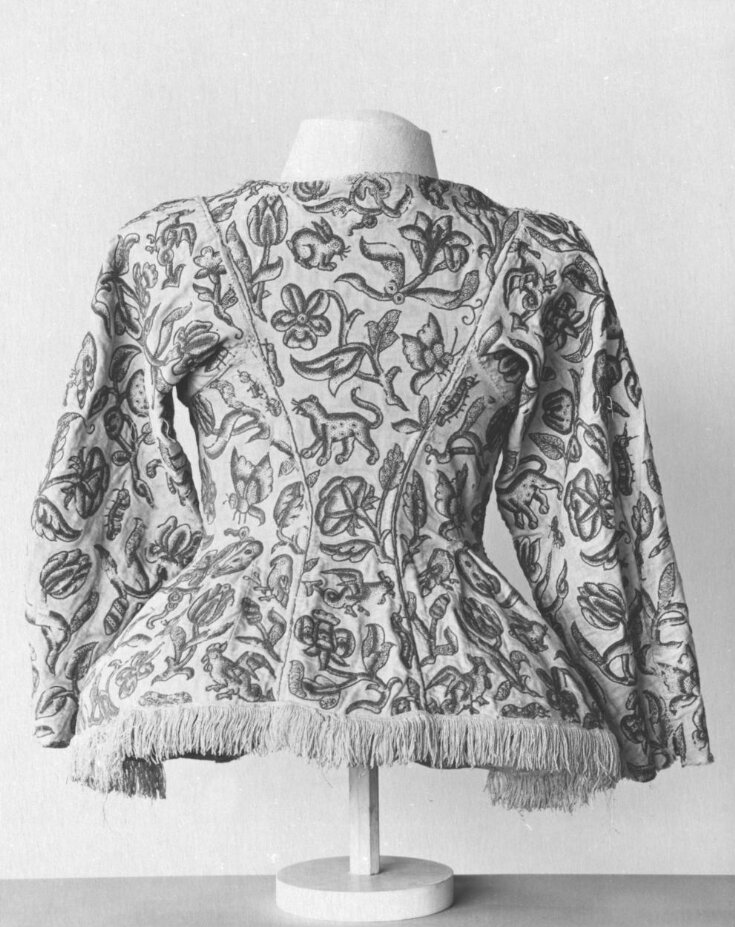
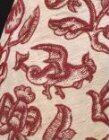
A mythical bird is just one of the fanciful creatures that populate this embroidered waistcoat of the 1640s. Worked in red wool on a thick twill of linen warp and wool weft, the coarseness of the thread and heaviness of the ground lack the delicacy of similar garments embroidered in silk on finer linen, but overall the work has a certain enchanting vitality. The design shows a development in later Jacobean needlework – the scrolling vines seen on jackets of the first two decades of the 17th century have disappeared. Each motif is worked separately, while retaining the curvilinear dynamism typical of Jacobean embroidery. During the later 17th century, this type of needlework, known as crewel work, grew in popularity. It became an important method of decorating household furnishings, particularly bed curtains and valances.
Object details
| Categories | |
| Object type | |
| Materials and techniques | Wool, linen, wool thread, linen thread; hand-woven, hand-embroidered, hand-sewn |
| Brief description | Woman's waistcoat, 1640s, English; Linen/wool embroidered in red wool crewelwork, with flowers, animals, birds, insects, altered |
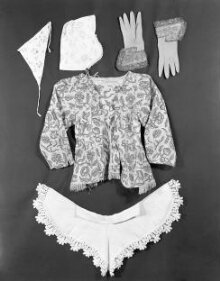
| Physical description | The waistcoat is made of linsey wolsey (linen warp, wool weft) twill and unlined. It opens down the front and the neckline is V-shaped and bound on the inside with striped linen tape. The sleeves are slightly full, three-quarter length and bound with red wool ribbon at the wrist. Gussets below the waist add fullness. A fringe of linen thread edges the hem. The linen is embroidered with red wool thread. The outlines are worked in stem stitch, infills in long and short and coral stitches and French knots. The embroidery design consists of individual sprigs with flowers and fruit, animals and birds, real and imaginary, and butterflies. The waistcoat has been altered, probably in the 17th century for another wearer. It may have originally laced down the front with the nine lacing holes on either side, over an embroidered stomacher. The latter appears to have been cut in half and sewn to each side of the front, and linen ties added. |
| Dimensions |
|
| Style | |
| Production type | Unique |
| Subjects depicted | |
| Summary | A mythical bird is just one of the fanciful creatures that populate this embroidered waistcoat of the 1640s. Worked in red wool on a thick twill of linen warp and wool weft, the coarseness of the thread and heaviness of the ground lack the delicacy of similar garments embroidered in silk on finer linen, but overall the work has a certain enchanting vitality. The design shows a development in later Jacobean needlework – the scrolling vines seen on jackets of the first two decades of the 17th century have disappeared. Each motif is worked separately, while retaining the curvilinear dynamism typical of Jacobean embroidery. During the later 17th century, this type of needlework, known as crewel work, grew in popularity. It became an important method of decorating household furnishings, particularly bed curtains and valances. |
| Bibliographic reference | Hart & North, 'Historic Dress in Detail' (V&A: V&A Publications, 1998), p.150. |
| Collection | |
| Accession number | T.124-1938 |
About this object record
Explore the Collections contains over a million catalogue records, and over half a million images. It is a working database that includes information compiled over the life of the museum. Some of our records may contain offensive and discriminatory language, or reflect outdated ideas, practice and analysis. We are committed to addressing these issues, and to review and update our records accordingly.
You can write to us to suggest improvements to the record.
Suggest feedback
You can write to us to suggest improvements to the record.
Suggest feedback
| Record created | March 11, 2005 |
| Record URL |
Download as: JSONIIIF Manifest
