
Smock
1560 - 1580 (made)
| Artist/Maker | |
| Place of origin |
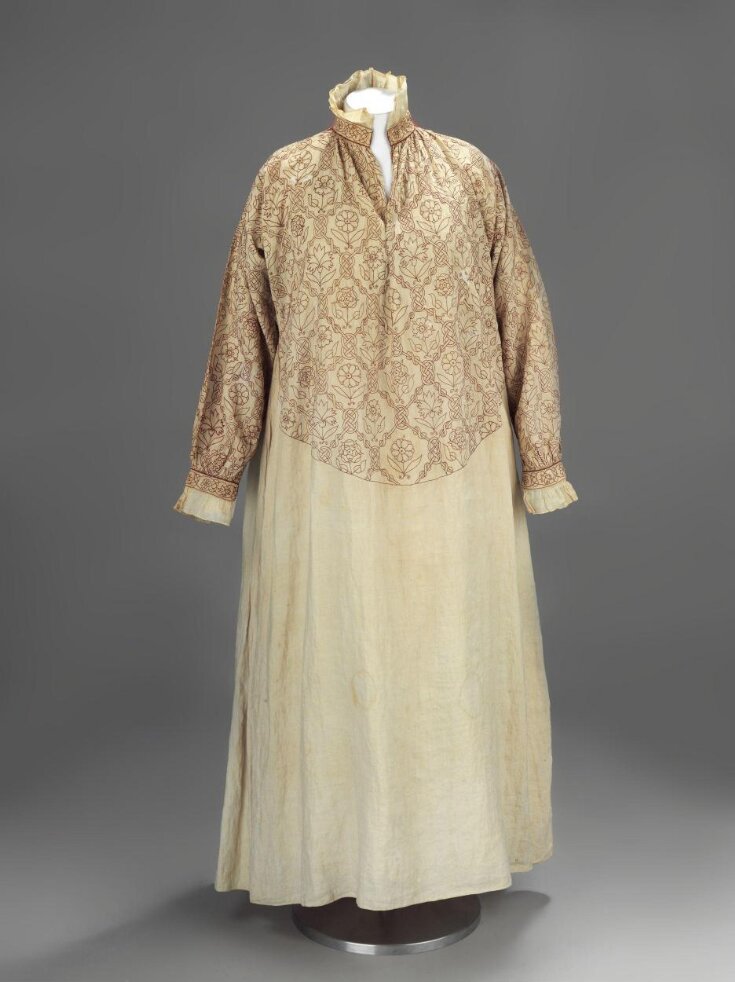
The smock was originally dated to the early seventeenth century and published as such in Hart and North, Historical Fashion in Detail (1998). However a closer look at the integral ruffle at the collar and cuffs reveals that these are inconsistent with the period of the separate ruff, c.1575 to 1620. Therefore the smock must date to the decades just before this period, 1560-1580.
Object details
| Categories | |
| Object type | |
| Materials and techniques | Linen, linen thread, silk thread; hand-woven, hand-embroidered, hand-sewn |
| Brief description | A woman's smock, 1560-1580, British; Linen embroidered with red silk in a design of strapwork and flowers |
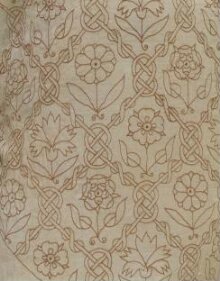
| Physical description | The smock is made of linen and has a high neck and collar, long sleeves with cuffs, and side gores. The collar and cuffs have an integral 'ruffle' of finer linen. The front and back above the waist, sleeves, collar and cuffs are embroidered in back stitch with red silk. The linen is a balanced weave of 40 threads per cm. The design is strapwork in diamond shapes with figure-of-eight knots. Stylised roses and gilly flowers are worked within the strapwork. |
| Dimensions |
|
| Style | |
| Production type | Unique |
| Subjects depicted | |
| Summary | The smock was originally dated to the early seventeenth century and published as such in Hart and North, Historical Fashion in Detail (1998). However a closer look at the integral ruffle at the collar and cuffs reveals that these are inconsistent with the period of the separate ruff, c.1575 to 1620. Therefore the smock must date to the decades just before this period, 1560-1580. |
| Bibliographic references |
|
| Collection | |
| Accession number | T.326-1982 |
About this object record
Explore the Collections contains over a million catalogue records, and over half a million images. It is a working database that includes information compiled over the life of the museum. Some of our records may contain offensive and discriminatory language, or reflect outdated ideas, practice and analysis. We are committed to addressing these issues, and to review and update our records accordingly.
You can write to us to suggest improvements to the record.
Suggest feedback
You can write to us to suggest improvements to the record.
Suggest feedback
| Record created | March 11, 2005 |
| Record URL |
Download as: JSONIIIF Manifest
