Chrismatory
late 15th century (made)
| Artist/Maker | |
| Place of origin |
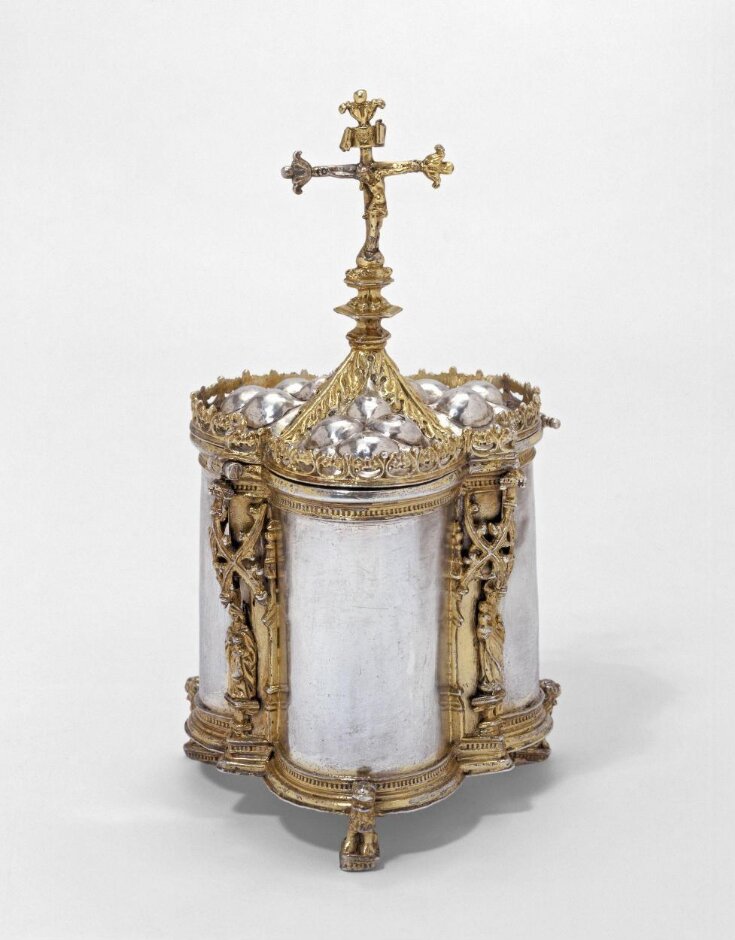
This was made to contain chrism (from the Greek word for ‘anoint’), which is the holy oil used in the Christian sacraments of confirmation, baptism and ordination. Chrism is made of pure olive oil and balsam. The trefoil shape of the chrismatory corresponds to the three separate compartments.
Ritual cleansing and anointing play a crucial part in Christian worship, as they do in other religions. Water, salt, incense and oils are used in ceremonies such as baptism and confirmation, and in the blessing of individuals and of sacred objects like altars and bells.
Ritual cleansing and anointing play a crucial part in Christian worship, as they do in other religions. Water, salt, incense and oils are used in ceremonies such as baptism and confirmation, and in the blessing of individuals and of sacred objects like altars and bells.
Object details
| Categories | |
| Object type | |
| Materials and techniques | Silver, parcel-gilt |
| Brief description | Silver, parcel-gilt, Germany, dated 1499 |
| Physical description | Silver, parcel- gilt. Triangular with figures of saints under Gothic canopies, the cover surmounted by a crucifix. |
| Dimensions |
|
| Marks and inscriptions |
|
| Gallery label |
|
| Historical context | Medieval Worship Until the 16th century Roman Catholicism was the universal faith of the Western world and Latin was its universal language. The needs of church ritual inspired the production of a range of richly decorated vessels and vestments, crosses and images in the form of altarpieces. Many were made of gold or silver, adorned with enamels or gems, precious materials seen as symbolic of the reverence due to the worship of God. Less wealthy churches used cheaper vessels in copper, brass or pewter. The celebration of Mass was and remains the most important service of the Roman Catholic liturgy. For this the minimum requirements are an altar, a chalice and missal, the book of texts necessary for the Mass. Holy Communion or Eucharist is that part of the Mass in which the people participate in the sacrifice of Christ, by partaking of his body and blood in the consecrated bread and wine, held in the chalice and paten. |
| Subjects depicted | |
| Summary | This was made to contain chrism (from the Greek word for ‘anoint’), which is the holy oil used in the Christian sacraments of confirmation, baptism and ordination. Chrism is made of pure olive oil and balsam. The trefoil shape of the chrismatory corresponds to the three separate compartments. Ritual cleansing and anointing play a crucial part in Christian worship, as they do in other religions. Water, salt, incense and oils are used in ceremonies such as baptism and confirmation, and in the blessing of individuals and of sacred objects like altars and bells. |
| Collection | |
| Accession number | 7243-1861 |
About this object record
Explore the Collections contains over a million catalogue records, and over half a million images. It is a working database that includes information compiled over the life of the museum. Some of our records may contain offensive and discriminatory language, or reflect outdated ideas, practice and analysis. We are committed to addressing these issues, and to review and update our records accordingly.
You can write to us to suggest improvements to the record.
Suggest feedback
You can write to us to suggest improvements to the record.
Suggest feedback
| Record created | March 4, 2005 |
| Record URL |
Download as: JSONIIIF Manifest
