Casket
ca. 1500 (made)
| Artist/Maker | |
| Place of origin |
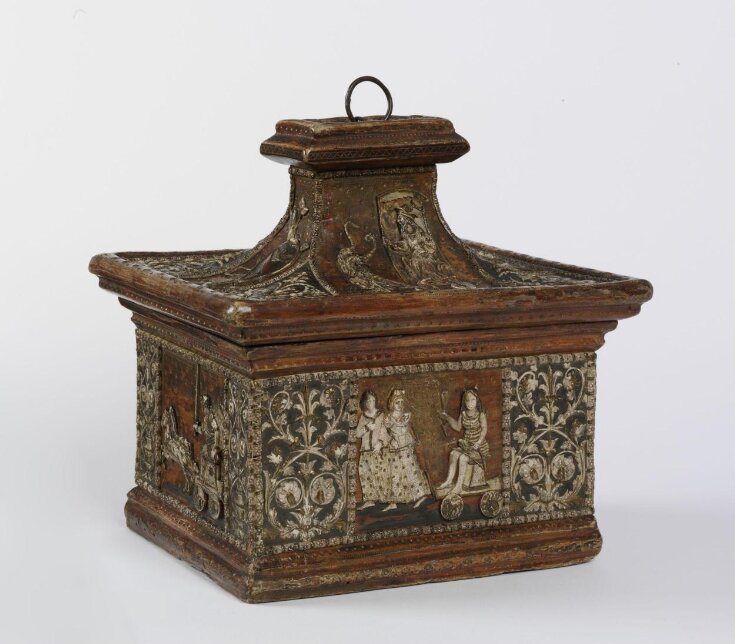
Although the figures on this box are similar to those on boxes decorated with white lead paste (or pastiglia), they are in fact made of gesso sottile, a very fine form of plaster of Paris. The box is decorated with the Roman gods and goddesses that represent the various planets, such as Jupiter, Saturn, Mercury and Venus, as well as Diana, the goddess of the moon. This astrological theme, popular in Europe throughout the Middle Ages and Renaissance, is enhanced by the inclusion of the signs of the Zodiac in the decoration of the wheels of the chariots.
Object details
| Categories | |
| Object type | |
| Materials and techniques | Moulded gesso on a painted and gilded background |
| Brief description | Rectangular box with deep plinth-shaped lid. |
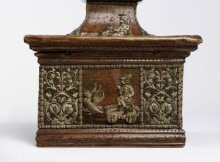
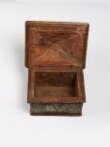
| Physical description | Rectangular box with deep plinth-shaped lid, made up of concave sides and a ring fitted on the top. The outside of the box is covered with moulded gesso motifs on a painted and gilded ground. The inside is painted red. All four sides of the box are decorated with a Roman God, personifying a planet, pulled in a car, placed between two panels decorated with symmetrically aranged acanthus scrolls and flowers. The acanthus panels are repeated on the corners of the lid, the front and back of which are decorated with deities and the sides with the (unidentified) coat of arms of the owner. On the front of the box is Luna (the moon) riding in a car pulled by two maidens, with one wheel decorated with Leo and the other with Cancer; on the back is Mercury, whose car rests on one wheel decorated with Virgo and the other with Gemini, and is pulled by two phoenixes; on the left side is Venus riding in a car, with Cupid standing in front of her, pulled by two doves. One wheel is emblazoned with Taurus and the other with Libra. On the right side is Mars in a car, with one wheel decorated with Aries and the other with Scorpio, pulled by two horses. On the front if the lid, Saturn, bearing the Scythe of Time, rides in a car pulled by two cranes: one wheel is decorated with Capricorn and the other with Aquarius. On the back, Jupiter rides in a car pulled by two doves, with Ganymede kneeling and presenting him with a cup. On one wheel of his car is Sagittarius and on the other Pisces. Note - the box is of nailed construction, with applied, mitred mouldings around the lid. It appears that a lock has been removed and the hole filled on the front of the box, and within, before interior paint was applied (though this lock may not have been original). |
| Dimensions |
|
| Style | |
| Production type | Unique |
| Gallery label | BOX
Giltwood decorated with moulded reliefs in gesso
ITALIAN; about 1500
W.21-1953
The decoration consists of Venus and Cupid in the Chariot of Love pulled by doves and Mercury in his chariot; the wheels of the chariots are decorated with the signs of the Zodiac. The choice of the 'Triumph of Love' as a subject may have connections with the development of Florentine Neo-Platonism in the late fifteenth century. Such boxes were made for personal use by women at their toilette.(2006-8) |
| Credit line | Given by Dr W. L. Hildburgh, FSA |
| Object history | This box was part of the collections of Dr. W.D.Hildburgh, FSA, (1876 - 1956) a distinguished scholar and benefactor to the V & A, and given to this museum with a number of pastiglia decorated boxes by the owner in 1953. It is not known where he acquired them from. PASTIGLIA BOXES Gilt pastiglia boxes were mostly made in Venice and Ferrara from about 1480 until 1550. Pastiglia or pasta is the name given to white lead paste, bound with egg white. This was often scented and described in contemporary inventories as pasta di muschio (musk paste). The pastiglia figures and motifs were shaped with a lead mould and then glued to the gilt surface of the box - hence their frequent recurrence on other boxes. The boxes are decorated with legends of Ancient Rome and the scenes copied from woodcuts such as Jacobus Argentoratensis' Triumph of Caesar (Venice, 1504) or illustrations of Livy's Roman History. (Label text, circa 2000, from old Medieval & Renaissance Galleries) Historical significance: Carved or moulded gesso, applied to boxes or cassoni, are mostly painted or gilded. On this box, the animals, floral scrolls, signs of the zodiac, and faces and limbs of the gods are either painted white or left in their natural off-white tones. This is a very rare instance of gesso being used consciously to imitate white lead pastiglia decoration. However, instead of being made up of small elements applied with small matrices as their white lead counterparts would have been, each individula illustration, be it Mars in his car or a plaquette of acanthus scrolls, appears to have been made from one wooden mould. Furthermore, it has an interesting plinth-shaped lid, more readily associated with Roman sarcophagi or ivory boxes from the Embriarchi workshop. This box is decorated with themes derived from a popular series of prints of the Seven Planets, and dates from times before the great astronomical discoveries of Copernicus and Gallillei, when it was believed that all the planets, including the sun, rotated round the earth and affected the human character. |
| Historical context | Pasta di Muschio (lit: scented paste) decoration on wooden boxes and frames was known in Ferrara by the 1450s, and this has been identified with the white lead decoration applied to wooden boxes with gilt grounds, that were being made in Venice and Ferrara from the mid to late 15th century. Although the moulded figures are made from gesso rather than lead, nonetheless the decoration is similar, and relies heavily on classical ornaments and subject matter. Like almost all surviving boxes of this type, the box was not fitted with a lock and would have contained odds and ends rather than valuable items. The Seven Planets, which decorate this box, are derrived from a series of engravings that originated in Florence from about 1450 and spread throughout Italy during the latter half of that century. Perhaps the closest parallels lie between the Jupiter on the lid of the casket and a Jupiter in a woodcut formerly in the Malaspina collection (Pavia), thought to have been executed in Venice. (cf. Lippmann, p. 4 - 5). Themes connected with the signs of the Zodiac had been popular throughout the Middle Ages and Renaissance: frescoes of such themes, which date from the early 15th century, adorn the Sala della Ragione in the Palazzo della Ragione in Padua. By the end of the fifteenth century, classical deities, whether illustrated as planets or mythical figures, were popular decorative subjects. Comparable objects See Pastiglia Boxes, hidden treasures of the Italian Renaissance (Cofanetti in Pastiglia), catalogue from the exhibition Pastiglia Boxes: hidden treasures of the Italian Renaissance from the collection of Galleria Nazionale d'Arte Antica, Rome: Lowe Art Museum, Miami, Feb. 13 - April 28, 2002, cat. XIX |
| Subjects depicted | |
| Summary | Although the figures on this box are similar to those on boxes decorated with white lead paste (or pastiglia), they are in fact made of gesso sottile, a very fine form of plaster of Paris. The box is decorated with the Roman gods and goddesses that represent the various planets, such as Jupiter, Saturn, Mercury and Venus, as well as Diana, the goddess of the moon. This astrological theme, popular in Europe throughout the Middle Ages and Renaissance, is enhanced by the inclusion of the signs of the Zodiac in the decoration of the wheels of the chariots. |
| Bibliographic references |
|
| Collection | |
| Accession number | W.21-1953 |
About this object record
Explore the Collections contains over a million catalogue records, and over half a million images. It is a working database that includes information compiled over the life of the museum. Some of our records may contain offensive and discriminatory language, or reflect outdated ideas, practice and analysis. We are committed to addressing these issues, and to review and update our records accordingly.
You can write to us to suggest improvements to the record.
Suggest feedback
You can write to us to suggest improvements to the record.
Suggest feedback
| Record created | March 1, 2005 |
| Record URL |
Download as: JSONIIIF Manifest
