The Mostyn Salt
Standing Salt
1586-1587 (hallmarked)
1586-1587 (hallmarked)
| Artist/Maker | |
| Place of origin |
Object Type
This type of salt cellar is known as a 'standing salt'. Salt was a precious commodity in 16th-century England, valued both as a preservative and a flavouring.
History & Use
From the late medieval period a large ceremonial covered salt, or 'great' salt, was placed on the high table at the host's side. This distinguished the status of the diners, who sat either 'above' or 'below' the salt. Smaller salts were arranged around the tables, next to the trenchers, or plates. These are known as 'trencher' salts. Great salts were common by the mid 16th century, but were still an important part of household silver, valued as high status objects, exchanged as New Year's gifts and passed on as heirlooms.
Design
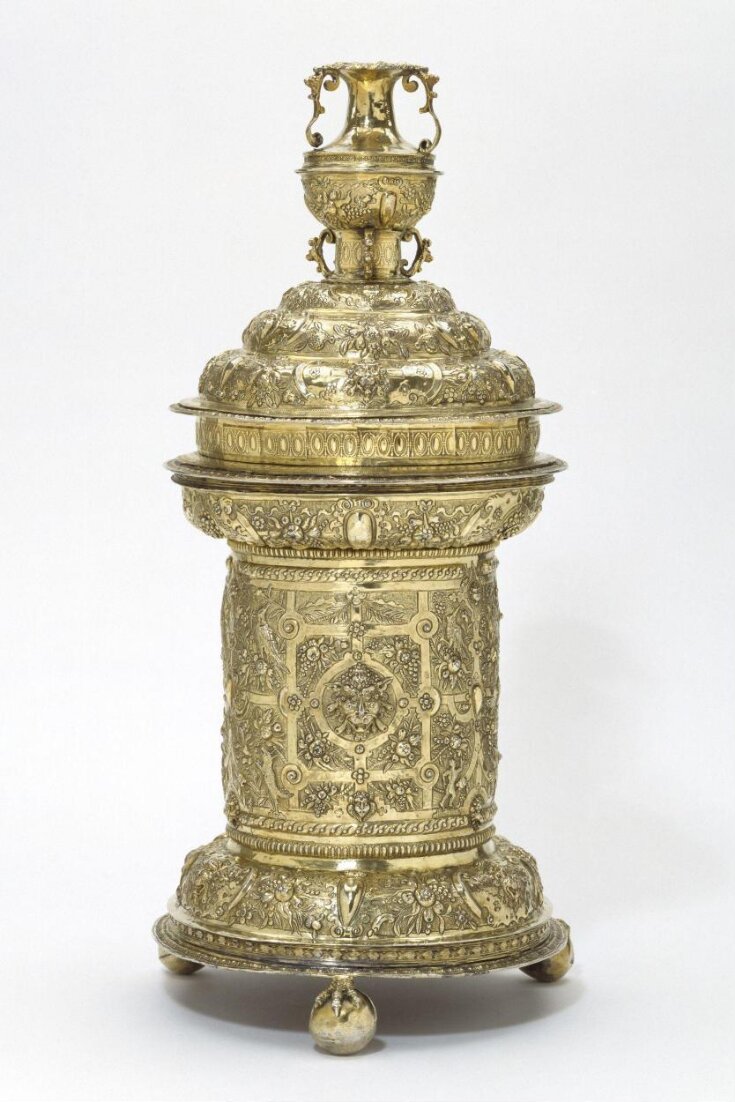
The ceremonial function of great salts ensured that they were ornamented in the very latest fashions. This example is decorated with motifs characteristic of the late Renaissance, such as strapwork, masks, flowers and fruit.
This type of salt cellar is known as a 'standing salt'. Salt was a precious commodity in 16th-century England, valued both as a preservative and a flavouring.
History & Use
From the late medieval period a large ceremonial covered salt, or 'great' salt, was placed on the high table at the host's side. This distinguished the status of the diners, who sat either 'above' or 'below' the salt. Smaller salts were arranged around the tables, next to the trenchers, or plates. These are known as 'trencher' salts. Great salts were common by the mid 16th century, but were still an important part of household silver, valued as high status objects, exchanged as New Year's gifts and passed on as heirlooms.
Design
The ceremonial function of great salts ensured that they were ornamented in the very latest fashions. This example is decorated with motifs characteristic of the late Renaissance, such as strapwork, masks, flowers and fruit.
Object details
| Categories | |
| Object type | |
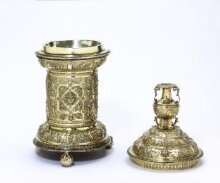
| Parts | This object consists of 2 parts.
|
| Title | The Mostyn Salt (popular title) |
| Materials and techniques | Silver gilt, embossed, chased, punched and engraved |
| Brief description | [*] The Mostyn Standing Salt |
| Dimensions |
|
| Marks and inscriptions |
|
| Gallery label | British Galleries:
By the 1580s ceremonial salt cellars served primarily as theatrical table sculpture. This massive example is the tallest to have survived, though its size and weight would not have been unusual for the period. The ornament includes familiar motifs taken from print sources, such as strapwork, fruit and masks, with more improvised animals and figures.(27/03/2003) |
| Object history | Made in London for the Mostyn family of Mostyn, Flintshire; by an unidentified maker using the mark 'T' in a pearl-bordered shield, struck on the outer lip, inside the bowl and on the lower part of the body. The purchase of the Mostyn salt by the then South Kensington Museum was made on the recommendation of Wilfred Cripps who thought that it was 'one of the most remarkable specimens of art craftsmanship of the Elizabethan period that has been on the market for many years. It is of very unusual size; and important both from an historical and art point of view- its manufacture is of the most characteristic and elaborate kind and of a high degree of excellence, both in this way and on account of its finish. It must have been the state cellar of the house of Mostyn and an object of importance even amongst the other important pieces of plate. The salt is of London make and of the year 1586-7.' (letter 29 July 1885) On 14 May 1886 Mr Mortimer Hunt of Messrs Hunt & Roskill called to examine the salt with a view to repairing it 'without the use of fire'- it was accordingly sent to their premises 156 New Bond Street for repair. |
| Summary | Object Type This type of salt cellar is known as a 'standing salt'. Salt was a precious commodity in 16th-century England, valued both as a preservative and a flavouring. History & Use From the late medieval period a large ceremonial covered salt, or 'great' salt, was placed on the high table at the host's side. This distinguished the status of the diners, who sat either 'above' or 'below' the salt. Smaller salts were arranged around the tables, next to the trenchers, or plates. These are known as 'trencher' salts. Great salts were common by the mid 16th century, but were still an important part of household silver, valued as high status objects, exchanged as New Year's gifts and passed on as heirlooms. Design The ceremonial function of great salts ensured that they were ornamented in the very latest fashions. This example is decorated with motifs characteristic of the late Renaissance, such as strapwork, masks, flowers and fruit. |
| Collection | |
| Accession number | 146:1, 2-1886 |
About this object record
Explore the Collections contains over a million catalogue records, and over half a million images. It is a working database that includes information compiled over the life of the museum. Some of our records may contain offensive and discriminatory language, or reflect outdated ideas, practice and analysis. We are committed to addressing these issues, and to review and update our records accordingly.
You can write to us to suggest improvements to the record.
Suggest feedback
You can write to us to suggest improvements to the record.
Suggest feedback
| Record created | April 29, 1999 |
| Record URL |
Download as: JSONIIIF Manifest
