
The Meeting of King Solomon and the Queen of Sheba
Cassone
1450-1500 (made), 1862 (restored)
1450-1500 (made), 1862 (restored)
| Artist/Maker | |
| Place of origin |
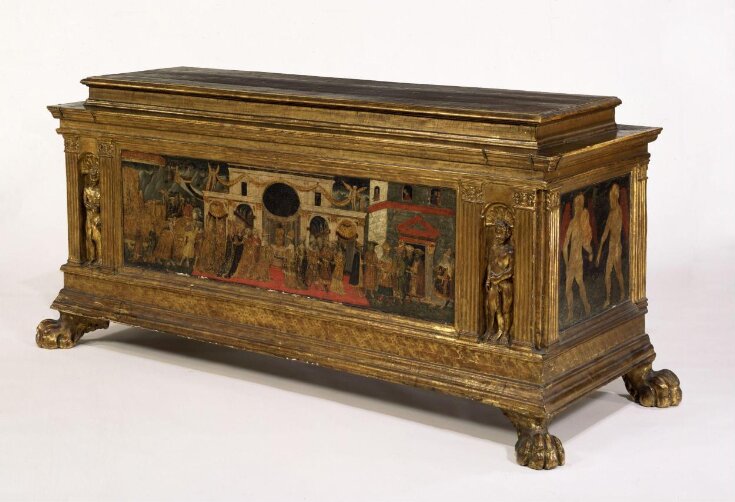
This cassone is a Florentine wedding chest from the mid-15th century. Italian marriage chests of this type were frequently decorated with religious and mythological stories and the present chest shows the Meeting of King Solomon and the Queen of Sheba, a popular subject at this time because it exemplifies such sought after virtues as wisdom and determination. Although certainly executed in Florence in the mid-15th century, and close to Apollonio di Giovanni's (1416 - 1465) style, the present panel was dubiously executed in his workshop. This chest seems to have survived quite substantially in its original conditions.
Object details
| Categories | |
| Object type | |
| Title | The Meeting of King Solomon and the Queen of Sheba |
| Materials and techniques | Poplar, the panels tempera on walnut(?) |
| Brief description | A Florentine cassone with 'The Meeting of King Solomon and the Queen of Sheba', Circle of Apollonio di Giovanni, 1450-1500 |
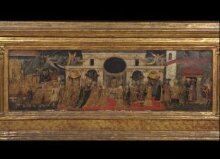
| Physical description | A large rectangular, gilded chest of sarcophagus form with a decorated front panel showing in the middle a man and a woman meeting before a tripartite temple, their respective cortege being behind them; on the left is a chariot before a landscape with various figures and winged putti while on the right, is a group of men standing before a palace; on each side a single panel shows two putti playing musical instruments on a dark background. Flanking the front panel on each side is a high relief figure of a naked boy holding a shield (the poses differing), standing within a shell niche between a pair of fluted pilasters. Flanking each side panel is a fluted pilaster of the same type. Around the top of the chest body, immediately below the lid is a cornice and frieze, plain gilded. The lid with rectangular raised section, is inset and hinged in front of a full-width, plain fixed board. On four lion's paw feet, underneath several base mouldings. The bare wood back apparently with areas of reddish stain. The interior plain, without obvious sign of a textile lining, except for the underside of the lid which is painted on a reddish wash with three large clumps of white flowered dog roses. On the right side is an old hole, apparently the fixing for a lid prop (missing). Gilding Water gilding over a thick gesso layer and a red bole, apparently applied on top of an earlier gilded surface, I could only see an earlier layer on the naked boy figure so they could be earlier and over gilded when the 19th C lid and mouldings were added which appeared to only have one layer of gilding. The lid and antependium are worked with low relief incised designs. The antependium is worked with a rod with spiral ribbon design. Construction Dovetailed poplar boards (each board made up of two horizontally-grained butted planks) with patches of white filler. The figures (apparently of wood and plaster or gesso) and pilasters applied. The bottom boards nailed up. The lockplate removed and patched. The lid held on two modern hinges, without internal evidence of earlier hingeing, any external evidence possibly hidden behind a batten along the top of the back. The front and both side panels appear (from edge splitting) to have been inset into the chest planks, rather than painted directly onto them. Dating 15th century: painted panels, possibly the main carcase and bottom boards 19th century: lid, base mouldings and feet; visible gilding |
| Dimensions |
|
| Styles | |
| Production type | Unique |
| Marks and inscriptions | 1862 sotto la Doratura [unclear] (Black paint on the reverse of a wooden strip running horizontally behind the lower front edge moulding)
|
| Gallery label |
|
| Object history | Purchased in 1862 for £80 Surface cleaning 1991. Historical significance: The front panel of this Florentine cassone (wedding chest) represents the Meeting of King Salomon and the Queen of Sheba who, intrigued by King Solomon's wisdom and wealth, undertook a long journey from Sheba (traditionally situated in modern Ethiopia) until Jerusalem to test him. Two winged putti playing musical instruments are represented on each side. The attribution of this painting has long debated: it was originally attributed to Dello Delli and successively to a follower of Pesellino (Schiaparelli, 1908), to the Cassone Master (Schubring, 1915), to the Master of the Jarves Cassoni (Berenson, 1932) and to Apollonio di Giovanni (Berenson, 1963). The panel is divided into narrative sequels from left to right: after crossing a mountainous landscape, the chariot of the Queen of Sheba with her suit arrives in Jerusalem, King Solomon and Queen of Sheba meet before a tripartite temple with an altar, King Solomon cortege is on the far right. According to E. Callmann (1974), 7852-1862 reproduced a compositional idea that belongs to a small group of similar cassone panels among which some were made in the workshop of Apollonio di Giovanni, the leading workshop in Florence in the mid 15th century. Unlike Apollonio's works, E. Callmann retained that the present painting is flatter and is lacking of Apollonio's typical lively movement in space. Compare with the other compositions, the figures are smaller and appear more proportionally adapted to the architectural setting. It seems however reasonable to think that this panel was painted by a contemporary imitator. The inside of fifteenth-century wedding chests was generally decorated with reclining nude figures, respectively a man and a woman in each chest, whereas sometimes there was a textile pattern imitating a cloth lining. E. Callmann noted that the present inside lid appears rather unique and imitated a textile pattern consisting in three floral sprigs in soft colours and not stencilled. |
| Historical context | The term cassone stands in Italian for chest and relates to large and ornate pieces of furniture made in Italy from the 14th to the end of the 16th centuries. They were generally made on the occasion of a relatively important wedding and contained the bride's trousseau. Writing in the mid-sixteenth century, Vasari describes cassoni thus: '…citizens of those times used to have in their apartments great wooden chests in the form of a sarcophagus, with the covers shaped in various fashions…and besides the stories that were wrought on the front and on the ends, they used to have the arms, or rather, insignia, of their houses painted on the corners, and sometimes elsewhere. And the stories that were wrought on the front were for the most part fables taken from Ovid and from other poets, or rather stories related by the Greek and Latin historians, and likewise chases, jousts, tales of love, and other similar subjects…'. (Giorgio Vasari, translated Gaston du C. de Vere, Lives of the Painters, Sculptors and Architects, vol. 1, London 1996, p.267) These lavishly decorated cassoni, often combined with pastiglia decoration, were generally commissioned in pairs. Florence, which specialised in the decoration of the front panel, was at that time the main centre of production, even though Siena and the Veneto also supplied cassoni. The painted decorations usually represented episodes from classical or biblical history or mythology appropriate for the newly wed. The most flourishing cassone workshop in Florence was run by Marco del Buono Giamberti and Apollonio di Giovanni but major artists such as Domenico Veneziano and Botticelli may have decorated cassoni on occasion. Painted cassoni went out of fashion towards the end of the 15th century when carved oaken chests came into vogue. |
| Subjects depicted | |
| Summary | This cassone is a Florentine wedding chest from the mid-15th century. Italian marriage chests of this type were frequently decorated with religious and mythological stories and the present chest shows the Meeting of King Solomon and the Queen of Sheba, a popular subject at this time because it exemplifies such sought after virtues as wisdom and determination. Although certainly executed in Florence in the mid-15th century, and close to Apollonio di Giovanni's (1416 - 1465) style, the present panel was dubiously executed in his workshop. This chest seems to have survived quite substantially in its original conditions. |
| Bibliographic references |
|
| Collection | |
| Accession number | 7852-1862 |
About this object record
Explore the Collections contains over a million catalogue records, and over half a million images. It is a working database that includes information compiled over the life of the museum. Some of our records may contain offensive and discriminatory language, or reflect outdated ideas, practice and analysis. We are committed to addressing these issues, and to review and update our records accordingly.
You can write to us to suggest improvements to the record.
Suggest feedback
You can write to us to suggest improvements to the record.
Suggest feedback
| Record created | February 15, 2005 |
| Record URL |
Download as: JSONIIIF Manifest
