
Cassone
ca. 1550 (made)
| Artist/Maker | |
| Place of origin |
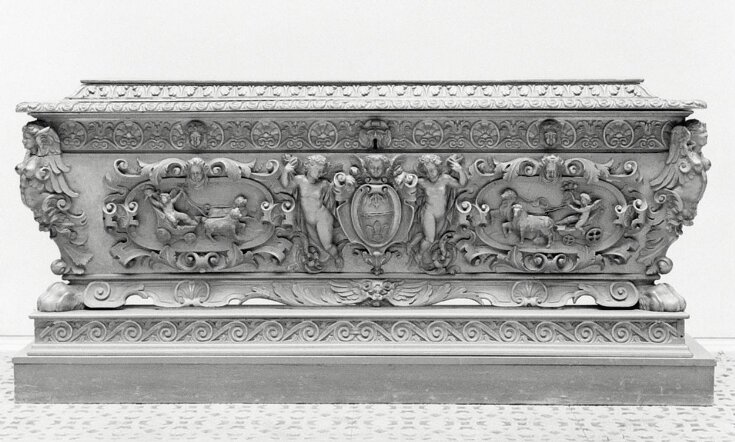
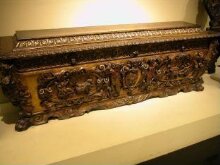
Cassone (literally 'large boxes') were the main form of storage in Italy throughout the 16th century. They were associated with weddings and often included the arms of the married couple. By about 1550, it had become more fashionable to carve rather than paint cassoni. They were decorated with mythological themes, often derived from murals by Raphael, Michelangelo and Giulio Romano in the palaces and villas of cardinals and noblemen in or near Rome. This example is decorated with winged amorini pulled in chariots by mythical animals, probably representing the Roman Gods, like those in the decorations of the Villa Lante, painted by Giulio Romano (1499 - 1546) in about 1520.
Object details
| Categories | |
| Object type | |
| Materials and techniques | Carved walnut, parcel gilt |
| Brief description | Of carved walnut, parcel gilt; Italy c1560 |
| Physical description | Coffer . Walnut wood, carved in high relief, and parcel gilt: in the centre of the front is a shield of arms supported by putti, and on either side of this is a cartouche with a putto in a chariot drawn by dogs and bulls |
| Dimensions |
|
| Style | |
| Gallery label |
|
| Object history | Bought for 110£ (No further information given in the early register) |
| Production | There is no information about the cassone in the early catalogue. JOhn Hungerfold Pollen claims that it was Florentine, but whether it came from a Florentine palazzo or Florence-based dealer is not clear. It is similar to a cassone that bears the arms of the Roman family, Delfini (Museum No. 4416 - 1857). |
| Subject depicted | |
| Summary | Cassone (literally 'large boxes') were the main form of storage in Italy throughout the 16th century. They were associated with weddings and often included the arms of the married couple. By about 1550, it had become more fashionable to carve rather than paint cassoni. They were decorated with mythological themes, often derived from murals by Raphael, Michelangelo and Giulio Romano in the palaces and villas of cardinals and noblemen in or near Rome. This example is decorated with winged amorini pulled in chariots by mythical animals, probably representing the Roman Gods, like those in the decorations of the Villa Lante, painted by Giulio Romano (1499 - 1546) in about 1520. |
| Bibliographic references |
|
| Collection | |
| Accession number | 4414-1857 |
About this object record
Explore the Collections contains over a million catalogue records, and over half a million images. It is a working database that includes information compiled over the life of the museum. Some of our records may contain offensive and discriminatory language, or reflect outdated ideas, practice and analysis. We are committed to addressing these issues, and to review and update our records accordingly.
You can write to us to suggest improvements to the record.
Suggest feedback
You can write to us to suggest improvements to the record.
Suggest feedback
| Record created | February 14, 2005 |
| Record URL |
Download as: JSONIIIF Manifest
