
Evening Dress
spring/summer 1952 (made)
| Artist/Maker | |
| Place of origin |
Balenciaga was the most exclusive fashion house in Paris immediately after World War II. The Spanish-born couturier Cristóbal Balenciaga (1895-1972), regarded by his peers as ‘the Master’, had moved to Paris from Spain in 1937. By 1952 he had 232 employees there and was producing 356 new designs per year. His clients, admitted to his salon only after a personal introduction, included many cosmopolitan women of different nationalities.
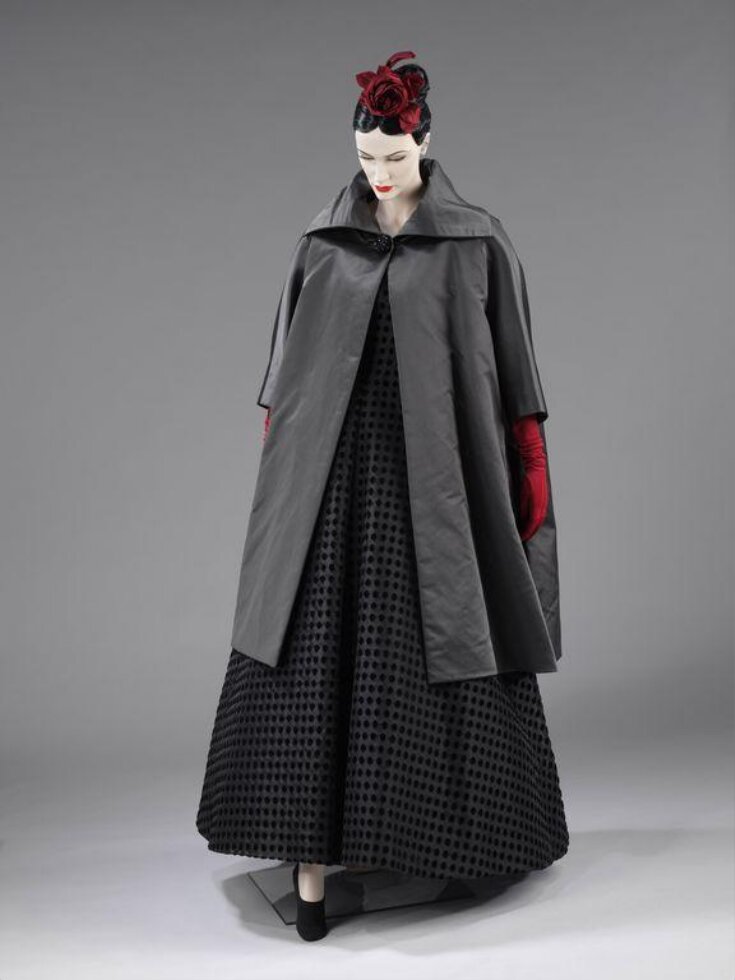
Balenciaga was a perfectionist in cutting, sewing and finishing garments, and was renowned for his exacting standards. The dress, shown here as it was displayed for the V&A’s 2007 exhibition, The Golden Age of Couture: Paris and London 1947-1957, reveals Balenciaga's preference for stiff, matte fabrics and his liking for the sombre black of the dress of the Spanish clergy - both contemporary and as depicted in the paintings of his fellow countryman, the artist Francisco de Zurbarán (1598–1664).
Balenciaga was a perfectionist in cutting, sewing and finishing garments, and was renowned for his exacting standards. The dress, shown here as it was displayed for the V&A’s 2007 exhibition, The Golden Age of Couture: Paris and London 1947-1957, reveals Balenciaga's preference for stiff, matte fabrics and his liking for the sombre black of the dress of the Spanish clergy - both contemporary and as depicted in the paintings of his fellow countryman, the artist Francisco de Zurbarán (1598–1664).
Object details
| Categories | |
| Object type | |
| Materials and techniques | Nylon organza with velvet, lined with silk |
| Brief description | Evening dress of nylon organza, Balenciaga, Paris, 1952 |
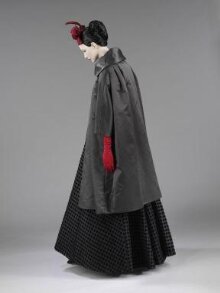
| Physical description | Evening dress of stiff, sheer black nylon organza with an all over regular pattern of black velvet spots. The spots are woven into the nylon fabric. The dress is full length, with a low heart shaped neckline and cap sleeves. There is a high waistline just under the bust in front. The dress is fitted to a tight waist and flares from there to the ground. It is cut in two panels at the front and four at the back to make it more fully flared. The back panels are cleverly cut, and are full-length, forming both the whole back of the dress. There is a small dart at either shoulder. At the skirt’s hem, there are small triangular infills where the front panels meet the side panels. The dress fastens with a metal and linen zip from the end of the sleeve which is closed with 2 black metal hooks and eyes, to the hip. It is lined with black silk taffeta stitched closely to the inside of the bodice along the seams and darts, but loose inside the skirt. A band of nylon stiffening is stitched around the inside of the skirt at hip level. |
| Dimensions |
|
| Production type | Haute couture |
| Marks and inscriptions | No label |
| Gallery label | Evening dress and coat (robe du soir)
Cristóbal Balenciaga (1895-1972)
Paris
1952 and 1960
The gown shows Balenciaga's preference for stiff, matt fabrics, while the heavy satin coat epitomises the superb cut and monastic simplicity of his designs. Its only accent is a large glittering jet button.
Dress: nylon organza with velvet spots
Coat: satin with jet button
Dress given by Mrs Catherine Hunt; coat by Baroness Alain de Rothschild
V&A: T.116-1970; T.20-1974(22/09/2007-06/01/2008) |
| Credit line | Given by Miss Catherine Hunt |
| Object history | Worn by Martita Hunt, the British actor. Given by her sister Miss Catherine Hunt following her death (see registered paper 69/2325). Martita Hunt (1900-1969) was a British theatre and film actor, best known for her 1946 performance as Miss Havisham in David Lean's film version of 'Great Expectations'. This is part of a large bequest of clothing and jewellery made by Martita Hunt to the V&A. |
| Production | Date attributed by Mme. Jouve - former Balenciaga archivist |
| Summary | Balenciaga was the most exclusive fashion house in Paris immediately after World War II. The Spanish-born couturier Cristóbal Balenciaga (1895-1972), regarded by his peers as ‘the Master’, had moved to Paris from Spain in 1937. By 1952 he had 232 employees there and was producing 356 new designs per year. His clients, admitted to his salon only after a personal introduction, included many cosmopolitan women of different nationalities. Balenciaga was a perfectionist in cutting, sewing and finishing garments, and was renowned for his exacting standards. The dress, shown here as it was displayed for the V&A’s 2007 exhibition, The Golden Age of Couture: Paris and London 1947-1957, reveals Balenciaga's preference for stiff, matte fabrics and his liking for the sombre black of the dress of the Spanish clergy - both contemporary and as depicted in the paintings of his fellow countryman, the artist Francisco de Zurbarán (1598–1664). |
| Collection | |
| Accession number | T.116-1970 |
About this object record
Explore the Collections contains over a million catalogue records, and over half a million images. It is a working database that includes information compiled over the life of the museum. Some of our records may contain offensive and discriminatory language, or reflect outdated ideas, practice and analysis. We are committed to addressing these issues, and to review and update our records accordingly.
You can write to us to suggest improvements to the record.
Suggest feedback
You can write to us to suggest improvements to the record.
Suggest feedback
| Record created | February 14, 2005 |
| Record URL |
Download as: JSON
