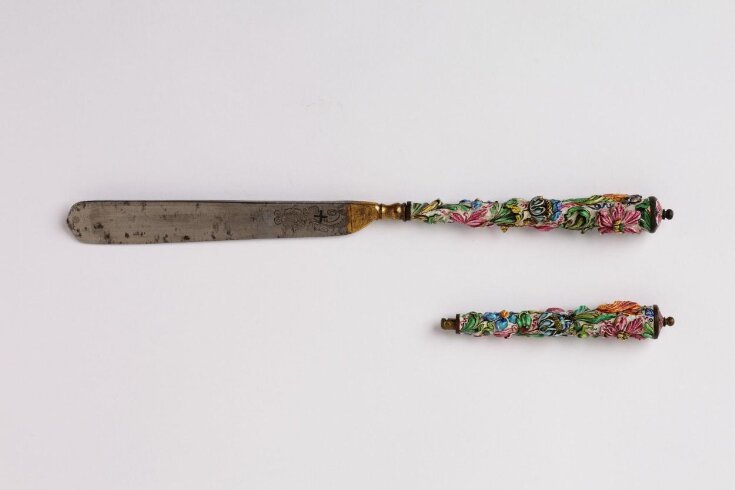
Knife and Fork Handle
1530-1580 (made)
| Artist/Maker | |
| Place of origin |
Enamelled handles, such as on this knife and fork, were fragile and easily damaged. Few examples survive in good condition. Most come from Germany and France where they were especially popular.
Ebony, ivory, fish skin, tortoiseshell, amber, bone, horn and shell were all popular for decorating cutlery. Around 1730 ceramic handles were introduced to Europe from China. Although cutlers were required by their guilds to be able to make a complete knife, handles of carved ivory, silver, bronze and glass were usually imported or made by specialist craftsmen.
Ebony, ivory, fish skin, tortoiseshell, amber, bone, horn and shell were all popular for decorating cutlery. Around 1730 ceramic handles were introduced to Europe from China. Although cutlers were required by their guilds to be able to make a complete knife, handles of carved ivory, silver, bronze and glass were usually imported or made by specialist craftsmen.
Object details
| Categories | |
| Object type | |
| Parts | This object consists of 2 parts.
|
| Materials and techniques | Steel, with handles of copper enamelled in relief |
| Brief description | Knife and fork handle with enamelled handles, Germany or France, 1530-80. |
| Physical description | Handles of copper enamelled in relief with insects, flowers and leaves. |
| Summary | Enamelled handles, such as on this knife and fork, were fragile and easily damaged. Few examples survive in good condition. Most come from Germany and France where they were especially popular. Ebony, ivory, fish skin, tortoiseshell, amber, bone, horn and shell were all popular for decorating cutlery. Around 1730 ceramic handles were introduced to Europe from China. Although cutlers were required by their guilds to be able to make a complete knife, handles of carved ivory, silver, bronze and glass were usually imported or made by specialist craftsmen. |
| Collection | |
| Accession number | 2254&A-1855 |
About this object record
Explore the Collections contains over a million catalogue records, and over half a million images. It is a working database that includes information compiled over the life of the museum. Some of our records may contain offensive and discriminatory language, or reflect outdated ideas, practice and analysis. We are committed to addressing these issues, and to review and update our records accordingly.
You can write to us to suggest improvements to the record.
Suggest feedback
You can write to us to suggest improvements to the record.
Suggest feedback
| Record created | February 4, 2005 |
| Record URL |
Download as: JSONIIIF Manifest
