Casket
about 1400 (made)
| Artist/Maker | |
| Place of origin |
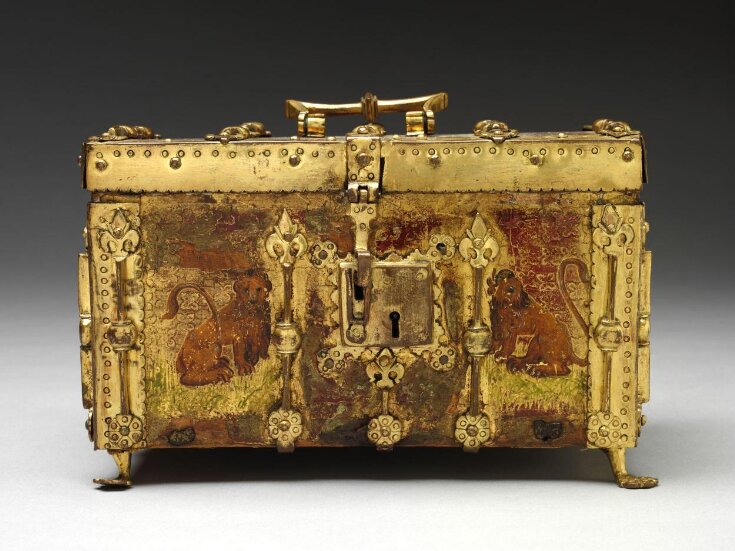
This exquisite casket is adorned with lions and gilt metal fleurs-de-lys, and is characteristic of French Gothic decoration of the 14th century. The richness of the decoration and the themes chosen, suggest that it would originally have belonged to a prince or nobleman. Before it was given to the museum in 1855, this object belonged to Ralph Bernal MP, heir to a fortune in the West Indies, and one of the greatest collectors of Medieval and Renaissance objets d’art in his time. After his death in 1854, his collections were sold off at high prices, which very much indicated the Victorian passion for all things Gothic.
Object details
| Categories | |
| Object type | |
| Materials and techniques | Painted and gilded wood, with gilt copper alloy mounts (partly replaced) |
| Brief description | French, 1300-1400, painted wood, Bernal Coll. |
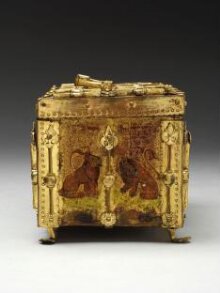
| Physical description | Wood (probably beech), rectangular, of nailed construction (12mm planks), end-lapped, with 3 nails holding the front and back to the base, 2 nails at each end, and with a hinged lid. The casket is painted (oil paint) on the front, back, ends and lid with four pairs of seated tawny lions on green grass energetically gazing in each direction (perhaps suggesting vigilance), on a stamped quatrefoil gilded ground (exposing the red bole in many places). The underneath plain, painted. Small areas of canvas are visible where gesso has worn away. The box mounted with gilt copper alloy straps (nailed around the lid and around each corner), and with U shaped bands running under the box which terminate in fleurs-de-lys and six-petalled flower heads, and fitted with an external lockplate (on replacement nails), and a hinged lid handle formed of 3 concave members with a central bead. The box stands on four feet of flattened six-lobed form (at least one of which appears to be a replacement), which are fastened on a spike and nail. No key. Small areas of retouching and regilding. The interior gilded, and the inside face of the lid gilded and punched with a repeated crowned cipher (C or G, or T on its side), and in the centre are two arms with crossed hands (perhaps to be read as clasped, for a betrothal), set within a quatrefoil. The interior of the box plain gilded |
| Dimensions |
|
| Style | |
| Marks and inscriptions |
|
| Gallery label |
|
| Credit line | Bernal Collection (Given by M.T. Smith, M.P.) |
| Object history | Given from the Bernal Collection by M.T.Smith Esq. M.P. Dated by Pollen to 15th century. Lent to the exhibition 'Ich, Maria von Geldern: Die Herzogin und ihr berühmtes Gebetbuch (1380-1429)', Museum Het Valkhof, Nijmegen, 2018-19. |
| Historical context | Probably given as a love gift to be used to hold jewellery and other small, precious items (much smaller boxes have been described as intended specifically for rings.) An object with a vulnerable painted surface, as here, would itself probably have been protected by a specially made leather carrying case. The fleur-de-lis often suggests a French origin, having long been part of the French royal insignia. Note however that Edward III (1327-77) assumed the quartered arms of France and England in 1340 (his claim through his mother Isabella, wife of Edward II). The fleur-de-lis need not indicate a French origin, and other northern European countries may be considered as possible places of manufacture (personal communication, 2007, from Elisabeth Antoine (Louvre, France). The crowned letter (identification uncertain) inside the lid: presumably relates to the original owner or owner's family (of royal or noble status). The motif showing two arms with clasped hands might refer to a family emblem rather than a specific betrothal. Lions: On this casket the lions in seated poses or prowling with backward and upwards glances are particularly prominent and appealing. Broadly speaking, the lion in medieval art could symbolise good or evil, Christ or the Devil, foe or ally, depending on its associations in the various stories. While Christians compared the devil to a roaring lion 'seeking whom he may devour' (1 Peter 5:8), the Medieval bestiary recounts how the father lion breathes life into cubs that are born dead, paralleling God the Father's resurrection of Jesus Christ. A heraldic meaning is possible for the lions on this casket, or more likely symbolic protectors of the valuables within it, and perhaps symbolic guardians of the owner herself. Lions in medieval art may embody strength (leo fortis, the strong lion, the source of whose strenght lay in his heart) as well as being associated with images of kingship and nobility. Some medieval commentators claimed that royal blood was immune to lion attacks. In the stories of Reynard the Fox it is the lion who is king, and on seals the lion is often referred to as King of the Beasts. Guardian lions are an ancient idea, found for example in Jewish and Buddhist cultures. Since the lion was supposed, according to legends in the bestiary, to sleep with his eyes open, many seals show lions curled up asleep at the base of a tree. The classical writer Aelian observes 'that even when asleep the lion moves his tail, showing, as you might expect, that he is not altogether quiescent, and that, although sleep has enveloped and enfolded him, it has not subdued him as it does all other animals', (quoted by Jackson p.133). Lions were said to be tolerant, even tempered and compassionate and in some medieval stories, lions lash themselves with their tails to work up a rage because they would normally not harm others unless angry. As this casket may have been a love gift to a woman, it is also interesting that according to some medieval writers lions would not harm a virgin. For lions in lore and legend, see Deirdre Jackson, Lion (London, 2010). For the use on goldsmiths' work of opus punctile (point work) - see Neil Stratford, De opere punctili, Beobachtungen zur Technik der Punktpunzierung um 1400, in Das Goldene Roessl: Ein Meisterwerk Pariser Hofkunst um 1400, (Munich Bayerisch Nationalmuseum, 1995), pp.131-146 |
| Production | Probably northern France |
| Subjects depicted | |
| Association | |
| Summary | This exquisite casket is adorned with lions and gilt metal fleurs-de-lys, and is characteristic of French Gothic decoration of the 14th century. The richness of the decoration and the themes chosen, suggest that it would originally have belonged to a prince or nobleman. Before it was given to the museum in 1855, this object belonged to Ralph Bernal MP, heir to a fortune in the West Indies, and one of the greatest collectors of Medieval and Renaissance objets d’art in his time. After his death in 1854, his collections were sold off at high prices, which very much indicated the Victorian passion for all things Gothic. |
| Bibliographic references |
|
| Collection | |
| Accession number | 1621-1855 |
About this object record
Explore the Collections contains over a million catalogue records, and over half a million images. It is a working database that includes information compiled over the life of the museum. Some of our records may contain offensive and discriminatory language, or reflect outdated ideas, practice and analysis. We are committed to addressing these issues, and to review and update our records accordingly.
You can write to us to suggest improvements to the record.
Suggest feedback
You can write to us to suggest improvements to the record.
Suggest feedback
| Record created | February 2, 2005 |
| Record URL |
Download as: JSONIIIF Manifest
