Communion Cup
1773-1774 (made)
| Artist/Maker | |
| Place of origin |
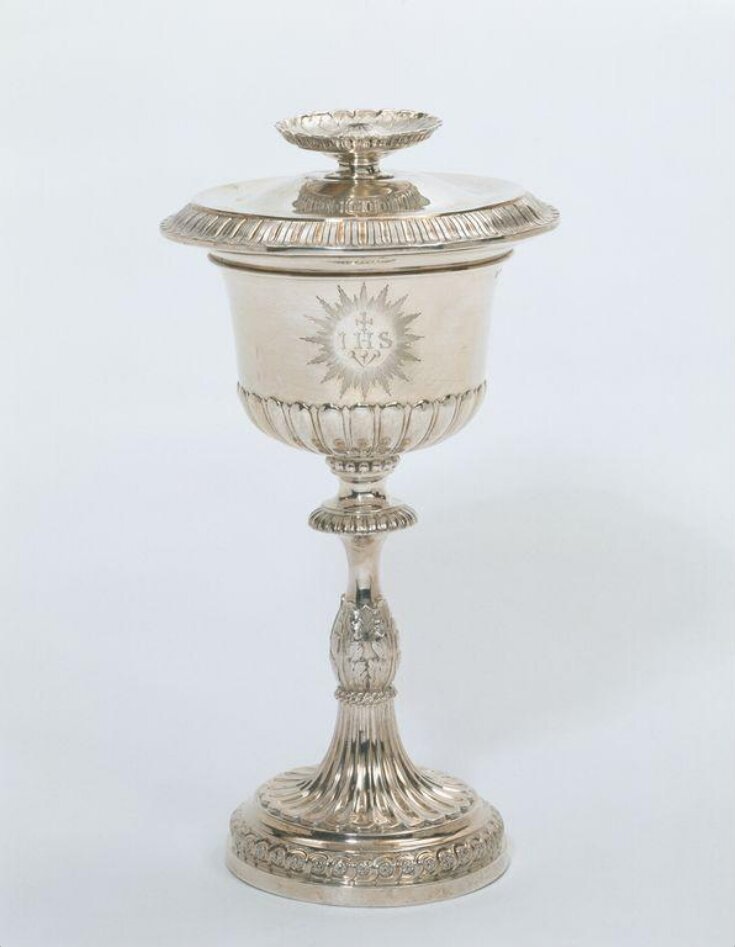
This chalice was used in Protestant worship to serve the consecrated wine during Holy Communion. It was given to the united parishes of Sudborne and Orford, in Suffolk, by Lord Hertford, then Lord Chamberlain and the Member of Parliament for Orford. His gift was calculated to win political support, but to keep the cost down the order stipulated that the vessels should be ‘as light as the nature of the work would possibly admit’. There was a matching flagon and Matthew Boulton charged £35 4s for the two.
Object details
| Categories | |
| Object type | |
| Materials and techniques | Silver, raised, chased and engraved. |
| Brief description | Communion cup, silver, Birmingham hallmarks for 1773-4, mark of Boulton and Fothergill |
| Physical description | cOMMUNION CUP, silver, vase-shaped body on tall A baluster stem with fluted base. |
| Dimensions |
|
| Style | |
| Production type | Unique |
| Marks and inscriptions | Engraved under the foot 'Given by the Earl of Hertford to the United Parishes of Sudborne and Orford'. |
| Gallery label | Chalice and Flagon
This chalice was used in Protestant worship to serve the consecrated wine during Holy Communion. It was given to the united parishes of Sudborne and Orford, in Suffolk, by Lord Hertford, then Lord Chamberlain and the Member of Parliament for Orford. His gift was calculated to win political support, but to keep the cost down the order stipulated that the vessels should be ‘as light as the nature of the work would possibly admit’. There was a matching flagon and Matthew Boulton charged £35 4s for the two.
This flagon was used in Protestant worship to hold the communion wine. It was given to the united parishes of Sudborne and Orford, in Suffolk, by Lord Hertford, then Lord Chamberlain and the Member of Parliament for Orford. His gift was calculated to win political support, but to keep the cost down the order stipulated that the vessels should be ‘as light as the nature of the work would possibly admit’. There was a matching chalice and Matthew Boulton charged £35 4s for the two.
Birmingham, England, 1773–4;
by Matthew Boulton (1728–1809) and
John Fothergill (died 1782)
Silver
Lent by the Vicar and Churchwardens
of St Bartholomew’s, Orford, Suffolk(22/11/2003) |
| Credit line | Lent by the Vicar and Churchwardens of St. Bartholomew's, Orford, Suffolk |
| Object history | The communion cup was commissioned by Francis, Earl of Hertford with a matching flagon from the Birmingham manufacturers Boulton and Fothergill and given to the united parishes of Sudborne and Orford in Suffolk. To keep the cost down the order stipulated that the vessels should be ' as light as the nature of the work would possibly admit'. Matthew Boulton charged £35 4s for the two pieces Historical significance: The gift was calculated to win political support. |
| Historical context | Gifts to the Church Gifts were the most important source of English church plate in the 17th century. The donor was usually a prominent member of the community, which in country parishes often meant the local landowner. But gifts came from other sources too. Many were given by women, showing their active involvement with the church. Churchwardens also took pride in commissioning new silver and often contributed to the cost. Occasionally, gifts like Lord Hertford’s chalice and flagon were made to win support for a political cause. Not all of these gifts were new. Old-fashioned domestic plate, often richly decorated with secular ornament, was welcomed and used for the service of communion or the collection of alms. The donor, Lord Hertford, was Lord Chamberlain and represented Orford as a 'Rotten Borough' in Parliament. |
| Summary | This chalice was used in Protestant worship to serve the consecrated wine during Holy Communion. It was given to the united parishes of Sudborne and Orford, in Suffolk, by Lord Hertford, then Lord Chamberlain and the Member of Parliament for Orford. His gift was calculated to win political support, but to keep the cost down the order stipulated that the vessels should be ‘as light as the nature of the work would possibly admit’. There was a matching flagon and Matthew Boulton charged £35 4s for the two. |
| Associated object | LOAN:ORFORDPCC.3-2005 (Set) |
| Other number | LOAN:ORFORDPCC.1-2005 |
| Collection | |
| Accession number | LOAN:ORFORDPCC.2-2005 |
About this object record
Explore the Collections contains over a million catalogue records, and over half a million images. It is a working database that includes information compiled over the life of the museum. Some of our records may contain offensive and discriminatory language, or reflect outdated ideas, practice and analysis. We are committed to addressing these issues, and to review and update our records accordingly.
You can write to us to suggest improvements to the record.
Suggest feedback
You can write to us to suggest improvements to the record.
Suggest feedback
| Record created | February 1, 2005 |
| Record URL |
Download as: JSON
