
Jain temple
Photograph
1858-1860 (photographed)
1858-1860 (photographed)
| Artist/Maker | |
| Place of origin |
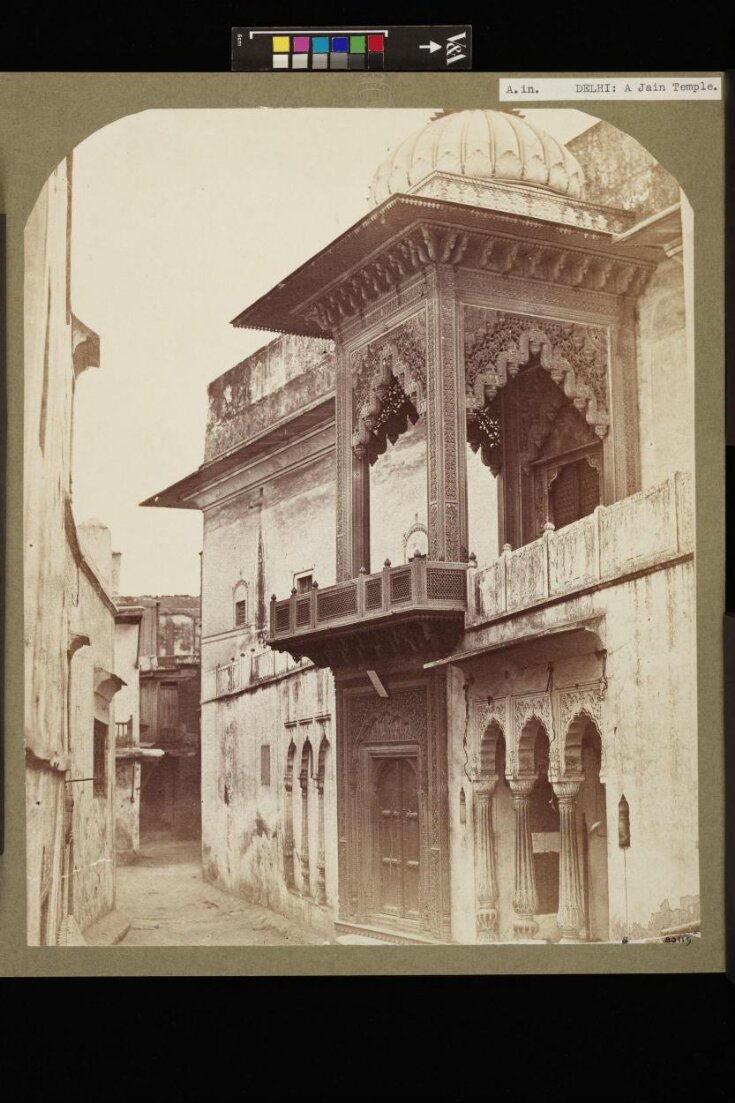
This photograph shows a Jain shrine, the Sri Digamber Jain Naya Mandir. Dated to 1807, it is situated between Chandni Chowk (Moonlight Square) and the Jami Masjid (mosque) in Old Delhi. It is one of a number of Jain shrines in this area, which is known as Dharmpura. This piece of land was given to the Jain community by the Emperor Aurangzeb for their services as bankers to the Mughal courts.
The photograph highlights the beautifully carved stonework of the pillars and brackets of the shrine’s façade. There are marble pillars on either side of the doorway and a dome at the top. The 19th-century art historian James Fergusson reproduced a woodcut of this temple to illustrate contemporary Jain architecture in his book on architecture. He, too, commented on the excellent craftsmanship of the carving.
The Italian-born photographer Felice Beato travelled through India documenting the aftermath of the so-called ‘Mutiny' or 1857 uprising of the Indian army. He took photographs of the sites associated with it. He also took more general photographs of the most important monuments of the cities he visited. This is one of them.
The photograph highlights the beautifully carved stonework of the pillars and brackets of the shrine’s façade. There are marble pillars on either side of the doorway and a dome at the top. The 19th-century art historian James Fergusson reproduced a woodcut of this temple to illustrate contemporary Jain architecture in his book on architecture. He, too, commented on the excellent craftsmanship of the carving.
The Italian-born photographer Felice Beato travelled through India documenting the aftermath of the so-called ‘Mutiny' or 1857 uprising of the Indian army. He took photographs of the sites associated with it. He also took more general photographs of the most important monuments of the cities he visited. This is one of them.
Object details
| Categories | |
| Object type | |
| Title | Jain temple (assigned by artist) |
| Materials and techniques | Albumen print from wet collodion glass negative |
| Brief description | Photograph of Jain temple, photographed by Felice Beato, Delhi, 1858-1860 |
| Physical description | This is a photograph of the Sri Digamber Jain Naya Mandir situated between Chandni Chowk and the Jami Masjid. Dated to 1807, it is one of a number of Jain shrines in this area. Known an Dharmpura, this area or piece of land was gifted to the Jain community by the Emperor Aurangzeb for their services as bankers to the Mughal courts. The quality of the photograph highlights the beautifully carved stonework of the pillars and brackets of the façade of the shrine. There are marble pillars on either side of the doorway and a dome at the top. |
| Dimensions |
|
| Marks and inscriptions | Negative number in bottom right hand side. |
| Object history | The photograph was initially part of the photographic collection held in the National Art Library. The markings on the mount are an indication of the history of the object, its movement through the museum and the way in which it is categorised. The mount is white with a label in the top right hand corner with the title. |
| Historical context | The 19th century art historian, James Fergusson, reproduced a woodcut of this temple in his book on architecture to illustrate Jain architecture of the period. He too commented on the excellent craftsmanship of the carving. The photographer, Felice Beato travelled thorough India after the ‘Mutiny or 1857 uprising’ of the Indian army and took photographs of the sites associated with it. He also took more general photographs of the most important monuments of the cities he visited, this being one of them. |
| Production | Beato was in India from January 1858 to February 1860. It is not clear when he was in Delhi during this period. |
| Subject depicted | |
| Places depicted | |
| Summary | This photograph shows a Jain shrine, the Sri Digamber Jain Naya Mandir. Dated to 1807, it is situated between Chandni Chowk (Moonlight Square) and the Jami Masjid (mosque) in Old Delhi. It is one of a number of Jain shrines in this area, which is known as Dharmpura. This piece of land was given to the Jain community by the Emperor Aurangzeb for their services as bankers to the Mughal courts. The photograph highlights the beautifully carved stonework of the pillars and brackets of the shrine’s façade. There are marble pillars on either side of the doorway and a dome at the top. The 19th-century art historian James Fergusson reproduced a woodcut of this temple to illustrate contemporary Jain architecture in his book on architecture. He, too, commented on the excellent craftsmanship of the carving. The Italian-born photographer Felice Beato travelled through India documenting the aftermath of the so-called ‘Mutiny' or 1857 uprising of the Indian army. He took photographs of the sites associated with it. He also took more general photographs of the most important monuments of the cities he visited. This is one of them. |
| Bibliographic references |
|
| Other number | D36 - Negative number |
| Collection | |
| Accession number | 80119 |
About this object record
Explore the Collections contains over a million catalogue records, and over half a million images. It is a working database that includes information compiled over the life of the museum. Some of our records may contain offensive and discriminatory language, or reflect outdated ideas, practice and analysis. We are committed to addressing these issues, and to review and update our records accordingly.
You can write to us to suggest improvements to the record.
Suggest feedback
You can write to us to suggest improvements to the record.
Suggest feedback
| Record created | January 31, 2005 |
| Record URL |
Download as: JSONIIIF Manifest
