Shrine
1640-1660 (made)
| Artist/Maker | |
| Place of origin |
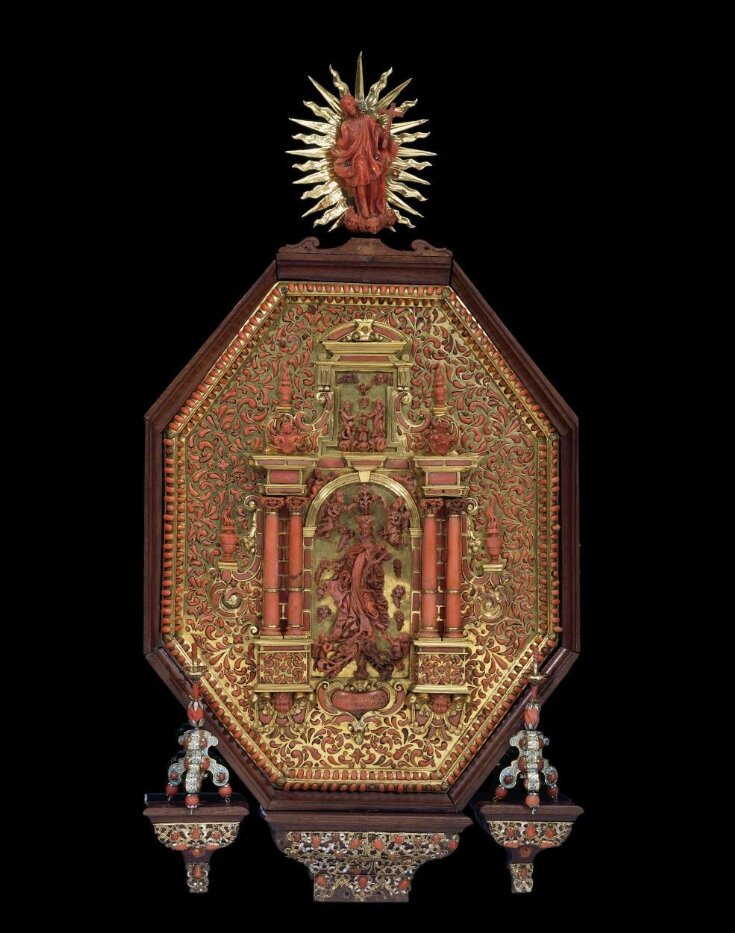
This small domestic shrine celebrates St Rosalia, a medieval hermit and the patron saint of Palermo in Sicily. After the Counter Reformation, a period of intense reform for the Roman Catholic Church from the 1540s, church authorities were keen to regulate the worship of approved saints. In 1627 St Rosalia's name was entered into the official list of Catholic martyrs by the Jesuits in Rome.
Craftsmen in Trapani, Sicily, were renowned for their imaginative and skilled use of coral. They decorated a wide variety of religious and secular vessels using this colourful technique.
Craftsmen in Trapani, Sicily, were renowned for their imaginative and skilled use of coral. They decorated a wide variety of religious and secular vessels using this colourful technique.
Object details
| Categories | |
| Object type | |
| Parts | This object consists of 3 parts.
|
| Materials and techniques | Copper-gilt, enamelled gilt-metal, gilt-brass, coral |
| Brief description | Copper-gilt, coral and wood, Trapani, Sicily, about 1640-61 |
| Physical description | Wall-mounted shrine, consisting of an elongated hexagonal back made of gilt copper and studded with coral, on a wooden foundation. The central statuette is of St Rosalia of Palermo holding a skull, beneath a small scene of the coronation of the Virgin Mary and a rounded arch and flanked by cherubs and columns topped with flaming lamps. Above the frame is a statuette of Christ encircled by copper-gilt rays. Below are three small wooden ledges decorated with coral and enamelled gilt metal, the two outer ledges supporting small gilt-brass candlesticks, enamelled and decorated with coral. |
| Dimensions |
|
| Marks and inscriptions | 'HANC DAT PAN ORM PVRPVRA ROSAE SVAE' (Inscribed in a coral cartouche below St Rosalia) |
| Gallery label | Shrine
This small domestic shrine celebrates St Rosalia, a medieval hermit and the patron saint of Palermo in Sicily. After the Counter Reformation of the mid 16th century, a period of intense reform for the Roman Catholic church, church authorities were keen to regulate the worship of approved saints. In 1627 St Rosalia’s name was entered into the official list of Catholic martyrs by the Jesuits in Rome.
Craftsmen in Trapani, Sicily, were renowned for their imaginative and skilled use of coral. They decorated a wide variety of religious and secular vessels using this colourful material.
Trapani, Sicily, about 1640–60, with later additions
Copper gilt, coral and wood
Museum no. M.159-1956. Hildburgh Bequest(22/11/2005) |
| Credit line | Dr W.L. Hildburgh Bequest |
| Historical context | The Counter Reformation The 16th century was a period of intense self examination for the Roman Catholic church. Internal dissent was undermining its authority and whole nations were going over to the new Protestant faiths. To clarify its role, the church held the Council of Trent from 1545 to 1563. It addressed concerns about religious education, abuses of wealth and the relief of the poor. The Society of Jesus (the Jesuits) became the champion of the reformed Catholic church and promoted the faith worldwide. At the heart of this Counter Reformation was the need to restore the Eucharist to the centre of worship. In Catholic belief, the Eucharist enshrines the moment when bread and wine, consecrated at the altar, are transformed into the body and blood of Christ. A priest holding up a monstrance Detail from The Adoration of the Holy Eucharist, by Claudio Coello, 1685-90 Monasterio del Escorial, Madrid. Art and Faith The image and message of the reinvigorated Roman Catholic church were actively promoted through dramatic architecture and furnishings. Throughout the 17th century new churches were built in the grand Baroque style. Their sumptuous interiors were complemented by elaborate monstrances, candelabra, sanctuary lamps and censers. Awe-inspiring altar silver drew the eyes of the faithful towards the Eucharist. |
| Subjects depicted | |
| Summary | This small domestic shrine celebrates St Rosalia, a medieval hermit and the patron saint of Palermo in Sicily. After the Counter Reformation, a period of intense reform for the Roman Catholic Church from the 1540s, church authorities were keen to regulate the worship of approved saints. In 1627 St Rosalia's name was entered into the official list of Catholic martyrs by the Jesuits in Rome. Craftsmen in Trapani, Sicily, were renowned for their imaginative and skilled use of coral. They decorated a wide variety of religious and secular vessels using this colourful technique. |
| Collection | |
| Accession number | M.159-1956 |
About this object record
Explore the Collections contains over a million catalogue records, and over half a million images. It is a working database that includes information compiled over the life of the museum. Some of our records may contain offensive and discriminatory language, or reflect outdated ideas, practice and analysis. We are committed to addressing these issues, and to review and update our records accordingly.
You can write to us to suggest improvements to the record.
Suggest feedback
You can write to us to suggest improvements to the record.
Suggest feedback
| Record created | January 24, 2005 |
| Record URL |
Download as: JSONIIIF Manifest
