Knife and Fork
1590-1600 (made)
| Artist/Maker | |
| Place of origin |
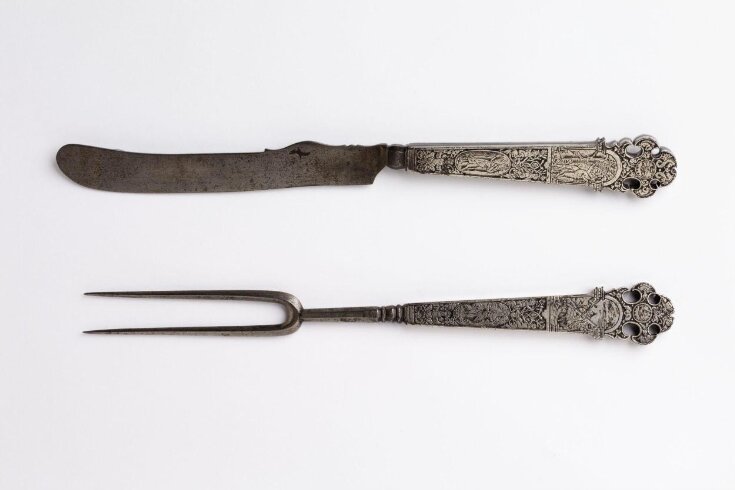
The engraved figures and biblical scenes are these items are based on designs by the 16th-century Flemish engraver Theodore de Bry. Lustrous black niello provides a strong contrast with the bright silver. Niello is a powdered mixture of black metal sulphides. It was pushed into the engraved lines and fused by heat. The surface was then polished.
Cutlers specialised in making blades. They trained as apprentices for up to seven years, working for a freeman cutler who housed and fed them. In England a cutler would have to prove himself as bladesmith and hafter (maker of handles) in order to obtain the freedom of the Worshipful Company of Cutlers, gain his own mark and set up his own business.
Many cutlers acted as middlemen who bought blades from bladesmiths, handles from hafters and sheaths from sheathers. They assembled the cutlery themselves and sold them under their own names.
Cutlers specialised in making blades. They trained as apprentices for up to seven years, working for a freeman cutler who housed and fed them. In England a cutler would have to prove himself as bladesmith and hafter (maker of handles) in order to obtain the freedom of the Worshipful Company of Cutlers, gain his own mark and set up his own business.
Many cutlers acted as middlemen who bought blades from bladesmiths, handles from hafters and sheaths from sheathers. They assembled the cutlery themselves and sold them under their own names.
Object details
| Categories | |
| Object type | |
| Parts | This object consists of 2 parts.
|
| Materials and techniques | Engraved silver and nielloed handles |
| Brief description | Wedding knife and fork, silver and niello handles, The Netherlands, 1590-1600. |
| Credit line | Salting Bequest |
| Summary | The engraved figures and biblical scenes are these items are based on designs by the 16th-century Flemish engraver Theodore de Bry. Lustrous black niello provides a strong contrast with the bright silver. Niello is a powdered mixture of black metal sulphides. It was pushed into the engraved lines and fused by heat. The surface was then polished. Cutlers specialised in making blades. They trained as apprentices for up to seven years, working for a freeman cutler who housed and fed them. In England a cutler would have to prove himself as bladesmith and hafter (maker of handles) in order to obtain the freedom of the Worshipful Company of Cutlers, gain his own mark and set up his own business. Many cutlers acted as middlemen who bought blades from bladesmiths, handles from hafters and sheaths from sheathers. They assembled the cutlery themselves and sold them under their own names. |
| Collection | |
| Accession number | M.612&A-1910 |
About this object record
Explore the Collections contains over a million catalogue records, and over half a million images. It is a working database that includes information compiled over the life of the museum. Some of our records may contain offensive and discriminatory language, or reflect outdated ideas, practice and analysis. We are committed to addressing these issues, and to review and update our records accordingly.
You can write to us to suggest improvements to the record.
Suggest feedback
You can write to us to suggest improvements to the record.
Suggest feedback
| Record created | January 20, 2005 |
| Record URL |
Download as: JSONIIIF Manifest
