
Valance
1580-1600 (made)
| Artist/Maker | |
| Place of origin |
Object Type
A bed set, which comprised valances, curtains and sometimes a bed cover, helped to create almost a separate chamber, cosy and 'furnished', within the bedroom. Valances such as this were used like a frieze around the top of the bed and covered the rods and rings on which the curtains were suspended. On very grand beds a second set of valances was fitted to cover the inner side of the rods.
Subject Depicted
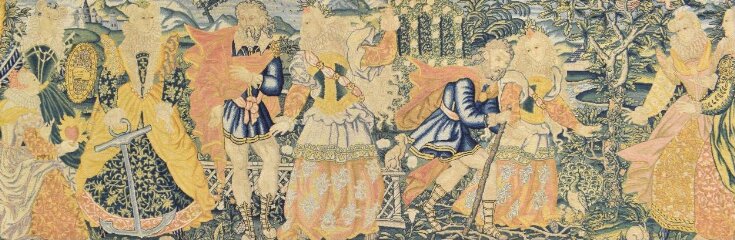
The setting of an ornamental garden scene with a mountainous skyline was very popular for this type of embroidered hanging. The female figures are fashionably dressed in the style of the French court. The theme of the Seven Virtues reflects the contemporary interest in that type of subject matter.
Makers & Making
The style and workmanship of this valance suggest that it was made at a professional workshop strongly influenced by French fashion. It could therefore have been the product of a French workshop, made for the English or Scottish market, or an English or Scottish workshop that was influenced by French fashion.
A bed set, which comprised valances, curtains and sometimes a bed cover, helped to create almost a separate chamber, cosy and 'furnished', within the bedroom. Valances such as this were used like a frieze around the top of the bed and covered the rods and rings on which the curtains were suspended. On very grand beds a second set of valances was fitted to cover the inner side of the rods.
Subject Depicted
The setting of an ornamental garden scene with a mountainous skyline was very popular for this type of embroidered hanging. The female figures are fashionably dressed in the style of the French court. The theme of the Seven Virtues reflects the contemporary interest in that type of subject matter.
Makers & Making
The style and workmanship of this valance suggest that it was made at a professional workshop strongly influenced by French fashion. It could therefore have been the product of a French workshop, made for the English or Scottish market, or an English or Scottish workshop that was influenced by French fashion.
Object details
| Categories | |
| Object type | |
| Materials and techniques | Linen canvas embroidered with wools and silks |
| Brief description | Valance of linen canvas embroidered with wools and silks, possibly made in France, Scotland or England, 1580-1600 |
| Physical description | Valance of linen canvas embroidered with wools and silks in tent stitch, with details in stem stitch and couched work. The scene is of an ornamental garden with a mountainous skyline. At the extreme left are three females, dressed in fashionable costume, with part of a fourth who may represent four of the seven virtues. The hand of the largely unseen figure holds a flaming sword (?) which possibly may belong to Justice or Temperance. A seated female holds a flaming heart and may represent Charity. A female behind bears a shield and may represent Justice, and another holds an anchor and may represent Hope. The next two scenes show the same couple, a male and female (unidentified) . Their costumes are semi classical. In the first scene the female beckons to the man, and in the second the man walks with difficulty with a stick and holds onto the arm of the woman. The final scene shows two women who appear to be awaiting for the arrival of the couple. |
| Dimensions |
|
| Gallery label | British Galleries:
Valances were borders around the top of an Elizabethan bed. They were often embroidered or woven in tapestry with lively and colourful images including figures from mythology. The figures here probably include four of the traditional Seven Virtues, shown here wearing versions of [check] classical dress.(27/03/2003) |
| Credit line | Bequeathed by Miss Maud Lilian Ochs |
| Object history | Registered File number 1957/3032. Although strongly influenced by French styles and fashion, valances of this type with secure provenances have English associations. This valance may therefore have been produced in an English, Scottish or French professional workshop. May be a partner to T.136-1991. |
| Subjects depicted | |
| Summary | Object Type A bed set, which comprised valances, curtains and sometimes a bed cover, helped to create almost a separate chamber, cosy and 'furnished', within the bedroom. Valances such as this were used like a frieze around the top of the bed and covered the rods and rings on which the curtains were suspended. On very grand beds a second set of valances was fitted to cover the inner side of the rods. Subject Depicted The setting of an ornamental garden scene with a mountainous skyline was very popular for this type of embroidered hanging. The female figures are fashionably dressed in the style of the French court. The theme of the Seven Virtues reflects the contemporary interest in that type of subject matter. Makers & Making The style and workmanship of this valance suggest that it was made at a professional workshop strongly influenced by French fashion. It could therefore have been the product of a French workshop, made for the English or Scottish market, or an English or Scottish workshop that was influenced by French fashion. |
| Bibliographic reference | Baker, Malcolm, and Brenda Richardson (eds.), A Grand Design: The Art of the Victoria and Albert Museum, London: V&A Publications, 1999.
|
| Collection | |
| Accession number | T.137-1991 |
About this object record
Explore the Collections contains over a million catalogue records, and over half a million images. It is a working database that includes information compiled over the life of the museum. Some of our records may contain offensive and discriminatory language, or reflect outdated ideas, practice and analysis. We are committed to addressing these issues, and to review and update our records accordingly.
You can write to us to suggest improvements to the record.
Suggest feedback
You can write to us to suggest improvements to the record.
Suggest feedback
| Record created | April 6, 1999 |
| Record URL |
Download as: JSONIIIF Manifest
