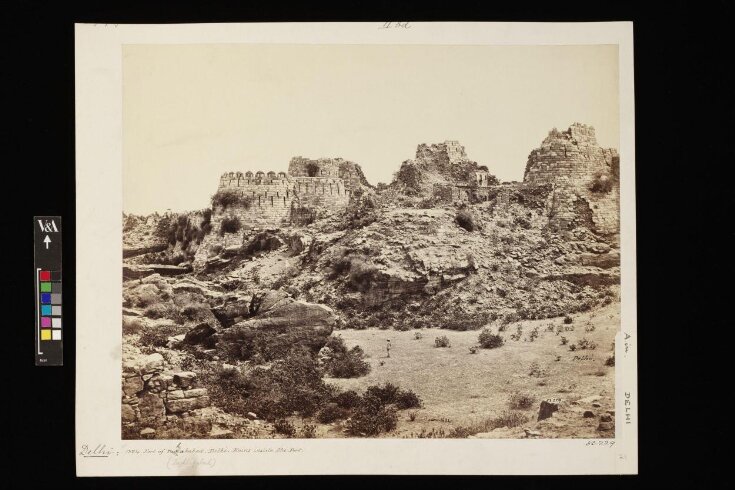

Ruins inside the Fort, Delhi
Photograph
1860s (photographed)
1860s (photographed)
| Artist/Maker | |
| Place of origin |
This photograph shows the ruins inside the Fort of Tughluqabad. Here you can see the fort’s impressive battered, sloping grey rubble walls and the massive rock formations on which it was built. The tiny figure in the foreground conveys the the grand scale of the architecture.
Tughluqabad was the third of the seven historical cities of Delhi and was built by Ghiyas-ud-Din Tughluq between 1321 and 1325. The complex included the city, palace precinct, citadel and fortified tomb. Built on a hill, the city was occupied for only five years and is now a vast complex of ruins.
The Tughluqs were more puritanical than the previous ruling dynasty in Delhi, the Khaljis. Their plain, severe grey stone structures are markedly different from the highly decorative style of the Khaljis.
The British photographer Samuel Bourne lived and worked in India between 1862 and 1869. During this time he toured the Himalayas and travelled through the subcontinent, photographing its landscape, architecture and historical sites. He set up a studio in Simla with Charles Shepherd and sold his prints sold to an eager public both in India and Britain.
Tughluqabad was the third of the seven historical cities of Delhi and was built by Ghiyas-ud-Din Tughluq between 1321 and 1325. The complex included the city, palace precinct, citadel and fortified tomb. Built on a hill, the city was occupied for only five years and is now a vast complex of ruins.
The Tughluqs were more puritanical than the previous ruling dynasty in Delhi, the Khaljis. Their plain, severe grey stone structures are markedly different from the highly decorative style of the Khaljis.
The British photographer Samuel Bourne lived and worked in India between 1862 and 1869. During this time he toured the Himalayas and travelled through the subcontinent, photographing its landscape, architecture and historical sites. He set up a studio in Simla with Charles Shepherd and sold his prints sold to an eager public both in India and Britain.
Object details
| Categories | |
| Object type | |
| Title | Ruins inside the Fort, Delhi (assigned by artist) |
| Materials and techniques | Albumen print from wet collodion glass negative |
| Brief description | Photograph of Tughlaqabad Fort, Delhi, India, by Samuel Bourne, 1860s. |
| Physical description | This photograph shows the ruins inside the Fort of Tughluqabad. Tughlaqabad was the 3rd of the 7 historical cities of Delhi and was built by Ghiyath’s-Din Tughluq between 1321-1325. The Tughlugs were more puritanical than the previous ruling dynasty in Delhi, the Khaljis, and their buildings are notable for their plain severe grey stone structures and are markedly different from the highly decorative style of the Khaljis. Tughluqabad comprises a city, palace precinct, citadel and fortified tomb. Built on a hill, the city was occupied for only five years and is now a vast complex of ruins. The photograph shows the impressive battered (inclined) walls, made of grey rubble, of the fort and the massive rock formations on which it is built. The tiny figure in the foreground gives a sense of scale to this grand architecture. Signature and negative number in bottom left hand corner. |
| Dimensions |
|
| Marks and inscriptions | Signature and negative number in bottom left hand corner. |
| Object history | The photograph was initially part of the photographic collection held in the National Art Library. The markings on the mount are an indication of the history of the object, its movement through the museum and the way in which it is categorised. The mount is white and has evidence of handwritten text across the top: IIbd. On the right hand side there is a label with: A.in. Delhi Bottom left: handwritten title |
| Historical context | Bourne took this photograph on his journey through India during the 1860s. In the published account of his journey, on his first encounter with Delhi on June 25th 1863 he wrote: ‘Of course Delhi can’t fail to be interesting to the photographer: the Cashmere Gate, the fort, and other noted places must be taken, while its mosques and similar buildings will be photographed for their own merits. About eleven miles from Delhi is the famous Kootub, of which many of my readers have seen Beato’s large photograph, published by Hering, of Regent Street.’ Bourne, S, Photography in the East, The British Journal of Photography, September 1 1863, pg 345. |
| Production | Bourne visited Delhi in 1863, as mentioned in his writings. He is also likely to have made subsequent visits in 1864 and 1866 though this is not recorded in his writings. This print would have been made before March 1867. |
| Subjects depicted | |
| Places depicted | |
| Summary | This photograph shows the ruins inside the Fort of Tughluqabad. Here you can see the fort’s impressive battered, sloping grey rubble walls and the massive rock formations on which it was built. The tiny figure in the foreground conveys the the grand scale of the architecture. Tughluqabad was the third of the seven historical cities of Delhi and was built by Ghiyas-ud-Din Tughluq between 1321 and 1325. The complex included the city, palace precinct, citadel and fortified tomb. Built on a hill, the city was occupied for only five years and is now a vast complex of ruins. The Tughluqs were more puritanical than the previous ruling dynasty in Delhi, the Khaljis. Their plain, severe grey stone structures are markedly different from the highly decorative style of the Khaljis. The British photographer Samuel Bourne lived and worked in India between 1862 and 1869. During this time he toured the Himalayas and travelled through the subcontinent, photographing its landscape, architecture and historical sites. He set up a studio in Simla with Charles Shepherd and sold his prints sold to an eager public both in India and Britain. |
| Bibliographic reference | Bourne, S, Photography in the East, The British Journal of Photography, September 1 1863, pg 345. |
| Other number | 1384 - Negative number |
| Collection | |
| Accession number | 53229 |
About this object record
Explore the Collections contains over a million catalogue records, and over half a million images. It is a working database that includes information compiled over the life of the museum. Some of our records may contain offensive and discriminatory language, or reflect outdated ideas, practice and analysis. We are committed to addressing these issues, and to review and update our records accordingly.
You can write to us to suggest improvements to the record.
Suggest feedback
You can write to us to suggest improvements to the record.
Suggest feedback
| Record created | December 22, 2004 |
| Record URL |
Download as: JSONIIIF Manifest
